Chris Cutrone discusses with Doug Lain Lenin contra the PMC and the new DSA, and Iran war resuming.
Doug Lain with Chris Cutrone, Nance and Michael Downs on The Last Election film
Doug Lain discusses his film The Last Election, on the 2024 U.S. election, with producer Chris Cutrone and Nance and Michael Downs, addressing the political moment and how film captures history, with reference to cinematic precedence for the project.
Chris Cutrone with Doug Lain on the DSA wave and the fate of the Millennial Left
Chris Cutrone discusses with Doug Lain the phenomenon of the DSA’s electoral success and the fate of the Millennial Left.
Chris Cutrone, James Vaughn and Spencer Leonard with Doug Lain on America 250
Chris Cutrone, James Vaughn and Spencer Leonard discuss America 250 with Doug Lain, on the occasion of Cutrone and Vaughn’s July 3, 2026 articles published in Compact Magazine.
Articles:
https://www.compactmag.com/article/why-marxists-loved-the-american-revolution
https://www.compactmag.com/article/the-new-worlds-declaration-of-independence-from-the-old
Spencer Leonard with Doug Lain on America and remembering and forgetting 1776:
Why Marxists loved the American Revolution
Chris Cutrone
Published in Compact, July 3, 2026
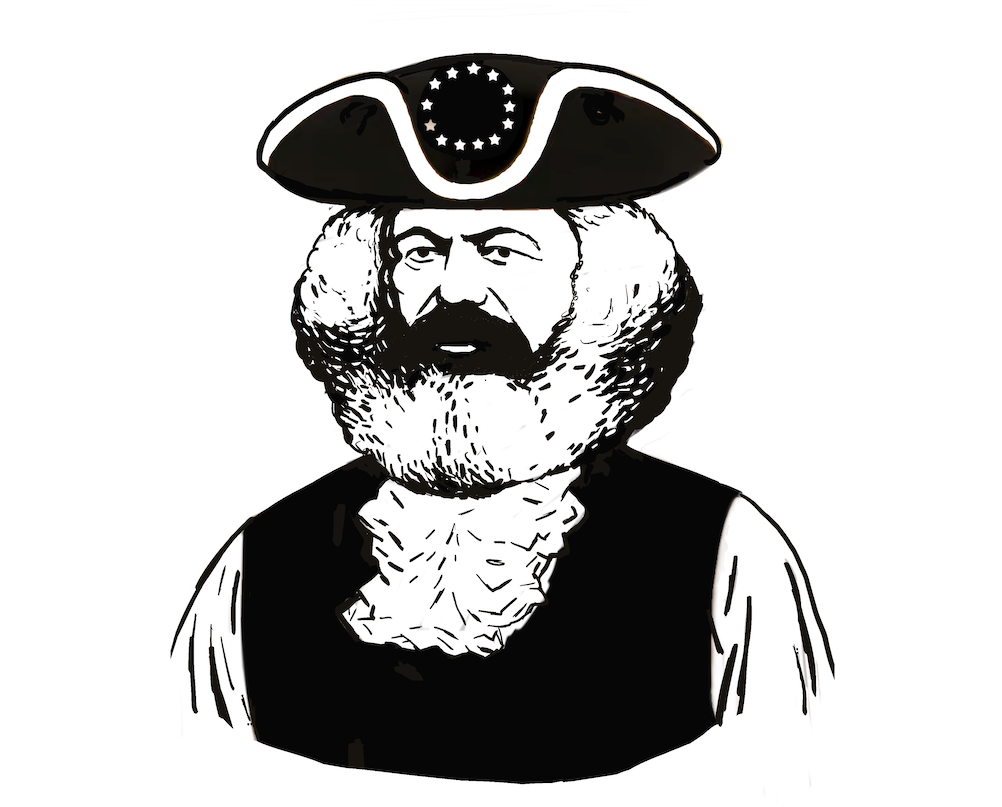
Hegel is usually understood to have found the final form of human society in the constitutional monarchy of Prussia, but he made an exception to his philosophy of history for America as the “land of the future.” He acknowledged to a friend that his model political regime was improved in the American constitutional republic as the ideal form of state for bourgeois civil society, with its elected monarchy in the presidency counterbalancing democracy so as to preserve the freedom of civil society. Marx and Engels regarded the United States as the most bourgeois, democratic, and free country of their time. Lenin called the American Revolution a “truly revolutionary war” and wrote in the early twentieth century that in America “freedom was most complete.”
For their part, Marxist-informed socialists in the United States such as the Socialist Party leader Eugene Debs claimed both the American Revolution and the Civil War and their political leaders as historical figures, such as Thomas Jefferson and Abraham Lincoln, to their cause and as their rightful legacy, as against the capitalist political parties, the Republicans and Democrats, falsely wearing their mantles. Russian revolutionary Vladimir Lenin greatly esteemed Debs, especially for his denunciation of US imperialism and involvement in World War I, which landed the five-time presidential candidate in jail. Debs returned the praise, calling himself, during the counterrevolutionary reactionary panic after the Russian Revolution and Woodrow Wilson’s Palmer Raids and repression of the Socialist Party, “from head to foot a Bolshevik and proud of it.”
Later, Frankfurt School critical theorist Theodor Adorno, who fled the Nazis to the United States, along with his colleagues Max Horkheimer and Herbert Marcuse, wrote endearingly about his experience of American society, and upheld the American republic’s constitutional separation of powers and checks and balances as the model for “critique”—the free interplay of theory and practice and subject and object—in maintaining and promoting the freedom of society.
“Marxists regarded the American Revolution as a ‘bourgeois’ revolution.”
So powerful was the influence of the American Revolution that the Communist Party in the United States named its party night school for workers after Thomas Jefferson. Its leader in the 1930s, Earl Browder, famously stated that “communism is as American as apple pie.”
What was the substance of this evaluation by such prominent Marxists of the United States and the American Revolution and its legacy? Marxism understood capitalism as a phenomenon based on bourgeois society, and Marxists regarded the American Revolution as a “bourgeois” revolution. What did this mean?
First, we must step back and examine the Marxist understanding of history and how it had led to capitalism. The basic idea is that the rise of modern bourgeois or “civil society” was a societal transformation on the same order of magnitude as the Neolithic Agricultural Revolution, which in Marxist terms had ushered in “class society” from the original “primitive communism” of Paleolithic hunter-gatherer communities. This was understood as the beginnings of capitalism. The Industrial Revolution was regarded as the crisis of bourgeois society and capitalism, indicated by the class division into capitalists and workers, specifically by the proletarianization of labor, in which workers no longer owned the means of production—the machines and other capital goods owned by the capitalist class. The Industrial Revolution, according to Marxism, led to the possibility and necessity of socialism: modern communism. The Industrial Revolution historically brought about the modern class struggle of the workers against the capitalists that led to socialism.
Capitalism was defined by its contradiction and crisis: the contradiction of bourgeois social relations and industrial forces of production; and the crisis of “socialism or barbarism”—capitalism was understood as the barbarization and decadence of bourgeois society, in which bourgeois principles were observed only in form and not in substance.
It is important to note that for Marxism bourgeois social relations were the social relations of labor, and bourgeois society itself was understood as the emancipation of labor from the traditional social relations of prior civilization, with its caste system, subsistence agriculture, and guild-craft control of artisan production.
The bourgeois revolution was the emancipation of the rights of labor against its traditional restrictions in the previous state: the ancien régime and its official religious sanctification. In this respect, it was the rights of private production and appropriation in civil society, which was the right of individuals to pursue their own chosen labor, offering its products on the free market. But this was a social form of labor: the social relations of free exchange, trade and commerce as the form of social cooperation and community; the freely associated laborers.
Trade in traditional civilization was restricted politically by the caste order, and was primarily in luxury or specialized goods for the ruling castes, and not the subsistence needs for the vast majority of people. The rise of bourgeois society was the transformation of immediate local subsistence production into production for trade and commerce. One produces not for one’s own subsistence needs or those of one’s immediate local community, but for trade to acquire subsistence goods for one’s own consumption from more distant others: the dependence of the majority on the commerce in subsistence goods. The exchange of traditional civilization governed by custom was replaced by trade according to worth freely negotiated according to the value of labor in the market.
This is why the modern society of production for trade and commerce is called “bourgeois,” meaning “urban” in French, by contrast with traditional civilization of the countryside where production was for subsistence in local agriculture —95 percent of the population were peasants; today, by contrast the vast majority of society’s members are workers: wage-laborers. Indeed, as Hannah Arendt put it, today even a king is someone employed in a job, not by divine status but performance evaluation of function. The seventeenth century English Revolution reduced the sovereign to the highest-paid employee serving ceremonially to perform the dignity of the state.
Capitalism, arising as such in the nineteenth century, was the contradiction and crisis of bourgeois society in the Industrial Revolution, in which a dynamic of replacing labor by automation introduced the business cycle of boom and bust, which was not merely a commercial crisis of supply and demand in market adjustments, but a crisis of value of wage-labor in the social system of production, indicating its potential obsolescence.
The First Industrial Revolution is conventionally dated from roughly 1750 to 1850 and was centered first in Britain and then, after the French Revolution, in France and the Benelux countries—Belgium, the Netherlands and Luxemburg—and those parts of Europe, such as the western part of Germany in the Rhineland, most affected by the French Revolution. (Marx and Engels hailed from this region, Engels from a factory-owning family.) This was where machine automation first took hold and the proletarianization of labor first took place.
The French Revolution was closely associated with the American Revolution, which itself was a further development of the English Revolution of the preceding century. The French Enlightenment and the revolutionaries it inspired were noted Anglophiles, and it was not mere coincidence that the storming of the Bastille took place in the centenary year of the seating of the constitutional monarch in the English Glorious Revolution, 1689, as politically theorized by John Locke. Marx said that of the two traditions of materialism, those of Descartes and Locke, it was Locke’s that led to socialism. Thomas Jefferson participated in both the American and French Revolutions, co-writing the American Declaration of Independence as well as the French Declaration of the Rights of Human Being and Citizen. He was joined in the latter task by Lafayette who himself had led the French forces in the American Revolutionary War. Saint-Simon, the leading French utopian socialist, served as a soldier in the Revolutionary War under Lafayette, and wrote of the indelible experience of freedom he had in America. The American Revolution is best understood as the continuation and radicalization of the English Revolution, as expressed by Benjamin Franklin and Jefferson’s revising of Locke’s inalienable rights of “life, liberty and property” to the “pursuit of happiness,” of which property was the mere means and not a right as an end in itself. This prepared the United States for the social freedom that made it Hegel’s “land of the future,” to be realized in the nineteenth century, contemporaneous with the rise of Marxism.
British utopian socialist Robert Owen presented his model community ideas to the US Congress, meeting with Founding Fathers and former Presidents John Adams, Thomas Jefferson, and James Madison, who were a keenly interested audience. One of the final expressions of Jefferson’s political sentiments was to endorse, in an 1825 letter to Frances Wright, the utopian socialist experiments underway as a means for facilitating emancipation and abolition as part of the greater cause of labor.
The Second Industrial Revolution is conventionally dated from 1871 to 1914, from the Franco-Prussian War to World War I. German victory over France led to unification under the Prussian Empire, which allowed for its rapid industrialization. Contemporaneously, the Meiji Restoration in Japan and political centralization under the emperor, triumphant over the samurai, and the victory of the Union in the American Civil War and the abolition of slavery, as well as the emancipation of the serfs in the Russian Empire, meant that these countries saw rapid industrialization in this period. The rise of these new industrial powers produced new international conflicts in global capitalism and eventually the World Wars of the twentieth century.
Whereas Marx and Engels were individuals in a “party of two” whose ideas about capitalism and socialism were relatively limited in their influence, the era of the Second Industrial Revolution saw the emergence of Marxism as a predominant ideology in the modern proletarian socialist movement of the working class. The new socialist parties most influenced by Marxism in the era prior to World War I were those in Germany, the United States, Russia, Italy and Japan: the countries of the Second as opposed to the First Industrial Revolution. Unlike the others, the United States was a liberal democratic constitutional republic. It was also quickly emerging as by far the largest and most dynamic and technically innovative capitalist economy in the world. The Marxists of the Second International such as Lenin and Eugene Debs understood that the future of socialism at a world scale would be ultimately decided in America.
Furthermore, in this period, the working class was greatly internationalized, with many workers migrating for work around the world, often not permanently settling but returning to their home countries after earning their fortunes. It was a smaller world at that time of original historical Marxism than we tend to appreciate. Many workers from around the world had experience living and working in the United States in this period, and they were influenced profoundly by its social freedom—much as Marx and Engels had been influenced by the freedom they experienced as exiles in France and England.
“Marx seriously considered permanently relocating to America.”
Interestingly, Marx seriously considered permanently relocating to America, to which many radical political refugees from Europe had emigrated in the nineteenth century, such as the “red ’48ers” and “Bohemians” who had fled from the failed 1848 Revolution in Germany and Central Europe. These German émigrés, with whom Marx was associated, participated in the abolitionist movement and the new Republican Party in the United States, whose leading newspaper, the New York Tribune, Marx regularly wrote for in the 1850s, and the red ’48ers served as officers in the Union Army during the Civil War and figured as Radical Republicans during Reconstruction. Later, in the period before the Russian Revolution, many leading and rank-and-file Bolsheviks lived and worked and organized as socialists in the United States. They took that American experience back with them in leading the Revolution in Russia. Many American socialists inspired by the Russian Revolution had first met the Bolsheviks in America.
As elsewhere, the contradiction between bourgeois society and its values of the rights and freedom of labor with new industrial capitalism was clearly manifest. This introduced a complex dynamic in which the struggle for socialism of the industrial proletariat was connected with upholding the older revolutionary tradition of the American and French Revolutions and the bourgeois rights enshrined therein. Just as French socialism emerged from the revolutionary tradition there, so did socialism in the United States, through both the American Revolution and the Civil War.
In Germany, the preeminent country of the Marxist-led socialist movement at the turn of the twentieth century, the working class claimed the legacy of German Idealist philosophy of Kant and Hegel, which was itself inspired by the English, American and French Revolutions, as against the capitalists. The working class claimed the intellectual and cultural heritage of the bourgeois revolution that had decayed—become “decadent”—under capitalism. This was also true in England, France, and America. In this way, the struggle for proletarian socialism took up the mantle of the earlier bourgeois revolution and emancipation that had been betrayed in capitalism.
So, it is not a simple matter of proletarian socialism succeeding the bourgeois revolution in terms of leaving it behind, but of actively recovering it, struggling within the revolutionary tradition from its contradiction in capitalism. Propagandistically, this was posed as the succession of the bourgeoisie by the proletariat as the historically revolutionary—and “universal”—class. What did this express?
The universality of the bourgeois revolution suffered some severe setbacks outside the United States in the nineteenth and twentieth centuries, as well as at home with the reinvigoration of slavery as a function of the Industrial Revolution, preventing it from dying out naturally, as the Founding Fathers had expected. Whereas there has been one continuous American republic from the Revolution to today—however modified substantially by the Civil War and Reconstruction Amendments—France, for example, is today in its Fifth Republic, interrupted by two monarchies, two empires and a fascist regime; and Britain remains a monarchy, albeit constitutional (even though it was a republic during its revolutionary Civil War in the seventeenth century); and Germany and Japan have been liberal democracies only since World War II. And the United States remains the preeminent capitalist country in the world that it became during the Second Industrial Revolution.
The modern bourgeois republic differs from the ancient republic in its respect for civil liberties and rights: the rights of civil society against the state, not observed by ancient democracy.
The Marxist understanding of the dialectical relation between capitalism and the possibility and task of socialism means that the contradiction of bourgeois social relations and industrial forces of production poses itself most purely in the United States of America, and has done so from early on. It has not been clouded by the question raised by Arno Mayer and others about just how “bourgeois” society and politics were in Europe before recent times, the supposed issue of “feudal holdovers” in Europe, even in France as well as in Britain up through World War II, before the victors imposed the essential criteria of the American republican system of liberal democracy onto Europe and Japan. This was not merely a function of capitalism, since capitalism has been compatible with illiberal and undemocratic political systems. The tension between capitalism and the freedom of American bourgeois society was made global in character in the “American Century” and leadership of the “Free World.” This was the intention of Woodrow Wilson’s League of Nations and realized in the United Nations system of the victorious Allies under American leadership, the Cold War erupting soon between them notwithstanding.
Just as in Marx’s and Lenin’s times, the specter of socialism or communism apparently still haunts the world. The greatest phenomenon of a new socialist movement in recent times has taken place in the United States with the Millennial left. In it, questions of original historical Marxism—the recovery of Marx and figures such as Lenin—have figured prominently. This was also true in the last major historical upsurge of interest in Marxism, in the 1960s New Left, which back then—as now—was influential and inspirational throughout the world. It was long understood that if Marxism is not relevant in the United States, then it is irrelevant everywhere else.
But the contemporary left tends to doubt the identical fates of the bourgeois revolution—with America as its last standing avatar—and the struggle for socialism, imagining the real struggle is taking place somewhere else. This consensus reflects not enlightenment but its forgetting. Marx’s and historical Marxism’s clear perspectives on the foundational character of the American Revolution and central character of the United States historically in the struggle for socialism have become obscured in the present. A reactionary anti-capitalism, both on the ostensible left and the avowed right, has made a casualty of America and its revolutionary history. But these doubts about the possibility of overcoming capitalism in America, the predominant capitalist country, are also doubts about socialism itself. This is not merely because of the political and economic centrality of the United States, but because bourgeois social relations and their contradiction in capitalism are expressed most purely in America.
In America’s two-hundred-and-fiftieth year, this is particularly poignant. In the recent era of neoliberalism—the Reagan and Thatcher revolution of neoliberal capitalism—the American “left” has reached to post-war European social democracy as a contrasting counter-model, and capitalism has been hastily identified with Anglo-Americanism. In this, both the counterrevolutionary character of social democracy and the revolutionary character of capitalism itself have been obscured. What was forgotten is that original historical Marxism opposed the welfare state of capitalism, which was seen—rightly—as intentionally undercutting the workers’ own social capacities and struggles by making them dependent wards of capitalist politics.
“This counterfeiting of socialism has been accepted as good coin.”
Instead, this counterfeiting of socialism has been accepted as good coin. The Millennial “left,” for instance the Democratic Socialists of America, has been content to accept what the right denounces demagogically as “socialism” in the welfare state, inverting its value positively as their own program. The original meaning of not only Marxism but socialism itself as the promised self-overcoming and transcendence of capitalism has been deranged beyond recognition. Worse still, “freedom” has become a strangely tabooed concept, both on the “left” and beyond. Pessimism about America expresses pessimism about socialism. It is pessimism about freedom. Choosing the pessimistic version of capitalism in “progressive” welfarism has meant doubting the possibility of socialism that Marxism originally recognized in capitalism as a self-contradictory form of freedom.
The crossroads of “socialism or barbarism” has cut through the heart of America as the preeminent capitalist country for the last two centuries. It still does. Hence, so does Marxism, indelibly. As we remember the American Revolution and its historical legacy, we are haunted by the remaining task of socialism: to realize the historic promise of freedom as the dialectical truth of capitalism. The truly emancipatory character of the American Revolution lives, however contradictorily, in capitalism, and its fate will be determined in the struggle for socialism. | §
Chris Cutrone with Doug Lain on Trump’s Iran deal MOU and philosophy and the Left
Chris Cutrone discusses with Doug Lain Trump’s intentions for his Iran deal or MOU Memorandum of Understanding agreed with the Islamic Republic. In the second half, they discuss the Millennial and Zoomer attraction to philosophy and its significance for the Left, socialism and Marxism — and Alexandre Kojeve and Europe.
The American Revolution at 250
Why Marxists loved America
Chris Cutrone
Presented on a panel with Matt McManus, Joel Kotkin and Gerald Celente in New York City, June 21, 2026.
Hegel made an exception to his philosophy of history for America as a “land of the future.” He acknowledged to a friend that his model political regime of constitutional monarchy on the basis of the English Revolution was improved in the American Constitutional Republic as the ideal form of state for bourgeois civil society, with its elected monarchy in the Presidency as counterbalance to democracy, to preserve the freedom of civil society. Marx and Engels regarded the United States as the most bourgeois, democratic and free country of their time. Lenin called the American Revolution a “truly revolutionary war” and wrote in the early 20thcentury that in America “freedom was most complete.”
For their part, Marxist-informed socialists in the United States such as the Socialist Party leader Eugene Debs claimed both the American Revolution and the Civil War and their political leaders as historical figures, such as Thomas Jefferson and Abraham Lincoln, to their cause and as their rightful legacy, as against the capitalist political parties, the Republicans and Democrats, falsely wearing their mantles. Russian revolutionary Vladimir Lenin greatly esteemed Debs, especially for his denunciation of U.S. imperialism and its involvement in World War I which had landed Debs in jail, and Debs returned the praise, calling himself, during the counterrevolutionary reactionary panic after the Russian Revolution and Woodrow Wilson’s Palmer Raids repression of the Socialist Party, “from head to foot a Bolshevik and proud of it.”
Later, Frankfurt School Critical Theorist Theodor Adorno, who fled the Nazis to the United States, along with his colleagues Max Horkheimer and Herbert Marcuse, wrote endearingly about his experience of American society, and upheld the American Republic’s Constitutional separation of powers and checks and balances as the model for “critique,” the free interplay of theory and practice and subject and object, in maintaining and promoting the freedom of society.
So powerful was the influence of the American Revolution that the Communist Party in the United States named its party night school for workers after Thomas Jefferson. Its leader in the 1930s, Earl Browder, famously stated that “communism is as American as apple pie.”
What was the substance of this evaluation by such prominent Marxists of the United States and the American Revolution and its legacy? Marxism understood capitalism as a phenomenon based on bourgeois society, and regarded the American Revolution as a “bourgeois” revolution. What did this mean?
First, we must step back and examine the Marxist understanding of history and how it had led to capitalism. The basic idea is that the rise of modern “bourgeois” society or “civil society” was a societal transformation on the same order of magnitude as the Neolithic Agricultural Revolution, which in Marxist terms had ushered in “class society” from the original “primitive communism” of Paleolithic hunter-gatherer communities. This was understood as the beginnings of capitalism. The Industrial Revolution was regarded as the crisis of bourgeois society and capitalism, indicated by the class division into capitalists and workers, specifically by the proletarianization of labor, in which workers no longer owned the means of production — the machines and other capital goods owned by the capitalist class. The Industrial Revolution, according to Marxism, led to the possibility and necessity of socialism — modern communism. The Industrial Revolution historically brought about the modern class struggle of the workers against the capitalists that led to socialism.
Capitalism was defined by its contradiction and crisis: the contradiction of bourgeois social relations and industrial forces of production; and the crisis of “socialism or barbarism” — capitalism was understood as the barbarization and decadence of bourgeois society, in which bourgeois principles were observed only in form and not in substance.
It is important to note that for Marxism bourgeois social relations were the social relations of labor, and bourgeois society itself was understood as the emancipation of labor from the traditional social relations of prior civilization, with its caste system, subsistence agriculture and guild-craft control of artisan production.
The bourgeois revolution was the emancipation of the rights of labor against its traditional restrictions in the previous state — the ancien régime and its official religious sanctification. In this respect, it was the rights of private production and appropriation in civil society, which was the right of individuals to pursue their own chosen labor, offering its products on the free market. But this was a social form of labor: the social relations of free exchange, trade and commerce as the form of social cooperation and community; the freely associated laborers. Trade in traditional civilization was restricted politically by the caste order, and was primarily in luxury or specialized goods for the ruling castes, and not the subsistence needs for the vast majority of people. The rise of bourgeois society was the transformation of immediate local subsistence production into production for trade and commerce. One produces not for one’s own subsistence or those of one’s immediate local community, but for trade to acquire subsistence goods for one’s own consumption from more distant others: the dependence of the majority on the commerce in subsistence goods. The exchange of traditional civilization governed by custom was replaced by trade according to worth freely negotiated according to the value of labor in the market.
This is why the modern society of production for trade and commerce is called “bourgeois,” meaning “urban” in French, by contrast with traditional civilization of the countryside where production was for subsistence in local agriculture — 95% of the population were peasants; today, by contrast the vast majority of society’s members are workers: wage-laborers. Indeed, as Hannah Arendt put it, today even a king is someone employed in a job, not by Divine status but performance evaluation of function: the 17thcentury English Revolution reduced the Sovereign to the highest paid employee serving ceremonially to perform the dignity of the state.
Capitalism, arising as such in the 19th century, was the contradiction and crisis of bourgeois society in the Industrial Revolution, in which a dynamic of replacing labor by automation introduced the business cycle of boom and bust, which was not merely a commercial crisis of supply and demand in market adjustments, but a crisis of value of wage-labor in the social system of production, indicating its potential obsolescence.
The First Industrial Revolution is conventionally dated from ~1750 to ~1850 and was centered first in Britain and then, after the French Revolution, in France and the Benelux countries — Belgium, the Netherlands and Luxemburg — and those parts of Europe, such as the western part of Germany in the Rhineland, most affected by the French Revolution. (Marx and Engels hailed from this region, Engels from a factory-owning family.) This was where machine automation first took hold and the proletarianization of labor first took place.
The French Revolution was closely associated with the American Revolution, which itself was a further development of the English Revolution of the preceding century. The French Enlightenment and the revolutionaries it inspired were noted Anglophiles, and it was not mere coincidence that the storming of the Bastille took place in the centenary year of the seating of the constitutional monarch in the English Glorious Revolution, 1689, as politically theorized by John Locke. Marx said that of the two traditions of materialism, those of Descartes and Locke, it was Locke’s that led to socialism. Thomas Jefferson participated in both the American and French Revolutions, co-writing the American Declaration of Independence as well as the French Declaration of the Rights of Human Being and Citizen, co-written by Lafayette who himself had led the French forces in the American Revolutionary War. The later leading French Utopian Socialist Saint-Simon served as a soldier in the Revolutionary War under Lafayette, and wrote of the indelible experience of freedom he had in America. The American Revolution is best understood as the continuation and radicalization of the English Revolution, as expressed by Benjamin Franklin and Jefferson’s revising of Locke’s inalienable rights of “life, liberty and property” to the “pursuit of happiness,” of which property was the mere means and not a right as an end in itself. This prepared the United States for the social freedom that made it Hegel’s “land of the future,” to be realized in the 19th century, contemporaneous with the rise of Marxism.
British Utopian Socialist Robert Owen presented his model community ideas to the U.S. Congress, meeting with Founding Fathers and former Presidents John Adams and Thomas Jefferson, and also James Madison, as a keenly interested audience. One of the final expressions of Jefferson’s political sentiments was to endorse, in an 1825 letter to Frances Wright, the Utopian Socialist experiments underway as a means for facilitating Emancipation and Abolition as part of the greater cause of labor.
The Second Industrial Revolution is conventionally dated from 1871 to 1914 — from the Franco-Prussian War to WWI. German victory over France led to unification under the Prussian Empire, which allowed for its rapid industrialization. Contemporaneously, the Meiji Restoration in Japan and political centralization under the Emperor, triumphant over the Samurai, and the victory of the Union in the American Civil War and the abolition of slavery, as well as the emancipation of the serfs in the Russian Empire, meant that these countries saw rapid industrialization in this period. The rise of these new industrial powers produced new international conflicts in global capitalism and eventually the World Wars of the 20th century.
Whereas Marx and Engels were individuals in a “party of two” whose ideas about capitalism and socialism were relatively limited in their influence, in the era of the Second Industrial Revolution there was the emergence of Marxism as a predominant ideology in the modern proletarian socialist movement of the working class. The new socialist parties most influenced by Marxism in the era prior to WWI were those in Germany, the United States, Russia, Italy and Japan: the countries of the Second as opposed to the First Industrial Revolution. Unlike the others, the United States was a liberal democratic constitutional republic. It was also quickly emerging as by far the largest and most dynamic and technically innovative capitalist economy in the world. The Marxists of the Second International such as Lenin and Eugene Debs understood that the future of socialism at a world scale would be ultimately decided in America.
Furthermore, in this period, the working class was greatly internationalized, with many workers migrating for work around the world, often not permanently settling but returning to their home countries after earning their fortunes. It was a smaller world at that time of original historical Marxism than we tend to appreciate. Many workers from around the world had experience living and working in the United States in this period, and they were influenced profoundly by its social freedom — much as Marx and Engels had been influenced by the freedom they experienced as exiles in France and England. Interestingly, Marx seriously considered permanently relocating to America, to which many radical political refugees from Europe had emigrated in the 19th century, such as the “Red ’48-ers” who had fled from the failed 1848 Revolution in Germany and Central Europe — “Bohemians.” These German émigrés, with whom Marx was associated, participated in the Abolitionist Movement and the new Republican Party in the United States, whose leading newspaper, the New York Tribune, Marx regularly wrote for in the 1850s, and the Red ’48-ers served as officers in the Union Army during the Civil War and figured as Radical Republicans during Reconstruction. Later, in the period before the Russian Revolution, many leading and rank-and-file Bolsheviks lived and worked and organized as socialists in the United States. They took that American experience back with them in leading the Revolution in Russia. Many American socialists inspired by the Russian Revolution had first met the Bolsheviks in America.
As elsewhere, the contradiction between bourgeois society and its values of the rights and freedom of labor with new industrial capitalism was clearly manifest. This introduced a complex dynamic in which the struggle for socialism of the industrial proletariat was connected with upholding the older revolutionary tradition of the American and French Revolutions and the bourgeois rights enshrined therein. Just as French socialism emerged from the revolutionary tradition there, so did socialism in the United States, through both the American Revolution and the Civil War.
In Germany, the preeminent country of the Marxist-led socialist movement at the turn of the 20th century, the working class claimed the legacy of German Idealist philosophy of Kant and Hegel, which was itself inspired by the English, American and French Revolutions, as against the capitalists: the working class claimed the intellectual and cultural heritage of the bourgeois revolution that had decayed — become “decadent” — under capitalism. This was also true in England, France and America. In this way, the struggle for proletarian socialism took up the mantle of the earlier bourgeois revolution and emancipation that had been betrayed in capitalism.
So, it is not a simple matter of proletarian socialism succeeding the bourgeois revolution in terms of leaving it behind, but of actively recovering it, struggling within the revolutionary tradition from its contradiction in capitalism. Propagandistically, this was posed as the succession of the bourgeoisie by the proletariat as the historically revolutionary — and “universal” — class. What did this express?
The universality of the bourgeois revolution suffered some severe setbacks outside the United States in the 19th and 20th centuries, as well as at home with the reinvigoration of slavery as a function of the Industrial Revolution, preventing it from dying out naturally as the Founding Fathers expected. Whereas there has been one continuous American Republic from the Revolution to today — however modified substantially by the Civil War and Reconstruction Amendments — France, for example, is today in its Fifth Republic, interrupted by two monarchies, two empires and a fascist regime; and the U.K. remains a monarchy, albeit constitutional (even though it was a republic during its revolutionary Civil War in the 17thcentury); and Germany and Japan have been liberal democracies only since WWII. And the U.S. remains the preeminent capitalist country in the world that it became during the Second Industrial Revolution.
The modern bourgeois republic differs from the ancient republic in its respect for civil liberties and rights — the rights of civil society against the state, not observed by Ancient democracy.
The Marxist understanding of the dialectical relation between capitalism and the possibility and task of socialism means that the contradiction of bourgeois social relations and industrial forces of production poses itself most purely in the United States of America, and has done so from early on. It has not been clouded by the question raised by Arno Mayer and others about just how “bourgeois” society and politics were in Europe before recent times, the supposed issue of “feudal holdovers” in Europe, even in France as well as in the U.K. up through the Second World War — before the victorious U.S. imposed the essential criteria of the American republican system of liberal democracy onto Europe and Japan. This was not merely a function of capitalism, since capitalism has been compatible with illiberal and undemocratic political systems. The tension between capitalism and the freedom of American bourgeois society was made global in character in the “American Century” and leadership of the “Free World.” This was the intention of Woodrow Wilson’s League of Nations and realized in the United Nations system of the victorious Allies under American leadership — the Cold War erupting soon between them notwithstanding.
Just as in Marx’s and Lenin’s times, the specter of socialism or communism apparently still haunts the world, as seen in the last Millennial generation’s attempted resuscitation of its tradition. Today, it appears as the ghost of Marxism. The greatest phenomenon of a new socialist movement in recent times has taken place in the United States with the Millennial Left. In it, questions of original historical Marxism — the recovery of Marx and figures such as Lenin — have figured prominently. This was also true in the last major historical upsurge of interest in Marxism, in the 1960s New Left, which back then — as now — was influential and inspirational throughout the world. It was long understood that if Marxism is not relevant in the United States, then it is irrelevant everywhere else.
Late doubts about this speculative proposition of identical fates of the bourgeois revolution — and America as its last standing avatar — with the struggle for socialism to overcome capitalism reflect not enlightenment but its forgetting. Socialist counter-identification with America as the predominant capitalist country expresses doubts about socialism. Marx’s and historical Marxism’s clear perspectives on the foundational character of the American Revolution and central character of the United States historically in the struggle for socialism have become obscured in the present. A reactionary anti-capitalism, both on the ostensible “Left” and avowed Right, has made a casualty of America and its revolutionary history. In its 250thyear this is particularly poignant. In the recent era of neoliberalism — the Reagan and Thatcher revolution of neoliberal capitalism — the American “Left” has reached to post-WWII European social democracy as a contrasting counter-model, and capitalism has been hastily identified with Anglo-Americanism. In this, both the counterrevolutionary character of social democracy and the revolutionary character of capitalism itself have been obscured. What was forgotten is that original historical Marxism opposed the welfare state of capitalism, which was seen rightly as — intentionally — undercutting the workers’ own social capacities and struggles by making them dependent wards of capitalist politics. Instead, this counterfeiting of socialism has been accepted falsely as good coin. The Millennial “Left,” for instance the Democratic Socialists of America, has been content to accept what the Right denounces demagogically as “socialism” in the welfare state, and inverting its value positively as their own program. The original meaning of not only Marxism but socialism itself as the promised self-overcoming and transcendence of capitalism has been deranged beyond recognition. — Worse still, “freedom” has become a strangely tabooed concept, both on the “Left” and beyond. Pessimism about America expresses pessimism about socialism. It is pessimism about freedom. Choosing the pessimistic version of capitalism in “progressive” welfarism has meant doubting the possibility of socialism that Marxism originally recognized in capitalism as a self-contradictory form of freedom.
The crossroads of “socialism or barbarism” has cut through the heart of America as the preeminent capitalist country for the last two centuries. It still does. Hence, so does Marxism, indelibly. As we remember the American Revolution and its historical legacy, we are haunted by the remaining task of socialism — to realize the historic promise of freedom as the dialectical truth of capitalism. The truly emancipatory character of the American Revolution lives, however contradictorily, in capitalism, and its fate will be determined in the struggle for socialism. | §
Chris Cutrone with Doug Lain on Marxism and individuals and America 250 and Trump
Chris Cutrone discusses with Doug Lain Adorno and Horkheimer’s Towards a New Manifesto (1956) and Marxist Critical Theory and politics; and the lack of celebration of the 250th anniversary of the American Revolution under Trump.
Marx and Engels and Adorno and Horkheimer were (not) alone
Rejoinder on Marxism and individuals
Chris Cutrone
I concluded my dismantling of Gabriel Rockhill’s slander against the Frankfurt School with the deliberately provocative lines:
Everyone has to think for themselves. There’s no “we” in socialism, comrades.
I don’t celebrate political isolation but recognize it — and am trying to overcome it! To paraphrase Nietzsche, I take my revenge on a bad feeling by making it public (in “Use and abuse of history for life,” Unfashionable Observations, 1876).
I have previously written about Adorno and Horkheimer’s Towards a New Manifesto and related writings, among other places, in two particular articles published at Nonsite.org, “Do we need Adorno?” and “Horkheimer in 1943 on party and class,” the latter on Horkheimer’s previously unpublished essay “On the sociology of class relations.” I refer to them so that my prior arguments about the Frankfurt School’s politics do not need to be repeated.
But there is much more than the Frankfurt School to the question of Marxism as an isolating intellectual phenomenon. It goes back to Marx and Engels themselves. Indeed, Lenin found himself a man alone at key moments, including both in 1917, when he had to criticize his comrades in the Revolution, and at the very end, in his resistance to Stalinization (see Moshe Lewin’s Lenin’s Last Struggle, 1968). While there should not be a reinforcement let alone ratification of the casting aside of Marxist critical theory by politics, it is also important to recognize that the actual problem is rather the opposite: turning Marxist critics into mere comrades. “Comrade Marx” won’t do. Neither will Comrade Adorno — nor Comrade Cutrone.
In response to the Critique of the Gotha Program, the Social-Democratic Party of Germany founder and longtime Chairman August Bebel wrote, “One can see that it was no easy thing to reach agreement with the two old men [Marx and Engels] in London.” (Bebel, My Life, 1912). But was it merely lack of agreement? Or was there an indispensable role for (Marx’s) critique in the proletarian struggle for socialism? The repressive character of having to justify critique by its practical applicability was not original to Adorno and Horkheimer, but already observed by Marx and Engels early in their political career.
Marx and Engels relished their isolation in the wake of 1848, which they found liberating. As they wrote to each other in 1851:
Marx to Engels (Feb. 11, 1851):
I am greatly pleased by the public, authentic isolation in which we two, you and I, now find ourselves. It is wholly in accord with our attitude and our principles. The system of mutual concessions, half-measures tolerated for decency’s sake, and the obligation to bear one’s share of public ridicule in the party along with all these jackasses, all this is now over.
http://www.marxists.org/archive/marx/works/1851/letters/51_02_11.htm
Engels to Marx (Feb. 13, 1851):
From now on we are only answerable for ourselves and, come the time when these gentry need us, we shall be in a position to dictate our own terms. . . . Besides we have no real grounds for complaint if we are shunned by the petits grands hommes; haven’t we been acting for years as though [Tom, Dick and Harry] were our party when, in fact, we had no party, and when the people whom we considered as belonging to our party, at least officially, sous réserve de les appeler des bêtes incorrigibles entre nous [with the reservation that between ourselves we called them incorrigible fools], didn’t even understand the rudiments of our stuff? How can people like us, who shun official appointments like the plague, fit into a ‘party’? And what have we, who spit on popularity, who don’t know what to make of ourselves if we show signs of growing popular, to do with a ‘party’, i.e. a herd of jackasses who swear by us because they think we’re of the same kidney as they? Truly, it is no loss if we are no longer held to be the ‘right and adequate expression’ of the ignorant curs with whom we have been thrown together over the past few years [since 1848].
We can always, in the nature of things, be more revolutionary than the phrase-mongers because we have learnt our lesson and they have not, because we know what we want and they do not, and because, after what we have seen for at least three years, we shall take it a great deal more coolly than anyone who has an interest in the business.
The main thing at the moment is to find some way of getting our things published; either in a quarterly in which we make a frontal attack and consolidate our position so far as [definite] persons are concerned, or in fat books where we do the same without being under the necessity of mentioning any one of these vipers. . . . What price all the gossip the entire émigré crowd can muster against you, when you answer it with your [forthcoming] political economy?
http://www.marxists.org/archive/marx/works/1851/letters/51_02_13.htm
This wasn’t sour grapes. Their marginalization would be vindicated by history.
Adorno and Horkheimer made the relation of their theory to the non-existent political practice of a socialist party clear in Towards a New Manifesto (1956):
[25 March:]
ADORNO: Shouldn’t we really have to think everything out from the beginning? Write a manifesto that will do justice to the current situation. In Marx’s day it could not yet be seen that the immanence of society had become total. That means, on the one hand, that one might almost need to do no more than strip off the outer shell; on the other hand, that no one really wants things to be otherwise.
HORKHEIMER: We still have something of a breathing space. We must not lose sight of that in our discussion of theory. We cannot be active politically and yet every word we write is political. We have to say clearly that the Communist Party is not a whit superior to the liberal politicians in the Federal Republic. The claim that new constellations are possible has echoes of Trotsky.
ADORNO: The fact that art exists is not rendered immaterial by the statement that what really counts is revolution.
HORKHEIMER: Art is actually not different from what we have in mind, but we have to articulate it.
ADORNO: We should not blind ourselves to this.
HORKHEIMER: We need to make explicit matters that Picasso can remain silent about. It must become quite clear from our general position why one can be a communist and yet despise the Russians.
ADORNO: We must be against [West German Chancellor Konrad] Adenauer.
HORKHEIMER: But that is only true as long as we list the reasons that make it possible to keep on living in the West. An appeal for the re-establishment of a socialist party.
ADORNO: With a strictly Leninist manifesto.
HORKHEIMER: Then we would be told that such a manifesto could not appear in Russia, while in the United States and Germany it would be worthless. At best, it might have some success in France and Italy. We are not calling on anyone to take action.
ADORNO: Practice is a rationally led activity; that leads ultimately back to theory. Practice is driven on to theory by its own laws.
HORKHEIMER: Theory is, as it were, one of humanity’s tools.
ADORNO: That means that theory and practice cannot be separated.
HORKHEIMER: That is conformism.
ADORNO: For a form of behaviour to be practical I must reflect on something or other. If I have the concept of reflection, the concept of practice implicitly postulates that of theory. The two elements are truly separated from each other and inseparable at the same time.
HORKHEIMER: Theory is required to reflect; it must know why.
ADORNO: What makes theory more than a mere instrument of practice is the fact that it reflects on itself, and in so doing it rescinds itself as mere theory.
HORKHEIMER: It can achieve that only by targeting true practice.
ADORNO: Contemplation had a point while it was still directed at an object in a theological sense. You always criticize theory on the grounds that a communist theory is really an absurdity, the pure observation of something that no longer exists. The concept of theory has undermined itself through the overall concept of enlightenment. There is something archaic about the concept of theory.
HORKHEIMER: Marx would say that what we perceive are not ideas but products of human practice, in a twofold sense. Firstly, in the sense that our attention is still taken up by our needs, and secondly, because we regard as nominalistically insoluble something that we are as yet unable to produce with the methods of science.
[30 March:]
HORKHEIMER: We have asked about the relationship between theory and practice if there is no longer a party. Now there is no party and this means that two sources of uncertainty are involved, if we continue to operate in the realm of theory. Firstly, because what is produced in the way of theory no longer has anything in common with Marx, with the most advanced class consciousness; our thoughts are no longer a function of the proletariat. Secondly, it seems then as if we are working on a theory for keeping in stock.
ADORNO: In the best case, it is theory as a message in a bottle.
HORKHEIMER: In stock. Perhaps the time will come again when theory can be of use. A theory that has ceased to have any connection with practice is art. What we need to respond to is the question of whether we are doing philosophy as pure construct.
ADORNO: If I had the choice between a construct and the stockroom, I would always choose the construct. To think thoughts because it is fun seems more dignified.
HORKHEIMER: First thesis: the choice between ideas as constructs and ideas in stock.
ADORNO: We have to express this as bluntly as possible without leaving anything obscure.
HORKHEIMER: Even if our theory doesn’t directly feed into practice, and even if the link with practice is utterly opaque, it will nevertheless benefit practice somehow or other. Thinking has lost direction in a very crucial way. Philosophy differs from art in this respect. If we speak of the injustice and mendacity of the world in a philosophical text and the world replies that it is not unjust and mendacious, since there is no alternative at present, it is just doing the best it can, this means that there is something wrong with theory. We rightly expect theory to have a definite meaning. In contrast, we just listen to music. Theory cannot be oblivious of itself. Theory as resistance. Basically your thinking too has a highly practical orientation.
ADORNO: I know that everything is false as long as the world is as it is.
HORKHEIMER: You would say that merely to say this is to achieve much. I say that a lot more has to happen. We have to point to the direction we must travel in to make sure that the horrors are no longer necessary. In your view theory has done its job once we can say that. I believe we must retain the aspect of Marxism which insists that it is not enough to say something is bad. In actuality we still have to do battle with the standpoint of the French counter-revolution, which maintains that the work done by the executioner is still needed since otherwise things would be even worse. . . .
HORKHEIMER: I do not myself think that pure cultural criticism is so important. An American might well say to us, what do you really want, we are the better human beings, we want to organize things so as to put an end to barbarism. This is what we have to sort out. Do you know what it is about practice that you reject? The recipe. Theory should not be a recipe, but if it remains quite unconnected with any such thing —
ADORNO: — It negates itself. When ideas become too concrete, I protest; when they become too abstract, you protest. When Marx and Engels wrote the Communist Manifesto there was no party either. It is not always necessary to join up with something already in existence.
HORKHEIMER: If you produce revolutionary writings in a non-revolutionary situation without engaging with the positive aspects of a culture, it always seems somehow hopeless.
ADORNO: But Marx did not have the aura of someone who was godforsaken.
HORKHEIMER: There was nothing sectarian about him. We must not write a single word that might fail to acknowledge that we live in this particular society and are a part of it.
ADORNO: We live on the culture we criticize.
HORKHEIMER: I meant the society.
ADORNO: You said that the barbarism of this culture can be countered only with barbaric methods. So are the means neutral towards the ends? In other words, can I really be opposed to barbarism if I myself write like writers in the Marxist tradition? . . .
ADORNO: We have to express ourselves in such a way that our readers can see quite clearly how things have to be changed, but one must allow the reader to see enough to enable him to glimpse the idea that change is possible.
HORKHEIMER: Second thesis: What we say today is something implicit in morality or Christianity. If there is so much affluence as there is in the Western world, we must give to those who have nothing.
ADORNO: The fault lies exclusively with ideology. Basically, we have to change consciousness, to dissolve the context of delusion in the minds of others. Then all would be well.
HORKHEIMER: It is not just the state of consciousness. If those who have plenty were to hand some over to the needy, they would ultimately find themselves overwhelmed by them. Human beings live on horror. It’s connected with eating meat. Your ‘beggar hurries to the gate’ [from a song in Adorno’s unfinished 1933 opera Der Schatz des Indianer-Joe, an adaptation of Mark Twain’s novel The Adventures of Tom Sawyer (1876)] — that is the culture we live in.
ADORNO: Theory is already practice. And practice presupposes theory. Today, everything is supposed to be practice and at the same time, there is no concept of practice. We do not live in a revolutionary situation, and actually things are worse than ever. The horror is that for the first time we live in a world in which we can no longer imagine a better one.
HORKHEIMER: The party no longer exists.
ADORNO: Any appeal to form a Left-wing socialist party is not on the agenda. Such a party would either be dragged along in the wake of the Communist Party, or it would suffer the fate of the SPD or [U.K.] Labour Party. It is not a political issue that there is no party.
HORKHEIMER: The moment politics is less able to do the right thing than at any time in history is also the moment politics is no longer of relevance.
ADORNO: The problem of he who speaks.
HORKHEIMER: Can it be said that today the political situation is worse than at any other time? It is not just worse. What links the two of us and separates us from other people is a kind of reluctance to say that twenty million are being murdered in China but soon there will be no more famines. What we reject is not practice but telling others what to do. Because we are still permitted to live, we are under an obligation to do something. | P
Chris Cutrone with Doug Lain on The Last Election film and Contra Rockhill on the Frankfurt School
Chris Cutrone discusses with Doug Lain their film The Last Election and Cutrone’s essay Contra Rockhill on the Frankfurt School.