VOM LETZTEN VERTRETER DES ALTEN ALS WEGBEREITER DES NEUEN UND EINEM BEHARRLICHEN IRRLÄUFER DER KULTURELLEN EVOLUTION
Derzeit gibt es eine Reihe von Ansätzen, die Tradition der Kritischen Theorie wieder politisch aufzunehmen. Über den „Negativen Nachmittag“ und andere Versuche.
Nur zu gut nachvollziehbar ist es, dass Menschen in Zeiten unüberschaubarer, einander überlagernder und durchdringender sozialer, politischer und ökonomischer Krisen eine Orientierung im Denken, einen archimedischen Punkt suchen, von dem aus das Geschehen verständlich und sogar veränderbar wird.
In einer Tradition des 19. Jahrhunderts hat man sich daran gewöhnt, derartige Denkanstrengungen als „radikal“ zu bezeichnen, weil sie das Ganze eben von der einen, der einzigen Wurzel erfassen wollen.
Anzeige
Bisweilen verbirgt sich freilich hinter dem Wunsch, „radikal“ zu denken, schlicht die Sehnsucht nach einer unbedingten, vorbehaltlosen, am besten völlig negierenden Haltung dem Ganzen gegenüber. Davon zeugt etwa das „Unsichtbare Komitee“ mit seinem kulturreaktionären Ekel vor der Massengesellschaft und dem revoluzzernden Schwadronieren vom „Kommenden Aufstand“.
Wunsch, radikal zu denken
Schwerer zu beurteilen sind neuere Versuche, die Tradition der Kritischen Theorie politisch aufzunehmen. So bietet etwa die Hamburger Studienbibliothek im Rahmen eines „Negativen Nachmittags“ ein Programm an, innerhalb dessen Adornos Verhältnis zu Lenin erörtert werden soll. Wem dies absurd erscheint, der muss zur Kenntnis nehmen, dass sich Adorno gelegentlich positiv zu Lenin geäußert hat.
In einem Brief an Horkheimer aus dem März 1936 etwa moniert er an Erich Fromm, dass es sich dieser mit dem Begriff der „Autorität“ zu leicht mache: mit einem Begriff „ohne den ja schließlich weder Lenins Avantgarde noch die Diktatur“ zu denken sei. Mehr noch: In aphoristischen Notizen aus dem Februar 1935 meint Adorno, dass man – anstatt Arbeiter der Verteilung von Flugzetteln zu opfern – „lieber Lenins Verhalten zu Kerenskis Revolution studieren“ möge: „seine Fähigkeit“, so Adorno zustimmend, „den gesellschaftlichen Hebelpunkt zu entdecken und zu nutzen: mit minimaler Kraft die unermessliche Last des Staates zu heben“.
Nachsicht angebracht?
Ein Fall für Nachsicht? Adorno war damals, 1935, zweiunddreißig Jahre alt, besuchte Eltern und Tante in Frankfurt, um dann im Schwarzwald Urlaub zu machen. Ein Aufsatz zum Jazz aus dem Jahr 1933, in dem vom musikalischen Einfluss der „Negerrasse“ die Rede war, ging einer 1934 in der Zeitschrift Die Musik veröffentlichen Rezension vorher, in der Adorno eine Vertonung von Gedichten des Reichsjugendführers von Schirach lobte, die – in seinen Worten – dem von Joseph Goebbels proklamierten „romantischen Realismus“ entspreche.
Was all das über den systematischen Gehalt seines Werks sagt? Nichts! Ebenso wenig wie die mit gutem Grund nicht publizierten Bemerkungen zu Lenin. Er habe derlei auch noch in den 1950er Jahren zu Horkheimer geäußert? Gut möglich, indes: Da sich Adorno in den 1960er Jahren lobhudelnd über Theodor Heuss ausgelassen hat, wird man auch dem kein allzu großes Gewicht zumessen können.
Aber wie dem auch sei, Anregenderes kommt aus den USA. Auf der Homepage von Chris Cutrone, einem in Chicago wirkenden Philosophen Jahrgang 1970, steht fett gedruckt und unübersehbar „The Last Marxist“ und darunter – wie das Amen in der Kirche – etwas kleiner: „Chris Cutrone is the last marxist!“ Wer meint, es hier mit unheilbarem Größenwahn zu tun zu haben, wird schnell eines Besseren belehrt: Cutrone, Gründer und Spiritus Rector einer sich weltweit organisierenden posttrotzkistischen, neoneomarxistischen Gruppe, bemüht ein heilsgeschichtliches Motiv.
Geht es ihm doch darum, sich – wie Johannes der Täufer, der sich als Vorläufer des Messias verstand – als letzter Vertreter des Alten und somit Wegbereiter des Neuen zu präsentieren: als letzter Marxist, der den Übergang ins gelobte Land eines von den Gebrechen der Vergangenheit geheilten „Marxianismus“ anführt.
Cutrone ist geistiger Mentor der weltweit agierenden Gruppe „Schnabeltier“, auf Englisch „Platypus“, die 2006 gegründet wurde und in ihrem „statement of purpose“ erklärt: „We agree with the young Marx in ’the ruthless criticism of everything existing‘ […]. Our present does not deserve affirmation or even respect, for we recognize it only for what came to be when the left was destroyed and liquidated itself.“
„Platypus“ halten übrigens eine genauestens austarierte Leseliste von Marx über Lukács bis zu Trotzki vor, die curricular – die Textstücke sollen systematisch aufeinander aufbauen – organisiert sind.
Aber was hat all das mit jenem eigentümlichen, so gar nicht in die Evolution passenden, eierlegenden Säugetier zu tun? Nun, Friedrich Engels sah so ein Tier im Londoner Zoo und kam zu dem Schluss, dass die Vernunft der Natur allen Darwin’schen Glaubenssätzen zum Trotz keineswegs mit den jeweiligen, historisch verfestigten Standards menschlicher Vernunft übereinstimmen muss. Kritische Theorie als beharrlicher, gleichwohl hoffnungsvoller Irrläufer der kulturellen Evolution? | §
Micha Brumlikist Professor für Erziehungswissenschaft in Frankfurt am Main, Publizist und Autor der taz.
Chris Cutrone
Chris Cutrone is a college educator, writer, and media artist, committed to critical thinking and artistic practice and the politics of social emancipation. ( . . . )
The death of Marxism and the emergence of neo-liberalism and neo-anarchism
Chris Cutrone
At the 2012 Platypus Affiliated Society’s (PAS) annual International Convention, held at the School of the Art Institute of Chicago March 30–April 1, Chris Cutrone, President of the PAS, delivered the following presentation, which has been edited for clarity. A full audio recording is available online at <http://archive.org/details/2012PresidentsReport>.
IN THE TRADITION we established just two years ago, there is a Platypus President’s report, speaking to the historical moment. At our convention last year, I presented on the “anti-fa” vs. “anti-imp” Left, as a division in the history of the Left that bears upon the present. ((See Chris Cutrone, “The ‘anti-fascist’ vs. ‘anti-imperialist’ Left: Some genealogies and prospects,” available online at <http://chriscutrone.platypus1917.org/?p=1203>.)) In the year prior to that, in my first report, I presented on the 1970s as a decade in the history of the Left that continues to inform the present, but in ways that are usually not acknowledged.
This year, I am presenting on “1873 to 1973: The century of Marxism.” The reason that I, in consultation with my comrades and colleagues, chose this topic, is to attempt to grasp the crisis of 2007–08 as closing the period of neoliberalism that began with the crisis of 1973. One thing to consider, therefore, is the parallel but also lack or disparity between the period from 1873 to, say, 1912 vs. the period from 1973 to today. I think this bears upon how we might consider our present historical moment. So the provocative formulation I have is to call the period from 1873 to 1973 the “century of Marxism,” locating Marxism itself historically in this period.
Historical periodization
I will begin with some historical dates, the birth and death years of various figures in the history of Marxism that are of prime importance for Platypus. The “century of Marxism” is, principally, after Marx’s time, and ends, roughly, around the time of Adorno’s death.
1818–1883 Karl Marx
1820–1895 Friedrich Engels
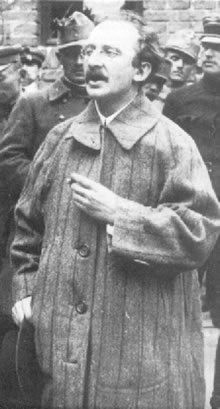
1870–1924 Vladimir Ilyich Lenin
1871–1919 Rosa Luxemburg
1879–1940 Leon Trotsky
1885–1971 Georg Lukács
1889–1914 Second International
1892–1940 Walter Benjamin
1895–1973 Max Horkheimer
1903–1969 Theodor W. Adorno
If, according to Jim Creegan, in his article on #Occupy, “Hot autumn in New York,” ((Jim Creegan, “Hot Autumn in New York,” in Weekly Worker 886 (October 20, 2011), available online at <http://www.cpgb.org.uk/article.php?article_id=1004580>.)) the events of 2011 were similar to but different in certain key respects from those of 1968 and 1999, this is due to 1968, as a crisis year of the New Left, and 1999, the year of the Battle of Seattle, taking place during periods of economic boom, whereas 2011 took place during the economic crisis that began in 2007–08. However, in terms of similarities and differences, what this comparison neglects is the crisis of 1973, the crisis of Keynesianism and Fordism that occurred in the aftermath of the New Left explosion of 1968. One can say, perhaps, that 1968 took place during an economic boom, but the 1970s phase of the New Left took place during a period of economic crisis, after 1973. Why Creegan, among others, may choose to forget this is that it raises the question of Marxism in the 1970s, the last time that there was a potential renascence of the Left during an economic crisis on the order of magnitude we’re facing today. The 1970s were a period whose failure conditions any attempts at Marxism in the present.
The last apparent renascence of Marxism, in the 1970s “Marxist-Leninist” turn of the New Left, may indeed be considered, rather, Marxism’s long-delayed death. In other words, Marxism didn’t come back to life in the ’70s so much as it finally died then. This is quite different from considering the collapse of the Soviet Bloc beginning in 1989 to be the crisis and death of Marxism. For it was in the 1970s that the crisis of Keynesian Fordism led to the neoliberal era, symbolized by the election of Thatcher and Reagan by the end of the decade. Neoliberalism has this crucial history in the 1970s, two decades before the 1990s, despite the preponderant consciousness today of later anti-globalization protests.
If the recent crisis is to be considered a crisis of neoliberalism, then it recalls the birth of the neoliberal era in the failure of the New Left, specifically the failure of New Left Marxism in the 1970s. The Marxist-Leninist turn of the New Left is coincidental historically with neoliberalism, so neoliberalism can be considered a historical phenomenon of the failure of the New Left. It was this failure that led to “postmodernist” anti-Marxism, specifically the death of the Left in its “post-political” phase of the 1980s–90s that we describe in Platypus’s official Statement of Purpose.
The century of Marxism: 19th and 20th centuries
The question before us, then, is the century of Marxism, considered as the emergence, crisis, death, and memory of Marxism. That question can be historically periodized as 1873–1973.
Marx’s thought predates this period, and is properly considered a phenomenon circa and in the aftermath of the Revolutions of 1848. ((See Cutrone, “The Marxist hypothesis: A response to Alain Badiou’s ‘communist hypothesis’,” in Platypus Review 29 (November 2010), available online at <http://platypus1917.org/2010/11/06/the-marxist-hypothesis-a-response-to-alain-badous-communist-hypothesis/>.)) If Marx’s own thought was born in the crisis of the 1840s (the “hungry ’40s”), then Marx-ism (as distinct from Marx’s own thought and practice), as a form of politics sui generis, a Marxist politics per se, dates from the collapse of the First International (International Workingmen’s Association) and the formation of the German Social Democratic Workers’ Party (SPD) in the 1870s. As such, Marxism is contemporaneous with the first Great Depression that began with the crisis of 1873. Marxism, as a form of politics distinct from other forms of socialism, dates from this period. Prior to this, there was no question of “Marxism” but, rather, Marx and Engels and their close colleagues participated in the broader socialist movement.
1873 is commonly regarded as the end of the mid-19th century “liberal” era (which saw a certain heyday in the 1860s, also when Leftist politics emerged from post-1848 reaction). In Marxist historiography, the period after 1873 dates the emergence of the “monopoly” era of capitalism, the era of modern “imperialism.” By contrast, the 1860s is the decade, for instance, marked by the U.S. Civil War, which conditioned the formation of the First International. ((See Karl Korsch, “The Marxism of the First International” (1924), available online at <http://www.marxists.org/archive/korsch/1924/first-international.htm>.)) However, that period ended by the 1870s.
Significantly, 1873 was a blow to, and not a boon for, the First International. If we take the First International as paradigmatic of 19th century socialism, the crisis of 1873 did not boost 19th century socialism as much as it was coincidental historically with the crisis of 19th century socialism, namely, the collapse of the First International. The 1870s signaled a shift. This shift, towards what became “Marxism,” therefore, was bound up with other changes. ((See Cutrone, “Lenin’s liberalism,” in Platypus Review 36 (June 2011), available online at <http://platypus1917.org/2011/06/01/lenin’s-liberalism/>. See also Cutrone, “1917,” in Platypus Review 17 (November 2009), available online at <http://platypus1917.org/2009/11/18/the-decline-of-the-left-in-the-20th-century-1917/>.)) These changes can be summed up in the historical shift from the liberal era to the state-centric era of capitalism.
“State capitalism” and Marxism
“State capitalism” is a tricky category, with a variety of different meanings. For instance, Friedrich Pollock, a member of the Frankfurt School, wrote an influential essay on “state capitalism,” published in the early 1940s, which referred to changes in the inter-war years of the early 20th century. But, in another sense, “state capitalism” can be dated in two very different ways: from 1873 or 1914, either Bismarck or WWI. The fact that state capitalism can be characterized as having such very different start dates is significant: it places, specifically, the period between these two dates under certain questions. This period, 1873–1914, is coterminous with another historiographic period, the time between the Franco-Prussian War and WWI (in France, this is the period of the Third Republic, after the collapse of the Louis Bonaparte’s Second Empire and the suppression of the Paris Commune), which developed towards a certain flowering of global capitalism in the Belle Époque. This is also the period of Marxism. Thus, it is significant that Marxism, in its “classical” era, can be considered a phenomenon of the turn to state capitalism. Marxists of this period called this era “imperialism,” or the “highest stage of capitalism,” the eve of socialist revolution. In other words, the period of the emergence of Marxism as a politics sui generis was also understood by Marxists of the time as sharing the historical moment of capitalism’s highest possible stage. “State capitalism,” in this view, was not the overcoming but rather the exacerbation of the contradictions of capitalism. Marxism was thus bound up with heightening contradiction.
The late-19th to early-20th century period of “imperialism” resulted in the First World War, which was, of course, the crisis of Marxism: the collapse of the Second International. The question is how Marxism was bound up with the imperialist phase of capitalism, and how the crisis of Marxism in WWI was connected to the other results of this period of history. In other words, how did the crisis of Marxism itself share in the historical moment of the emergence and crisis of state capitalism, understood by Marxists at the time as “imperialism”?
For the Marxists of this time, WWI was the crisis of capitalism in its period of “revolution,” which was signaled, in an inaugural sense, by the Russian Revolution of 1905. Marxists such as Lenin, Luxemburg, and Trotsky regarded this period as one confronted by the choice of “socialism or barbarism,” or, more specifically, the “civil war” of the workers against the capitalists or a “world war” between imperialist states. This was the prognosis.
The 20th century (1): The death of Marxism
Both predictions, of civil war and world war, in fact, came spectacularly true. Up to that time, Marxists understood this as either one alternative or the other. As it turned out, it was both. There was a world war and a civil war in 1914–19, in which the Second International collapsed and Marxism was divided. Marxism was divided specifically on the questions of both the imperialist world war and the class-struggle civil war that followed. So the crisis of Marxism was not only over the world war but was also over the civil war.
Marxism, specifically as a form of politics sui generis (distinguished from the greater 19th century history of socialism, from the Utopians to Proudhon, Blanqui, Lassalle, Bakunin, et al.) that had developed in the preceding period, from 1875–1914, did not survive its crisis in WWI and the revolutions that followed. Rather, Marxism died then.
The failure of Marxism can be seen most clearly in the birth of a new right-wing form of politics, fascism, in this period, issuing directly out of the crisis of Marxism in WWI (see, for instance, Benito Mussolini, who before the war was a leading member of the Marxist Left of the Italian Socialist Party). Fascism, 20th century social-democratic reformism, 20th century forms of nationalism (i.e., “anti-colonialism”), and Stalinism were the predominant (but not exclusive) results of the failed crisis of Marxism 1914–19.
So, how are we to regard the history of Marxism post-1919? Precisely as its post-history, its memory.
The 20th century (2): The memory of Marxism
The memory of Marxism was carried, for the purposes of our project in Platypus, principally by two figures: Trotsky and Adorno. Trotsky, as the major surviving figure of Second International radicalism (Luxemburg died in 1919, and Lenin in 1924); and Adorno, as the “Critical Theorist” who tried to sustain the insights of Lukács and Korsch in the aftermath of 1917–19 (also through the attempt to sustain Benjamin’s work, which was itself inspired by Lukács and Korsch’s work of the early 1920s). Trotsky and Adorno represented the disintegration of theory and practice that had characterized the crisis and failure of Marxism as a relation of theory and practice, as a form of thinking and political action sui generis, as it had developed up to 1914. In other words, Marxism developed from the 1870s, it ran into a crisis by 1914, and then it became divided in its theory and practice, especially around the revolutions of 1917–19. These two figures, Trotsky and Adorno, exemplify the effects of this history. But what they actually exemplify, to be more precise, is not the separation of theory (Adorno) from practice (Trotsky), but, rather, both Adorno and Trotsky are symptoms of the disintegration of Marxism as a relation of theory and practice that developed in the preceding period. The theory and practice problem exists on both sides of Trotskyism and the Frankfurt School.
The memory of Marxism haunted the 20th century, especially regarding the grotesque farce of Marxism in Stalinism. If there was a tragedy of Marxism in 1914–19, then this was followed by the farce of Stalinism. Both Trotsky and Adorno exemplify the possibilities for anti-Stalinist Marxism.
What died in the 1970s (let alone in 1989!) was not Marxism but rather the memory of Marxism, which had been only tenuously sustained. Between 1919 and 1973, we had the memory of Marxism, which faded out: this memory did not really survive Adorno’s death. This is not to say that Adorno was the personal embodiment of the memory of the Marxism, but that it didn’t really survive the time of Adorno’s death. The reason that the passing of the memory of Marxism might date, coincidentally, with the death of Adorno (who was more a thinker and not a very overtly political actor), is that “Trotskyism” as a form of Marxist politics did not really survive Trotsky’s death in 1940.
What is of interest, then, is how the last great renaissance of interest in Marxism, in the 1970s, actually marked the “death” of its effective memory. The apparent recovery of Marxism in the ’70s was actually the effective obscuring of its memory.
What we have been living through more recently, say, since the 2000s, is the exhaustion and falling away of the means for obscuring the memory of Marxism that emerged and developed in the 1970s–80s–90s, which were a process of forgetting Marxism. The 1990s were an especially interesting period in this history, as there were already some intimations of the exhaustion of the postmodernism of the previous 1970s–80s. In this sense, 1989 can be considered a certain end to the “long 1960s” that had extended into the ’70s and ’80s (or, ’89 can be considered as an “inverted ’68”).
The period from 1914 to 1973 (or, perhaps, 1989) was the essential, “short” 20th century. ((Cf., Eric Hobsbawm, The Age of Extremes: The Short Twentieth Century 1914–1991 (New York: Vintage, 1994).))
Platypus: Marxism in the 21st century?
Now, what does this say about Platypus in this regard? There are two different generations of Platypus, broadly speaking: the generation of the 1990s and that of the 2000s. These two generations express (the tensions within) the possible recovery of the memory of Marxism against its passing means of effacement. Thus, two different founding moments of Platypus’s own historical consciousness—1999, Seattle, and 2007, the exhaustion of the anti-war movement—are interrelated and interact specifically as different modulations of the exhaustion of processes for obscuring the memory of Marxism. Platypus, therefore, has two histories: a pre-history, 1999–2007; and an actual history, 2007–11/12.
If we compare our historical period with one a hundred years ago, the specificity of our project can be thrown into stark relief.
Whereas Marxism up to 1914 responded to and participated in the culmination of the imperialist phase of post-1873 capitalism, Platypus circa 2012 faces the very different challenges of the crisis of the neoliberal phase of post-1973 capitalism. In other words, our project in Platypus is a product of the end of the post-1973 neoliberal era. In this respect, the era of Marxism 1873–1914 could not contrast more starkly with our time, 1968/73–2011. Where one, 1873–1914, was a mounting crisis and a deeply ambivalent process of historical progression and regression, the other, our period, is one of spiraling decomposition.
This is how Platypus must relate to the history of Marxism: through the profound contrasts of post-1873 vs. post-1973 history.
Unprecedented historical moment
The reason that our project in Platypus is unprecedented is precisely because our historical moment is unprecedented: without the post-1848 and post-1873 projects of Marxism, and without the memory of Marxism 1914/19–73. Our period is a “post-Marxist” time in a totally unparalleled way. We are entering into a time not only very much unlike post-1873 or post-1914, but also significantly unlike the decades post-1973 (1970s–80s) and post-1989 (1990s–2000s).
This is why our project is so specifically one of the 21st century, of its first, and, now, its second decade. We need to attend closely to the various ways in which our project is so conditioned. The specificity of our time is our task.
Reference to the history of Marxism, as the ghost that might still haunt us, helps specify the peculiarities of our time, in which a fundamental transformation of Marxism is necessary for it to continue at all—for Marxism to be reborn, or, more precisely, to be reincarnated, in the traditional sense of spirit forgetting its past life. Such forgetting today, however, is a pathological repression. We must make Marxism remembered, if however, and necessarily, obscurely.
Unredeemable legacy of the 20th century
The 20th century, the period of the emergence, crisis, death, and memory of Marxism, cannot really be redeemed. In other words, the language of redemption you find in the Second International, with figures such as Rosa Luxemburg, or even with figures such as Benjamin or Adorno (who followed Luxemburg), their notion of redemption doesn’t apply for us in the 21st century. The reason that the 20th century cannot be redeemed is that, unlike the 19th century, we can say that the 20th century was one of unnecessary suffering. This is because the failure of Marxism was unnecessary—which is why it cannot be properly forgotten.
Rather, all of (prior) human history is now filtered through the 20th century—not through capital (as in the 19th century, for Marx), but rather through the failure of Marxism. The postmodernist attempt to overturn “grand narratives” of history was first and foremost the attempt to overcome Marxism as the grandest of all narratives of history. But postmodernism was not successful in this.
Whereas, for Marx, capital was the crossroads of human history as it had culminated in the 19th century, the 20th century was characterized by the crossroads of Marxism. This affects what came after. All ideology today is anti-Marxism, thus always returning to the question of Marxism. This is why Platypus is not about Marxism as an answer to the crisis of history, but rather as a question. That means that Platypus as a project is peculiar and unlike any other Marxist project historically, and the reason that we are unlike any other Marxist project today is that we emerged when we did. Our historical moment is unlike any other period. We cannot pose Marxism as an answer but only as a question.
Now, our claim is not that Marxism is a question, but is, rather, the more emphatic one, that Marxism is the question.
Because of the nature of the last year, 2011–12, this narrative requires a postscript, on anarchism.
Neo-anarchism and neo-liberalism
I just narrated 1873–1973 with respect to Marxism. Now, I’d like to narrate 1873–1973 in terms of anarchism.
Post-1873, anarchism was a waning ideology in the wilderness, excluded from the Second International, and thus cast into the shadows.
Post-1973, by contrast, it has become impossible to avoid anarchism. There is a way in which everything has become a kind of anarchism. Everything becomes filtered through an ethos of anarchism. Such (pseudo-)”anarchism” is more ideologically prevalent today than ever before.
It is significant that anarchism was excluded from the Second International. For the Second International, it didn’t seem that this was to any political detriment.
Starting in 1905, however, with the Russian Revolution, there began to be a changed relationship between anarchism and Marxism. After the 1870s, Marxism felt entirely justified in regarding anarchism as an antiquated and obsolete ideology. After 1905, however, this is no longer really the case. There are splits in both Marxism and anarchism that point to a changed relationship between Marxism and anarchism. Starting with 1905, anarchists become Marxists and, also, Marxists become (somehow) more anarchist. For instance, it was important for Rosa Luxemburg to argue, with respect to her pamphlet on 1905, The Mass Strike, the Trade Unions and the Political Party (1906), that she was not offering an anarchist argument or apologia for anarchism.
And, later, again, with the Russian Revolution in 1917, significantly, anarchists became Marxists.
From 1920/24–73, however, dissident Marxism becomes (“neo”-)anarchism, as seen in “council-communism,” Korsch’s later (post-1924) trajectory, figures such as Castoriadis, Murray Bookchin, the Situationist International, etc.
In 1969, Adorno wrote, in his last essay, “Resignation,” that “the return of anarchism is that of a ghost,” that (historical) Marxism’s critique of anarchism remained valid (see there Adorno’s paraphrasing of Lenin’s 1920 pamphlet “Left-Wing” Communism: An Infantile Disorder).
Marxism’s failure to transcend anarchism post-1919 means that the recrudescence of anarchism becomes an important symptom of the failure of Marxism. But this return of anarchism is not true but rather “pseudo.”
More broadly speaking, socialism’s failure to transcend liberalism in the 20th century means that liberalism becomes an important symptom of the failure of socialism, i.e., neo-liberalism. There are thus significant parallels between neo-liberalism and what we might call neo-anarchism after the failure of Marxism in the world revolution 1917–19.
Why characterize (pseudo-“)anarchism(“) as “dishonest liberalism,” or, as “hysterical” liberalism? ((See “The Occupy Movement, a Renascent Left, and Marxism Today: An interview with Slavoj Žižek,” in Platypus Review 42 (December 2011–January 2012), available online at <http://platypus1917.org/2011/12/01/occupy-movement-interview-with-slavoj-zizek/>.)) What might we mean by that? This is because anarchism is the only serious non-Marxian approach to socialism—other versions of socialism, for instance 20th century Social Democracy, are more clearly apparently relapses into (decadent, “ideological” forms of) liberalism. (Hence, Luxemburg’s characterization, in Reform or Revolution?,1900/08, of Eduard Bernstein’s “reformism” as “liberalism.”)
The failure of Marxist socialism thus has two essential results: neo-anarchism and neo-liberalism. They are distinguished not in principle, as their proponents might imagine, but only on a spectrum of opportunism. Hence, the indicative, symptomatic ideology of “libertarian socialism” in our post-1973 era. Libertarianism is merely an ideologically cruder version of anarchism, or, (neo- or pseudo-)anarchism post-1973 is merely an ideologically overwrought libertarianism. Anarchists are libertarians who take themselves too seriously; and libertarians are anarchists who are content to remain muddled in their thinking.
Following the Marxism of Lenin and Trotsky (and Luxemburg), Stalinism, as a form of “state socialism” is not to be defined properly as “authoritarian” but rather as opportunist. It was not simply a “wrong way,” but an opportunistic adaptation to defeat (or failure), what Trotsky called the “great organizer of defeat.” Hence, neo-anarchism is to be defined as dishonest opportunism, or as “(reactionary-)utopian ideology.”
The primary character of such ideology is the obscuring of history—the effacing of post-1848 political authoritarianism (“Bonapartism”) as a historical symptom that cannot be avoided but must be worked through. Anarchism is indicted by its anti-Marxism. This is what it means to say that (neo-)anarchism lacks historical consciousness or theory, replacing this with anthropology or psychology.
Q&A
In speaking about the “unnecessary suffering” of the 20th century, what did you mean?
It is significant that it is only in the late 19th century that one finds, for instance, a genocidal policy towards indigenous peoples (e.g., Native Americans). But, also, there is a new kind of racism, whether Dreyfus Affair anti-Semitism, or the new post-(collapse of) Reconstruction anti-black racism in the U.S. These came to characterize the 20th century. I would assert that such pathologies were not historically necessary but avoidable.
What about Bonapartism, as a post-1848 vs. post-1873 phenomenon?
This is related to the difference between Marx and Marxism, which is potentially obscure. Is there a difference in Bonapartism post-1848 and post-1873? Perhaps. This is the importance of “state capitalism.” What is the difference between the 1848 Revolutions and the (1870–71) Paris Commune? What is the difference between the First and Second Internationals? Marx and Engels did not seek to make “Marxism,” whatever that would be, hegemonic in the First International. But it seems to become necessarily hegemonic in the Second International. This expresses a historical shift.
I have two questions about the historical periodization: perhaps two blind spots. What about the period between the death of Trotsky in 1940 and the emergence of the New Left in the 1960s? This would appear to be an important bridge period. Also, aren’t you collapsing the post-1973 and post-1989 periods? What about the 1980s, before the collapse of Stalinism, but after the efflorescence of the 1970s? One sees this, for example, in the degeneration of the Spartacist League, among other Marxist organizations, after the 1970s.
The 1980s were importantly characterized by the disintegration of the Left into academicism and activism. Hence, there were two phases of what I’m calling the obscuring of the memory of Marxism, in which this occurred differently: the 1970s and the 1980s.
In terms of the mid-20th century period, one could say this was the heyday of Stalinism, as well as of ersatz or quasi-Stalinism, that is, Third World nationalism and Maoism, Castroism/Guevarism, etc. The Cold War films of the period showed the “blob” of the “Red Menace” growing. But this was not, I would contend, the growth of Marxism.
The memory of Marxism was sustained by the farce of Marxism in Stalinism.
But wasn’t Adorno’s own work a response to this mid-20th century moment?
I would say that neither the Frankfurt School nor Trotskyism experienced any real development in the mid-20th century, after 1940. At best, they held their ground. At worst, they retreated.
What about the 1860s? What about Bonapartism as an epochal development? What about Marx’s own growth and maturity as a political thinker? In 1873, from my understanding of European history, the kind of state interventionism one sees then is a political choice, not (merely) an economic one. When was the crisis of Marxism? How does this relate to the crisis of neoliberalism in the present? Why do you place such emphasis on Trotsky and Trotskyism? I know you were once around the Spartacist League. But wasn’t Trotskyism a farce as much as Stalinism? Didn’t Trotsky underestimate the profound, paralyzing influence of Stalinism? Wasn’t Stalinism a profounder problem than Trotsky thought? Isn’t there a problem with the “red thread” argument, linking Marx, through Lenin, Trotsky, etc.?
I must say that I don’t think Trotsky’s Fourth International project was particularly viable. But I also don’t think the Third, Communist International project was viable. Now, of course, Lenin and Trotsky had to hope against hope with the Third International.
But this is not to fault Trotsky (or Lenin!). When Trotsky was launching the Fourth International—people had spoken of the October Revolution as one characterized by “youth;” the soldiers were teenagers—there was still a living memory of the Revolution in the 1930s. Those who were once 20 were then 40, and thus still capable of making revolution. There is also the problem of what I would call Trotsky’s self-vulgarization, his propaganda orientation. Moreover, there was a problem in Trotsky trying to split the Third International, and basing his politics on the early Third International. But we must bear in mind that after 1933 Trotsky also oriented towards the remnants of Second International Social Democracy (as expressed in the so-called “French turn”), and refused to characterize Stalinism as somehow more Left than Social Democracy. I think that Trotsky’s “crisis of leadership” estimation of political possibilities meant something more supple than what his followers offered later. I think he recognized the profundity of the problem and its historical roots.
Let me be clear: The failure of Marxism was profound. Hence, there is no Marxism to return to. There is no answer, only a question. The question is the failure of Marxism.
The reason I am putting such emphasis on post-1873 history is to raise the issue of Marxism per se. Not the question of the workers’ movement or of socialism, but of Marxism. This is not posed later, in 1938 (the founding of the Fourth International) or 1933 (the failure of Third International to stop Nazism), or 1923 (the definitive end of the post-WWI revolutionary wave) or 1919 (the crushing of the German Revolution) or 1917 (the October Revolution as revolutionary split in Marxism) or 1914 (the collapse of the Second International in WWI). The question of Marxism is posed already at the outset in the 1870s. Why was the SPD necessary? Why does the SPD take the form it does? Why did Marxists join a Lassallean party?
So, there is the issue of the SPD, founded in 1875, being what Moishe Postone, for one, has called a “Lassallean party with Marxist verbiage.” Wasn’t it always a Lassallean party with “Marxist” window-dressing? My question is, is there such a thing as a “Marxist party?” Or, is there, rather, a socialist party with Marxists participating in it? Marxism was the “historical consciousness” of the socialist workers’ movement. There’s a famous photograph of Rosa Luxemburg, flanked on stage by portraits of Lassalle and Marx. Now, what did that mean? Certainly, Luxemburg was aware of Marx’s critique of and political opposition to Lassalle. So, what did it mean for an avowed “Marxist” such as Luxemburg to participate in a socialist workers’ movement and political party with a strong tradition of Lassalleanism?
But the history of Marxism was always characterized by the critique of socialism, starting with Marx in the 1840s, but carried forward, for instance, in Lenin’s critique of Narodnism, “Legal Marxism,” and “Economism.” Or, more generally, in the Marxist critique of anarchism, whether of Proudhon or Bakunin, et al. There is also the “Revisionist Dispute” within Marxism itself in the 1890s. What would it mean, then, to speak of Marxism as a form of politics per se?
Just as Marxism as a philosophy or theory is peculiar, as a political practice it is also quite peculiar. If, for Marxists, the socialist workers’ movement always shades off into liberalism and anarchism, is always overlaid with anarchist and liberal ideology, then Marxism is always in a constant struggle against these. But this is not a struggle merely of opposition but of critical recognition.
About the “maturity” of Marxism, there is a question. I don’t think of the “mature Marx” as the writer of Capital, but also and perhaps more importantly as a political figure. In the critique of Korsch’s “Marxism and Philosophy” (1923) by Kautsky that we published, ((See Karl Kautsky, “A Destroyer of Vulgar-Marxism,” in Platypus Review 43 (February 2012), available online at <http://platypus1917.org/2012/01/30/destroyer-of-vulgar-marxism/>.)) Kautsky accuses Korsch, along with Lenin and the Bolsheviks (including Trotsky), for being enamored of “primitive Marxism,” i.e., that of Marx and Engels in the 1840s, and ignoring subsequent development. ((Ibid.)) Both Korsch and Kautsky have some points to score in that debate. What’s the difference, for example, between Marx in the Manifesto and in the “Programme of the Parti Ouvrier” (1880)? ((Jules Guesde and Karl Marx, “The Programme of the Parti Ouvrier,” available online at <http://www.marxists.org/archive/marx/works/1880/05/parti-ouvrier.htm>.)) These differences are potentially vital. But can they be considered simply as development?
There is, for instance, the issue that Marx himself was accused (in the 1860s) of being right-wing or opportunistic, in his endorsement of unions and workers’ consumer cooperatives, etc. Lukács is good at pointing this out (in “Reification and the Consciousness of the Proletariat,” in History and Class Consciousness, 1923), that is, the symptomatic character of Lassalle’s criticism of Marx for supposedly being “economistic” and neglecting politics. But Lassalle criticized the “economic” struggles of the workers more generally, going so far as to call this the mere struggle of economic “objects” as objects (of capitalism). But Lukács’s point was that Marx recognized a dialectic of economics and politics, or, of the workers as both “objects” and “subjects” of capitalism. Marx didn’t take unions or cooperatives as good in themselves, but rather as historical (and symptomatic) forms that the workers’ movement was taking, to be pushed through. They are the forms through which the possibility for socialism can be grasped. They can’t be accepted in their own terms, but they’re also not to be criticized, let alone rejected as such.
That’s why I emphasize this period of the collapse of the First International and the birth of the SPD in the 1870s, to bring out the issue of Marxism as such.
What about the crisis of liberalism? When does the crisis of liberalism become the necessity for Marxism? When was this shift?
For Marx, certainly liberalism was “dead” as an emancipatory politics already in 1848. It was liberals, after all, who put down the workers in June 1848. Liberalism dies several deaths. The death of liberalism in 1848 is different from that in the 1870s (for example, with the failure of Reconstruction in the U.S.).
This raises the question of historical “progress.” The necessity for socialism grows between 1848 and 1873. Engels, for example, in his 1895 Introduction to Marx’s The Class Struggles in France, ((See Friedrich Engels, “Introduction to Karl Marx’s The Class Struggles in France 1848 to 1850” (1895), available online at <http://www.marxists.org/archive/marx/works/1895/03/06.htm>.)) discusses the still not exhausted potential for capitalist development after 1848. But this wasn’t for Engels merely “economic” but political. Capitalism continues to grow, economically, in a sense. The question was whether such growth was a political advance. The evidence of “progress,” for Engels, was the growth of the socialist workers’ movement. What Marx and Engels had “underestimated” was the potential for capitalism to contribute to the growth of the workers’ movement for socialism. But that is precisely what we have not seen since 1973! Perhaps not since 1919.
What about Marx’s (infamous) Preface to the Contribution to the Critique of Political Economy (1859), about “productive forces” and “relations of production?” To call the 20th century one huge ball of unnecessary suffering seems to belie Marx’s sense of contradiction. This is part of the continuing strange character of “what it means to live.” Chris, I’ve heard you address, for instance, financial techniques as forces of production, still contributing to the development of social possibilities. The 20th century as unnecessary suffering fails to get at that aspect of history. Capitalism hasn’t shut down yet. On the other hand, Marx and Engels, in the Manifesto, project the rest of the 19th century as unnecessary. So, the 20th century could be seen still as necessary, while the 19th century could also be seen as unnecessary.
The reason I put it this way, highly tendentiously, is to focus the question of Marxism. In other words, will Marxism play a role in emancipation? If it does, then the 20th century was unnecessary. If it does not, then perhaps the 20th century was necessary, in getting beyond, and transcending, Marxism. If the history of actual Marxism as politics plays no role, then the New Left was right, revolution in 1917 had been premature. If this history still has a role to play, however, then perhaps 1917 was not so premature, and what came later was not so necessary.
We must ask, in what ways might the history of Marxism play a role? As practical politics? As theory? How? As a relation of theory and practice, as Adorno puts it in “Marginalia to Theory and Praxis” (1969)? In what way was and is Marxism necessary?
Why should a project such as ours, beginning in the 21st century, be “Marxist?” Why shouldn’t we be “post-Marxist?” Why can’t we say, simply, that the history of Marxism has some contributions to make, but look at all these other things, anarchism, etc.?
How is it that Stalinism, Maoism, etc., weren’t Marxism? Is it because they abandoned an emancipatory vision? Is it because they became one-sided in their opposition to capitalism, and denied its contributing to emancipatory possibilities? So that, today, it doesn’t seem that capitalism holds such possibilities. What would it take to make that possibility active again? It would seem that the only way to do that would be to work through the history of the 20th century.
I’m not exactly saying that (about Stalinism and Maoism, etc.). To get back to the issue of Trotskyism, yes, Trotskyism was farcical in a sense. It was not the Marxism practiced by Lenin, Luxemburg, and Trotsky himself in an earlier period. It was not the relation between theory and practice that Marxism once was. This is what makes the history of Trotskyism, including Trotsky’s own in the 1920s and ’30s, farcical, in a sense.
Why isn’t Trotsky a tragic figure, why is he farcical? Well, because the real tragic figures of Marxism, to my mind, are Lenin and Luxemburg. Lenin, to me, was a tragic figure. Also, Marx and Engels themselves. Marxism was the tragedy.
The ambiguity of the 20th century raises the issue of ideology. Could Marxism again become a guiding ideology?
There is the difference of the dialectic of history, as expressed by Marxism in the late 19th and early 20th centuries, and the exhaustion of history in our present period. That’s what Fukuyama meant by the “end of history.” While untrue in a certain sense, it is symptomatically expressive in another sense.
What is the possibility of the recovery of the memory of Marxism? I think that the casualty of the death of Marxism was the workers’ movement itself, despite the 1930s, let alone the ’60s and ’70s. The “class struggle,” as previously found in history, ended. Not labor militancy, but class struggle. The failure of Marxism is the failure of the socialist workers’ movement. Stalinism was not only the farce of Marxism but also of the socialist workers’ movement. This is related to social democracy and even fascism. When Friedrich Hayek, in The Road to Serfdom (1944), said that the roots of fascism are to be found in pre-WWI social democracy, even a benign case like Austrian Social Democracy, he had a point. Horrific if true, still, there is the problem of the plausibility of Hayek’s account, which was influential. Hayek, after all, is a key progenitor of neo-liberalism, that is, 20th century liberalism.
The 20th century was the rehash of 19th century ideology. There’s nothing new. Hayek, for instance, doesn’t come up with anything new, but rather goes back to liberalism, to ideology before socialism. The recrudescence of old ideologies is indicative. The 19th century, by contrast, was very new at the level of ideology.
What about fascism? What about fundamentalism? Aren’t they new in the 20th century?
Well, fundamentalism might be new, but I am emphasizing the Left. Fundamentalism is obviously conservative, and reaches back well before the 19th century. Fascism has roots in the 19th century, specifically in history after the 1870s. But, on the Left, liberalism and anarchism, as forms of anti-Marxism, still claim to be emancipatory, not conservative ideologies. They, like Marxism, originate in the 19th century. They are still with us today. The question is whether and how Marxism still is. | §
Transcribed with the assistance of Nikolas Lelle
Originally published in The Platypus Review 47 (June 2012).
Historical specificity, the temporality of capital, and the supra-historical
Chris Cutrone
Presented on a panel with Fabian Arzuaga, Bo-Mi Choi and G. S. Sahota at the Critical Historical Studies conference, Chicago Center for Contemporary Theory (3CT), University of Chicago, December 3, 2011.
History is a way the present relates to itself. History mediates the present, and anticipates the future. The relation of past and present in history is a social relation, a relation of society with itself, as a function of change. The proper object of the present is history: the present is historical; it is constituted by history. The present is history; history is the present. As Hegel put it, the “philosophical” approach to history is concerned with the “eternally present:” what in the past was always present. This is a function of modernity. What is at issue is the form of the present in history, or, the form of history in the present.
Three writings, by Nietzsche, Benjamin and Adorno, respectively, reflect upon the specific form of history in capital, and on the possibility of transcending the historicism that emerged in the 19th century, as it continued to inform the 20th: Nietzsche’s 1873 “On the Use and Abuse of History for Life;” Benjamin’s 1940 “Theses on the Philosophy of History;” and Adorno’s 1942 “Reflections on Class Theory.” Nietzsche’s essay inspired Benjamin’s; Adorno’s followed directly upon Benjamin’s.
Nietzsche and the genesis of history
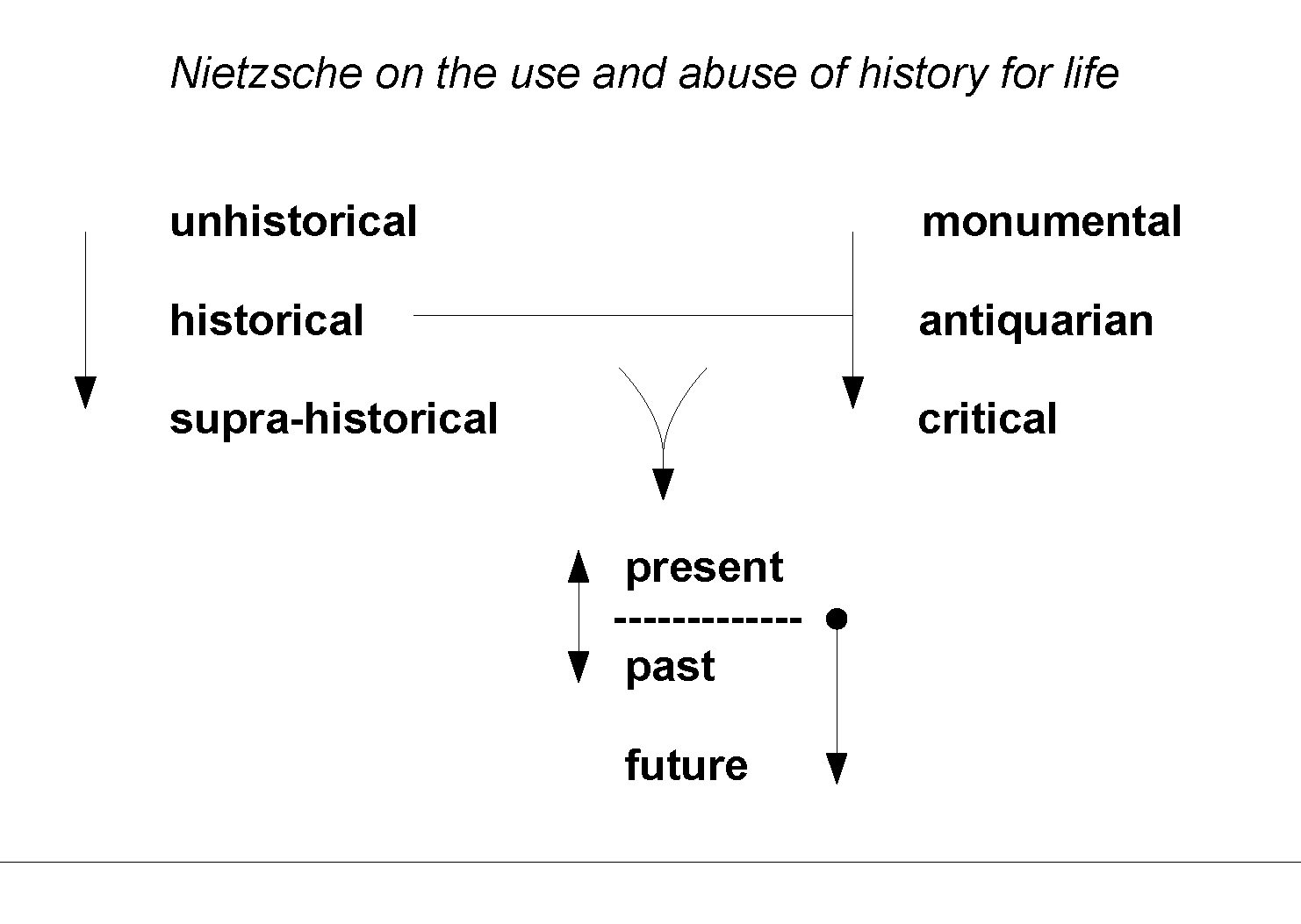
Nietzsche’s second “untimely meditation” (or “unfashionable observation”), “On the Use and Abuse of History for Life,” critiqued what translator and Nietzsche scholar Peter Preuss called the 19th century “discovery” of history. Nietzsche regarded history specifically as a symptomatic expression of the genuine needs of the time. For Nietzsche, the symptom of history is expression of an illness, but Nietzsche’s approach to such illness is as to “pregnancy:” not to be cured in the sense that it is eliminated, but rather undergone successfully to bring forth new life.
19th century historicism was, for Nietzsche, the hallmark of a historically peculiar form of life: modern humanity. Modern humanity is historical in a precise sense: “history” is historical. For Nietzsche, the question is what the symptom of history indicates about the need for humanity to overcome itself in present form. Nietzsche’s expression for this potential self-overcoming of historical humanity is the “supra-historical.” It points beyond history, towards a new form of life that is possible in history.
For Nietzsche, there are three forms of the historical: the “monumental;” the “antiquarian;” and the “critical.” Nietzsche addressed these different phases of the historical as expressing different “uses” or needs for the historical in the “life” of humanity. In each of them the past figures differently. The forms of the historical are distinguished from the greater three categories with which Nietzsche’s essay is concerned: the “unhistorical;” the “historical;” and the “supra-historical.” The latter three categories refer, respectively, to the pre-human, the human, and the supra-human. Humanity becomes itself through history; and it potentially overcomes or transforms itself in transcending itself as historical. As Preuss pointed out, history is the record of the “self-production” of humanity. Therefore, the transformation of humanity, the changes in its self-production, changes history, and changes what the past is for humanity. In this respect, it is possible to address Nietzsche’s essay as indicating the possibility for going beyond the historical, or overcoming the present relation humanity has to itself, in and through history.
Benjamin and Adorno on Nietzsche and Marxism
Benjamin, and Adorno following him, appropriated Nietzsche’s account of history for their Marxist critical theory of the “philosophy of history,” specifying Nietzsche’s symptomology of history as symptomatic of capital. For Benjamin and Adorno, Nietzsche’s account of history was historically specific to its moment of capital, the late 19th century, with further implication for the 20th century.
What would it mean to get “beyond history?” First, it is necessary to identify, as Adorno put it, “what history is:” its possibility and necessity. For Benjamin, history originates in the demand for redemption. Following Benjamin’s “Theses on the Philosophy of History,” and responding to Marx and Engels’s Communist Manifesto, in “Reflections on Class Theory” Adorno wrote that,
According to [Marxian] theory, history is the history of class struggles. But the concept of class is bound up with the emergence of the proletariat. . . . By exposing the historical necessity that had brought capitalism into being, political economy became the critique of history as a whole. . . . All history is the history of class struggles because it was always the same thing, namely, prehistory. This gives us a pointer as to how we can recognize what history is. From the most recent form of injustice, a steady light reflects back on history as a whole. Only in this way can theory enable us to use the full weight of history to gain an insight into the present without succumbing in resignation to the burden of the past.
This relation of pre-history, history, and a potential post-historical condition was, for Adorno, the relation of the present to the “burden of the past:” can it be redeemed?
Adorno addressed a certain problem in Marxism’s so-called “dialectical” approach to history, in that it tended to be, paradoxically, one-sided:
[Marxism has been praised] on account of its dynamism. . . . Dynamism is merely one side of dialectic: it is the side preferred by the belief in practicality. . . . The other, less popular aspect of dialectic is its static side. . . . The law that, according to the Hegelian dialectic, governs the restlessly destructive unfolding of the ever-new consists in the fact that at every moment the ever-new is also the old lying close at hand. The new does not add itself to the old but is the old in distress.
This was Adorno’s interpretation and attempted further elaboration of Benjamin’s injunction to read history “against the grain” (Thesis VII). But what did Adorno mean by “the new?”
Potential futures are generated out of the relation of past and present, out of the relation of the present to itself through history. The dynamic of history is inherent in the self-contradiction of the present: history is a projection of it. What is the “practicality” of history? The emergence or departure of the new is the self-overcoming of the present, or the self-overcoming of history: its immanent transcendence. Nietzsche’s phrase, “self-overcoming” is, literally, the “Selbstaufhebung:” self-fulfillment and self-negation. The present provides an opportunity for the self-overcoming of history.
The “new is the old in distress” because it is the present in tension with itself: is the present merely the ever-same? The “static side of the dialectic,” in which the “ever-new is the old lying close at hand,” means that, as Benjamin put it, “every second is the strait gate through which the Messiah [redemption] might enter” (Addendum B). The “homogeneous” and “empty” time of the ever-same is also, potentially, the “full” time-of-the-now (Jetztzeit). History is dialectical, but it is a “negative” dialectic of the present: the present, in its potential for self-overcoming, disintegrates as history disintegrates into the mere facticity of the past. Historicism is a symptom of failed self-overcoming. For Benjamin, the task was to “construct” history, rather than to merely “add” the new to the old (Thesis XVII). This is the contrast Adorno found between the new as “the old lying close at hand” and the “restlessly destructive unfolding of the ever-new” that is “always the same thing, namely, prehistory.” The “static side” of the dialectic of history is thus a resource. The question is whether it is a resource for the emergence of the new or the perpetuation of the old: either, or both.
Nietzsche’s “untimeliness”
The discontent of history is the source of Nietzsche’s “untimely thought.” What potential critique of the present does history offer? Nietzsche recognized himself as a product of 19th century historicism. Nietzsche characterized as “antiquarian” the deadly transformation of history into the mere facticity of the past. As a Classical philologist, Nietzsche was well prepared to address the melancholy of modernity expressed in historicism. As Benjamin put it, quoting Flaubert, “Few people can guess how despondent one has to be in order to resuscitate Carthage” (Thesis VII). (The reference to Carthage echoes that with which Nietzsche began his essay, the Ceterum censeo [“I judge otherwise”] of Cato the Elder: “Carthago delenda est [Carthage must be destroyed].” As Nietzsche put it, this was the spirit with which his “consideration of the worth and the worthlessness of history” began.) In response to such threatening acedia, Nietzsche contrasted his “critical” approach to history.
Here it becomes clear how badly man needs, often enough, in addition to the monumental and antiquarian ways of seeing the past, a third kind, the critical: and this again in the service of life as well. He must have the strength, and use it from time to time, to shatter and dissolve something to enable him to live: this he achieves by dragging it to the bar of judgment, interrogating it meticulously and finally condemning it; every past, however, is worth condemning.
This approach, Nietzsche pointed out, was counter to the historicist passion of his time, the prevalent “consumptive historical fever.” Nevertheless, Nietzsche found his own philological concerns to motivate a certain dissatisfaction with the ethos inherent in “the powerful historical tendency of the times, as it has been, by common knowledge, observed for the past two generations, particularly among the Germans” since the early 19th century.
I must be allowed to ascribe this much to myself on account of my profession as a classical philologist, for I would not know what sense classical philology would have in our age unless it is to be effective by its inappropriateness for the times, that is, in opposition to the age, thus working on the age, and, we hope, for the benefit of a coming time.
The consummation and self-destruction of 19th century historicism in Nietzsche presented the demand for the “supra-historical,” for getting beyond the historical comportment that had produced Nietzsche, a self-overcoming of history.
Beyond history?
The question of getting beyond history relates to Nietzsche’s characterization of “critical history,” that is, the possibility and necessity of “condemning a past” in creating what he called a “new nature.” This is the need to forget. This is not the forgetting that might be taken to characterize the unhistorical, animal condition (according to Nietzsche, the unhistorical condition is that of the grazing animal, which does not speak because it immediately forgets what it was going to say). “Forgetting,” in Nietzsche’s sense, is an activity in service of life: it can only be considered, not unhistorical, but post- or supra-historical, that is, a form of historical forgetting that overcomes a form of remembering. There is a human need to forget that is not natural but develops: it is a new need.
For Benjamin, the need to “forget” is related to the need to “redeem” history. “Redeemed” history could not only be potentially “cited” in “all its moments,” but also, more importantly, forgotten. The need to remember is matched by the need to forget. So, the question turns on the necessity for remembering that would need to be overcome in order to make forgetting, in a transcendent sense, possible and desirable.
Benjamin’s concept of historical redemption in the “Theses on the Philosophy of History” was informed by the correspondence he conducted with Horkheimer on the Arcades Project (for which the “Theses” were drafted as an introduction), specifically concerning redemption. Horkheimer pointed out that any redemption must be qualified: the dead remained dead; their sacrifice could not be redeemed in certain respects. For Benjamin, this affected the quality of history: it became the record of wasted potential, or “barbarism.” This was history’s standing reproach to the present.
If, for Nietzsche, “critical history” means standing in judgment over history, by contrast, for Benjamin, the critical value of history was in its judgment over the present: history was an effect of the present’s judgment of itself. What does the present need to remember; what to forget? What does it need to judge? If Nietzsche called for the historian to be “man enough” to judge the past, for Benjamin, the required “strength” was to receive history’s judgment and not be devastated by it: the memory of “enslaved ancestors” (Thesis XII). For the nature and character of both the ancestry and the enslavement were precisely the matters to be judged, remembered and forgotten. From what are we descended, and from what must we free ourselves? How do we judge this?
Capital as form of history to be redeemed
Adorno identifies “how we can recognize what history is” by the “steady light” reflecting “from the most recent form of injustice.” The theory that is thus enabled, without succumbing to the past, must be able to distinguish the potential for the present to depart from the “ever-same.” For Benjamin, this “Messianic” potential for redemption available in every present moment is the product of two opposed vectors: regression and stasis. The “static side” of the historical dialectic that Adorno identified was, for Benjamin, the potential “exploding” of the “continuum of history” (Thesis XVI), a “standstill” (Thesis XVI), or “activating the emergency brake on the locomotive of history” (Paralipomena Thesis XVIIa). The motivation for this was the “regression of society” (Thesis XI). Otherwise, one might “succumb,” “in resignation to the burden of the past.”
Capital presents an apparently unredeemable history, at least in any traditional (theological) sense of redemption. Benjamin was no melancholic but rather sought to diagnose and potentially overcome the melancholy of modernity. But this could only be achieved immanently, from within modernity’s “dialectic” of history. This dialectic had, for Adorno, two sides: dynamic and static. The dialectic of history in capital is one of constantly generated but wasted new potentials. This is its “injustice,” what gives modernity its peculiar, specific melancholy, affecting its demand for redemption. While all of human history may have been characterized by the Messianic demand for redemption, modern history’s demand for redemption is specific and peculiar. Modern history liquidates all prior history, however rendering it, according to Benjamin, more as “rubble” (Thesis IX) than as resource.
Modern history ruins prior forms of redemption, in favor of what is, for Benjamin, a specious form of remembering: history as the accumulation of mere facts. What would be its “opposite?” The traditional Messianic eschatological “end of time” is matched by the modern “monstrous abbreviation” that summarizes the entire history of humanity (Thesis XVIII) in capital: an appropriation of all of history that threatens to become its barbarization. For Benjamin, this must be countered by a constructed “constellation,” in which the demand for the redemption of history transforms the time of the present into one of potential secular redemption: not the negation of time as in the coming of the Messiah, but the redemption of time, in time (Addendum A). This would amount to the effective transformation of history, a “fulfillment” of the “here-and-now” appearing as a “charged past” that has the ability to “leap into the open sky of history” (Thesis XIV) as opposed to subordination to a “chain of events” (Thesis IX) or “causal nexus” (Addendum A). Neither celestial redemption outside of time nor secular time without redemption, Benjamin’s philosophy of history seeks the relation of modern temporality to the transformed demand for redemption.
The question is how to overcome the ideological abuse of history to which it is subject in modernity. This abuse is due to the form of temporality in capital. For Benjamin, this concerns the “citability” of the moments of the past, which modern society makes possible — and necessary. This is no mere addition to knowledge of the past, a quantitative increase, but rather the fundamental qualitative transformation of what counts as historical knowledge, the self-knowledge of humanity as a function of time. Is the self-production and self-transformation of humanity a function of time? In capital, this is the case, but in a certain sense, producing what Benjamin called a “causal chain” of events “anterior” to the present. However, such spatialization of time, once, historically, did not, and so, potentially, would no longer, pertain in a “supra-historical” condition for humanity, as prognosed by Nietzsche.
The temporality of capital
From the transformation of time in time, it becomes possible to turn the “abbreviation” of time in capital into the potential supersession of the form of change as a function of time. From Nietzsche’s “critical” approach to history, as an active appropriation of the present, Benjamin turned to the reception of history as critical to the present: the present as crisis of history. Where, for Nietzsche, the culmination of history was the crisis of the historical, and the possibility for a supra-historical form of humanity, for Benjamin, the culmination of the peculiar historical comportment of modern humanity is the crisis of history, the crisis of humanity. All of history becomes citable, but as amalgamation. Where, for Nietzsche, a future changed condition “must come” if humanity is to survive, for Benjamin, if history is to be redeemed, humanity must be transformed. (Benjamin: “Humanity is preparing to outlive culture, if need be;” this is Nietzsche’s “strange goal.”)
As Adorno concluded his “Reflections on Class Theory,” “This means, however, that dehumanization is also its opposite. . . . Even if the dynamic at work was always the same, its end today is not the end.” The transformation of humanity envisioned by Benjamin and Adorno, appropriating Nietzsche’s discontent in history, was one that would transcend all historical culture “hitherto.” Benjamin and Adorno matched Nietzsche’s “rumination” with Marx and Engels’s Manifesto. The self-overcoming of the entire history of civilization and of its “process of transmission” (which cannot be avoided but only “reversed,” pointing not to the future but the past) would be “against the grain” of the historical progress that can only be regarded as “regression:” the inversion of the meaning of history; the end of history as the end of pre-history in the present, or, the potential redemption of the history of civilization that capital makes possible of itself.
The dialectic of memory and forgetting involves changes in both the forms of remembering and the process of forgetting. A form of remembrance is a way of forgetting. It serves a certain way of life. To remember is to forget in a certain way; to forget is to overcome a certain need to remember, and to overcome the past in a certain way. If the present is an effect of history, then it is in the way the past causes the present.
Why is the past, in modernity (according to Benjamin, following Nietzsche), “citable” in all of its moments? Because all of history is (potentially) negated by capital — just as it is (potentially) fulfilled by it. The question is the possibility and necessity of the appropriation of all of history in capital. The mode of appropriation of the past in capital, its “process of transmission,” is the society prevailing throughout “all of history:” “barbarism.” This means that all moments of the past potentially become culpable in capital, by becoming the endless resource of the present: history. Capital is the literal “Aufhebung” of history. But can capital become the Selbst-aufhebung of history? Or does modern history exhibit, rather, a dynamic that is alien to all of history, as it was practiced hitherto (prior to the challenge of modernity)? Is capital the potential for redemption in history, or its ultimate denial, its final liquidation? The fundamental ambivalence of history in capital is the key to what it is: an injustice to be made good. This is what capital has promised humanity at the end of history. Can it be fulfilled? Will it? (( This link between redemption and forgetting has its utopic as well as dystopic valences. As Kafka wrote in conclusion of his last published story, “Josephine the Singer, or the Mouse Folk” (in The Complete Stories, trans. Willa and Edwin Muir [New York: Schocken, 1995], 360–376), in a decidedly non-human, zoomorphic parable:
“Josephine’s road, however, must go downhill. The time will soon come when her last notes sound and die into silence. She is a small episode in the eternal history of our people, and the people will get over the loss of her. Not that it will be easy for us; how can our gatherings take place in utter silence? Still, were they not silent even when Josephine was present? Was her actual piping notably louder and more alive than the memory of it will be? Was it even in her lifetime more than a simple memory? Was it not rather because Josephine’s singing was already past losing in this way that our people in their wisdom prized it so highly?
“So perhaps we shall not miss so very much after all, while Josephine, redeemed from the earthly sorrows which to her thinking lay in wait for all chosen spirits, will happily lose herself in the numberless throng of the heroes of our people, and soon, since we are no historians, will rise to the heights of redemption and be forgotten like all her brothers.” (376) )) | §
Bibliography
Adorno, Theodor W., “Reflections on Class Theory,” trans. Rodney Livingstone, Can One Live after Auschwitz? A Philosophical Reader, ed. Rolf Tiedemann (Stanford, CA: Stanford University Press, 2003), 93–110.
Benjamin, Walter, “Theses on the Philosophy of History,” trans. Harry Zohn, Illuminations, ed. Hannah Arendt (New York: Schocken, 1968), 255–266; “On the Concept of History,” trans. Dennis Redmond (2005), available on-line at: <http://www.marxists.org/reference/archive/benjamin/1940/history.htm>; “Paralipomena to ‘On the Concept of History’,” Selected Writings vol. 4 1938–40 (Cambridge, MA: Harvard, 2006), 401–11.
Nietzsche, Friedrich, “On the Use and Abuse of History for Life,” trans. Ian Johnston (2010), available on-line at: <http://records.viu.ca/~johnstoi/nietzsche/history.htm>; On the Advantage and Disadvantage of History for Life, trans. Peter Preuss (Indianapolis, IN: Hackett, 1980).
The last letters between longtime colleagues and friends Theodor W. Adorno and Herbert Marcuse in 1969, in which they debated the difficulties of their perspectives in the face of the 1960s New Left, help to situate Frankfurt School Critical Theory’s Marxism and its continued legacy. On the one hand, Adorno is notorious for calling the police on student demonstrators. But Adorno insisted nonetheless that Marx was not “obsolete” and socialism remained possible, if not immediately. On the other hand, Marcuse’s lectures of the time, such as “The End of Utopia” (1967), his interview in New Left Review on “The Question of Revolution” (1967), and his December 4, 1968 speech “On the New Left” (in Herbert Marcuse, The New Left and the 1960s: Collected Papers of Herbert Marcuse vol. 3, ed. Douglas Kellner [New York: Routledge, 2005],122–127) made important concessions to the historical moment, against which Adorno sought to warn, in his final writings, “Marginalia to Theory and Praxis” and “Resignation,” which were developed directly from his correspondence with Marcuse. Responding to Adorno, Marcuse acknowledged the fatal mixture, “Rational and irrational, indeed counter-revolutionary demands are inextricably combined.” Marcuse thought that prominent New Left activists like “Danny the Red” Cohn-Bendit, who tried to scandalize Marcuse for his past work for the U.S. government during WWII, were isolated and ultimately minor figures. But Adorno grasped the significance of the kind of action advocated by those like Cohn-Bendit and Rudi Dutschke, especially in their self-conception, an “intransigence” of ethical posturing rather than self-recognition. As Adorno put it to Marcuse, “[T]here are moments in which theory is pushed on further by practice. But such a situation neither exists objectively today, nor does the barren and brutal practicism that confronts us here have the slightest thing to do with theory anyhow.” Adorno and Marcuse’s prognoses on the 1960s New Left thus forecast on-going problems faced by political practice and theory with emancipatory intent, casting subsequent history into critical relief.
Theory and practice: the historical moment of the 1960s
Adorno and Marcuse differed in their estimations of the New Left, but this difference is misunderstood if it is taken to be between opposing and supporting the student and other protests of the 1960s. Rather, the difference between Adorno and Marcuse was in their estimation of the historical moment. Where Marcuse found a potential prelude to a future rather than an actual reinvigoration of the Left, let alone possible revolution, in the 1960s, Adorno was more critical of the direction of the New Left. Marcuse was also critical of the New Left, but accommodated it more than Adorno did. While Adorno might be mistaken for the more pessimistic of the two, it was actually Marcuse’s pessimism with respect to current and future prospects for Marxism that facilitated his greater optimism towards the New Left.
The late divergence of Marcuse from Adorno took place in the context of the turn in the New Left in 1969. Adorno grasped a waning of the moment and lowering of horizons that brought forth desperation from the students, whereas Marcuse thought that future prospects remained open. The separation of theory from practice was both the background for and the result of the turn in the New Left by 1969. Where Marcuse tried to theoretically discern the potential, however obscure, in the New Left, Adorno prioritized a critical approach, and emphasized not merely the lack of theoretical self-awareness, but also the lack of political practices that could lead out of the crisis of the New Left by 1969.
Adorno emphasized the historical affinity of the late New Left moment with that of the crisis of the Old Left in the late 1930s. Adorno thought that history was repeating itself. Adorno maintained the need for a critical-theoretical approach that could sustain such historical consciousness. By contrast, Marcuse emphasized the potentially new historical situation of the 1960s, and, for Marcuse, this included the changed character of Adorno and Horkheimer’s Frankfurt Institute for Social Research itself. Marcuse thought that the Institute had become politically compromised such that its essential character differed fundamentally in the 1960s from the 1930s: it was part of the established order. Adorno pled for recognizing continuity, especially in his own thinking.
In addressing the difference between Adorno and Marcuse, it is important not to neglect other differences that informed and impinged upon their conflict. On the one hand, there were the student protesters, whose perspectives were quite different from either Marcuse’s or Adorno’s. On the other hand, there was Horkheimer’s rejection of the New Left, which was different from Adorno’s critique of it. The actual character of Adorno’s critique of the New Left is lost if his perspective is assimilated to Horkheimer’s.
This affected the quality of Adorno’s correspondence with Marcuse in 1969, the documentary record of their disagreement. Marcuse called out Horkheimer’s statements in the press, and Adorno responded to Marcuse in defense of Horkheimer. But Adorno’s defense of Horkheimer’s statements, especially against their misrepresentation, did not mean that Adorno’s perspective was the same as Horkheimer’s or that he entirely agreed with him.
There were more than two sides, for or against the New Left. Neither Adorno nor Marcuse was either for or against the New Left: both supported the student and other protesters in certain respects, while both remained critical. Indeed, it was precisely such black-and-white thinking, either/or, for-or-against, that both Marcuse and Adorno thought was characteristic of prevailing authoritarianism in society, from which the New Left was not exempt. In this respect, Habermas’s pejorative characterization of the New Left as harboring “red fascist” tendencies spoke to the underlying continuity between the 1930s and the 1960s, which Adorno was keen to point out, and Marcuse did not deny, but only downplayed its importance in the moment.
The issue of Stalinism loomed in estimating the character of the New Left, for both Adorno and Marcuse. “Red fascism” was a term in the aftermath of the 1930s for characterizing precisely the problem of Stalinism. Marcuse thought the problem of Stalinism had waned in importance with respect to the politics of the New Left, whereas Adorno thought that it remained, as bad if not worse than ever. This is the crucial respect in which Adorno’s thought differed from Horkheimer’s (and perhaps also from Habermas’s): Adorno did not regard the problem of Stalinism as having increased since the 1930s, whereas Horkheimer did. Horkheimer’s perspective may thus be characterized as sharing features of the trajectories of other post-WWII Marxists, towards “Cold War” liberalism and social democracy.
The difference between Adorno and Horkheimer that can become obscured regarding the disagreement with Marcuse traces back to the beginning of WWII, and the debate in the Institute about Friedrich Pollock’s “state capitalism” thesis. While Pollock was addressing Nazi Germany, this approach has also been regarded as characterizing Stalinism in the Soviet Union. At the time, Adorno differed from his colleagues, averring, in a rather orthodox Marxist way, that even Nazi Germany must be regarded as remaining “contradictory.” This would also apply to the Soviet Union. The question was the character of that contradiction. In what way did such new historical phenomena as Nazi Germany and the Soviet Union, as well as the New Deal U.S., still exhibit the contradiction of capital in Marx’s terms, in however historically transformed ways?
Marcuse’s revision of Marx
The issue of the contradiction of capital from a Marxist perspective arose for the 1960s New Left: In what ways had Marx and Marxist politics potentially become obsolete? Prior to his disagreements with Adorno in 1969 regarding the New Left, in 1967 Marcuse had delivered a speech on “The End of Utopia” in which he took issue with Marx’s conception of emancipation from capital. He began with the following broadside against Marx:
I believe that even Marx was still too tied to the notion of a continuum of progress, that even his idea of socialism may not yet represent, or no longer represent, the determinate negation of capitalism it was supposed to. That is, today the notion of the end of utopia implies the necessity of at least discussing a new definition of socialism. The discussion would be based on the question whether decisive elements of the Marxian concept of socialism do not belong to a now obsolete stage in the development of the forces of production. This obsolescence is expressed most clearly, in my opinion, in the distinction between the realm of freedom and the realm of necessity[,] according to which the realm of freedom can be conceived of and can exist only beyond the realm of necessity. This division implies that the realm of necessity remains so in the sense of a realm of alienated labor, which means, as Marx says, that the only thing that can happen within it is for labor to be organized as rationally as possible and reduced as much as possible. But it remains labor in and of the realm of necessity and thereby unfree. I believe that one of the new possibilities, which gives an indication of the qualitative difference between the free and the unfree society, is that of letting the realm of freedom appear within the realm of necessity — in labor and not only beyond labor.
This echoed a concern in Marcuse’s prior book, Eros and Civilization, which he republished with a new Preface in the late 1960s. There, Marcuse appropriated Schiller’s account of the “play drive:” work was to become play. In Eros and Civilization, Marcuse contemplated the possibility of a “work instinct,” or a need to labor that could be transformed in a more benign direction rather than being enlisted in combination with the “death drive,” as under capitalism. Upon its initial release, Horkheimer and Adorno had passed on publishing Marcuse’s book in Germany, without comment.
In what ways was “work” still necessary? The problem with Marcuse’s critique of Marx’s supposed obsolescence was that it mischaracterized Marx’s account of necessity in capital. For Marx, capital exhibited precisely a false necessity to labor. It was the “false” character of necessity that Marx understood to be “alienation” in capital. Alienation was not the result of necessity, but a “false,” or self-contradictory necessity. Capital was not motivated by the material need for labor, but rather its social need, which had become potentially obsolete and thus “false.”
A commonplace misunderstanding, owing to vulgar “socialist” sloganeering, such as calling for “production for human needs not profit,” is that capitalism is motivated by profit-seeking. For Marx, capital may be facilitated by profit-seeking, and thus enlist the greed of capitalists, but this is for capital’s, that is, society’s own self-alienated ends, namely, the preservation of value in the system. Where capitalism was supposed to be a means to serve the ends of humanity, humanity became the means for serving the ends of capital. But this is something that workers, in struggling against their own exploitation, also motivate. Marx’s point was that the value of labor had become self-contradictory and self-undermining in the post-Industrial Revolution society of capital: workers’ struggle for the value of their labor was self-contradictory and self-undermining. This was for Marx the “contradiction of capital:” labor was socially necessary only in a self-contradictory sense, in that workers can only acquire their needs through earning a wage, while human labor and thus the workers themselves become increasingly superfluous in the social system. This was why Marx articulated freedom and necessity in the way he did, not because he assumed the material necessity of human labor as the basis for society.
Marcuse and the New Left: changes in capitalism?
Marcuse, on the other hand, did assume such a necessity, if not materially, then socially and politically, in the sense of the necessary dignity of humanity that the surpluspopulation of the Third World contradicted by the superfluity of their labor, which contrasted starkly, and with a politically invidious effect, against the abundance of the more industrially developed countries.
Thus, also in 1967, Marcuse gave an interview for the journal New Left Review titled “The Question of Revolution,” in which he stated that “the conception of freedom by which revolutionaries and revolutions were inspired is suppressed in the developed industrialized countries with their rising standard of living.” This was no mere matter of redistribution of goods at a global scale, but a turning away from work for material abundance and accumulation.
Furthermore, Marcuse made much of the brute oppression and stark life-and death struggle of the people of Vietnam and others in the Third World as a salutary factor for emancipatory politics: “the revolutionary concept of freedom coincides with the necessity to defend naked existence: in Vietnam as much as in the slums and ghettos of the rich countries.” By characterizing the military campaigns of the North Vietnamese Communist regime and the National Liberation Front in South Vietnam in terms of a defense of naked existence, Marcuse evacuated politics, with the result of eliminating any potential basis for a critique of these struggles, and crudely instrumentalizing the horror of their realities. Similarly, Adorno’s student Oskar Negt had characterized the war in Vietnam as “the abstract presence of the Third World in the metropolis.”
The German New Leftist Rudi Dutschke, in his 1968 essay on “Historical Conditions for the International Fight for Emancipation,” wrote of the war in Vietnam as “an intellectual productive force in the process of the development of an awareness of the antinomies of the present-day world.” Dutschke went so far as to say that it was “through lectures, discussions, films, and demonstrations” that “Vietnam became a living issue for us,” thereby blurring contemplative imagery and brute realities.
Adorno’s recovery of Marx: labor in capital
Adorno questioned the direct connection between the anti-imperialist politics of the Vietnamese Communists and the discontents of the students. In his 1969 essay on “Marginalia to Theory and Praxis” (included as the last selection, one of the two “Dialectical Epilegomena” to Critical Models: Catchwords, the last collection of essays he edited for publication), Adorno remarked that “it would be difficult to argue that Vietnam is robbing anyone of sleep, especially since any opponent of colonial wars knows that the Vietcong for their part practice Chinese methods of torture,” repeating language he had used in one of his last letters to Marcuse questioning Marcuse’s less-than-critical support for late-’60s student radicalism.
The center of Adorno’s “Marginalia to Theory and Praxis” was the argument that the separation of theory and practice was “progressive,” that is, emancipatory. Adorno contrasted Marx with “Romantic socialism,” which considered the division of labor and not the self-contradiction of the value-form of labor in capital, as the source of alienation.
The recently translated conversation between Adorno and Horkheimer in 1956, “Towards a New Manifesto,” about the impossibility of critical theory divorced from political practice, begins by addressing labor as “mediation.” Here, Adorno and Horkheimer addressed labor’s “ideological” function in advanced capitalism, that its social necessity is both “true” and “false.” For instance, Adorno says that if socialism means, at least at first, an equitable division of labor such that he must work as an “elevator attendant” for a couple of hours each day, he wouldn’t mind. In a fragmentary reflection from 1945, Adorno wrote of the “law of labor” under which contemporary reality is constrained and distorted: not the law of “capital,” but the law of labor (quoted in Detlev Claussen, Adorno: One Last Genius [Cambridge, MA: Harvard University Press, 2008], 48).
Andrew Feenberg has pointed out in Horkheimer and Adorno’s conversation the specter of Marcuse haunting them. But only Horkheimer mentioned Marcuse, trying to chastise Adorno’s political speculations. Adorno didn’t take the bait: evidently, he didn’t mind the association with Marcuse. Adorno’s differences with Marcuse developed as a function of the New Left. But Adorno’s disagreement with Marcuse was over the character of capitalism, not the New Left.
Coda: Beyond labor?
The difference today, more than 40 years after Marcuse and Adorno’s conflict over the New Left in 1969, is precisely the way capitalism has developed since then. Today, while in certain respects like the 1960s, the question of the possibility of a society beyond the compulsion to labor looms, however differently. This is why Adorno’s recovery of Marx, rebutting Marcuse’s late doubts about historical Marxism, can still speak meaningfully and critically today. The problem with capitalism today is not overabundance in consumer goods, as Marcuse along with other New Leftists thought, but rather the continued compulsion to labor that distresses society. This is why, in contrast to Marcuse, and with Adorno and Marx, we must still consider emancipation to lie beyond and not in labor.
Adorno’s recovery of Marx’s original conception of “alienation” is important, not because the issues Marcuse raised were wrong, but rather because Marcuse’s perspective is liable to be assimilated to political perspectives, after the New Left, with which Marcuse himself would not have agreed. Marcuse’s assumptions about capitalism remain esoteric and hidden, taking too much for granted that remains invisible to his readers, whereas by contrast Adorno is explicit enough to earn his work’s rejection by the post-New Left politics whose problems he sought to critique. The basis of Marcuse’s apparent amenability to the New Left and its aftermath, however, is falsely assumed. | §
I find Macnair’s analysis and critique of the political motivations and potential consequences of Rees’s affirmative account of Marxist Hegelianism compelling and good. I agree with Macnair’s conclusion that, despite Rees’s former SWP/UK leader Alex Callinicos’s anti-Hegelian Althusserianism, Rees considering “historical experience summed up in theory” was intrinsically connected to the SWP’s concept of the party as one which “centralises experience”, with all the problems such a conception entails.
I wish to offer a rejoinder to Macnair’s idea that such problematic conceptions of theory and political practice have roots in Lenin, Luxemburg and Lukács, Macnair’s analysis of whom I find to be false. Also, I do not think that Macnair quite gets Hegel, although I agree with his characterisation (in “Against philosopher kings,” Weekly Worker 749, December 11, 2008) that “philosophy — as such — is inherently only a way of interpreting the world”, and so limits Hegel’s work for the political purposes under consideration. Furthermore, I agree with Macnair’s interpretation of Lenin with respect to the purposes of his polemical defence of Marxist approaches to philosophy in Materialism and empirio-criticism (1908). Moreover, I agree with his central point that philosophical agreement cannot be the basis of agreement on political action.
However, as Nicholas Brown responded to comrade Macnair’s question at the opening plenary on ‘The politics of critical theory’ of the Platypus convention in Chicago on April 29, it is not possible to ‘Hegelianise’ Marx, because Marx was more Hegelian than Hegel himself (Platypus Review 37, July 2011). That is, Marx tried to achieve the ‘Hegelian’ self-consciousness of his own historical moment. The question is, what relevance has Marx’s Hegelianism today, and what is the relevance of taking such a Hegelian approach to the history of Marxism subsequent to Marx?
Lukács, Lenin, Luxemburg
I disagree that Lukács’s “subject” of history is the point of view or relative perspective of the proletariat as the revolutionary agent that must assert its “will”. Rather, I take Lukács to be following Lenin and Luxemburg (and Marx) quite differently than Macnair seems to think, in that the workers’ movement for socialism is the necessary mediation for grasping the problem of capital in its “totality”, that the workers must not remake the world in their image, but rather lead society more generally beyond capital. Hence, as Macnair characterises the approach of the Kautskyan “centre” of the Second International, the socialist workers’ movement must be a leading, practical force in democratic struggles beyond the workers’ own (sectional) interests in the transformation of society as a whole.
I disagree that Lenin made a virtue of necessity in the Russian Revolution after October 1917 and adopted a voluntarist (and substitutionalist) conception of the working class and the political party of communism. Rather, Lenin consistently criticised and politically fought against those tendencies of Bolshevism and in the early Third International. I do not think that Lenin’s newly found ‘Hegelianism’ after 1914 was the means by which he achieved (mistaken) rapprochement with the ‘left’.
The key is Luxemburg. I do not think she was a semi-syndicalist spontaneist/voluntarist, or that she neglected issues of political mediation: she was not an ‘ultra-left’. I take her pamphlet, The mass strike, the political party, and the trade unions (1906), to have an entirely different political purpose and conclusion. It was not an argument in favour of the mass strike as a tactic, let alone strategy, but rather an analysis of the significance of the mass strike in the 1905 Russian Revolution as a historical phenomenon, inextricably bound up in the development of capital at a global scale, and how this tasked and challenged the social democratic workers’ movement (the Second International and the SPD in particular) to reformulate its approach and transform itself under such changed historical conditions, specifically with regard to the relation of the party to the unions.
Luxemburg’s perspective was neither anarcho-syndicalist/spontaneist nor vanguardist, but rather dialectical. The mass strike was not a timeless principle. For Luxemburg, 1905 showed that the world had moved into an era of revolutionary struggle that demanded changes in the workers’ movement for socialism. A contradiction had developed between the social democratic party and (its own associated) labour unions, or ‘social democracy’ had become a self-contradictory phenomenon in need of transformation.
Furthermore, I take Lenin’s critiques of Kautsky for being “non-dialectical” to be very specific. This is not a critique of Kautsky ‘philosophically’ (although it does speak to his bad practices as a theorist), but politically. It is about Kautsky’s non-dialectical approach to politics: that is, the relation of theory and practice, or of social being and consciousness, in and through the concrete mediations of the historically constituted workers’ movement. Kautsky failed in this. Lenin agreed with Luxemburg in her Junius pamphlet (1915) that the problem was Kautsky thinking that the SPD’s Marxism (that is, what became Kautsky’s USPD) could “hide like a rabbit” during World War I and resume the struggle for socialism afterward. Or, as Lenin put it in his Imperialism: the highest stage of capitalism (1916) and Socialism and war (1915), contra Kautsky’s theory of ‘ultra-imperialism’, the world war must be seen as a necessary and not accidental outcome of the historical development of capitalism, and so a crisis that was an opportunity for revolutionary transformation, and not merely, as Kautsky thought, a derailment into barbarism to be resisted. This was the essential basis for agreement between Luxemburg and Lenin 1914–19.
I do not think the separation of the pre-World War I Lenin from Luxemburg is warranted, especially considering their close collaboration, both in the politics of the Russian movement and in the Second International more generally, throughout the period 1905–12 and again 1914–19. Throughout their careers, Lenin and Luxemburg (and Trotsky) were exemplars of the Second International left, or ‘radicals’ in the movement. They all more or less mistook Kautsky to be one of their own before August 1914. Also, Kautsky himself changed, at various points and times — which is not to say that Lenin, Luxemburg and Trotsky never changed.
But the question is the nature and character of such change, and how these figures allow us to grasp the history of Marxism. It is not about learning from their trials and errors, I think, but rather from the example of their ‘consciousness’, not merely theoretically, but practically. Moreover, the history of Marxism must be approached as part and parcel, and the highest expression, of the history of post-1848 capital.
Hegelianism
Lukács’s ‘Hegelian’ point was that “subjective” struggles for transformation take place in and through “necessary forms of appearance” that misrecognise their “objective” social realities, not in terms of imperfect approximations or more or less true generalised abstractions, but specifically as a function of the “alienated” and “reified” social and political dynamics of capital. Capital is “objective” in a specific way, and so poses historically specific problems for subjectivity.
The reason for Marxists distinguishing their approach from Hegel is precisely historical: that a change in society took place between Hegel’s and Marx’s time that causes Hegelian categories, as those of an earlier, pre-Industrial Revolution era of bourgeois society, to become inverted in truth, or reversed in intention. Marx’s idea was that the “contradiction” of bourgeois society had changed. Thus the dialectical “law of motion” was specific to the problem of capital and not a transhistorical principle of (social) action and thought. Marx’s society was not Hegel’s. The meaning of Hegel had changed, just as the meaning of the categories of bourgeois society had changed. Labour-time as value had become not productive (if not unproblematically) — as in Hegel’s and Adam Smith’s time, the era of ‘manufacture’ — but destructive of society; as a form of social mediation, wage-labour had become self-contradictory and self-undermining in the Industrial Revolution, hence the ‘crisis of capital’.
One fundamental disagreement I have with Macnair’s approach, in which I think I follow Lenin, Luxemburg, Lukács and Marx, is with the idea that the potential transformation of capitalist society involves the confrontation of two antithetical social principles, of the workers (collectivism) vs the capitalists (individual private property). Capital, as Marx understood it, is not based on the mode of existence of the capitalists, falsely generalised to society as a whole, but rather that of the workers. This is not a top–down, but a bottom–up, view — shared by Smith, for example. As Lukács put it, the fate of the worker becomes that of “society as a whole” (“Reification and the consciousness of the proletariat” [1922] part 1, ‘The phenomenon of reification’ in History and class consciousness: studies in Marxist dialectics [Cambridge, MA: MIT Press, 1971], 91). The contradiction of capital is the contradiction of the workers’ — not the capitalists’ — existence in society. For Marx, capital is a social mode of production and not merely a relation of production. As a mode of production, capital has become increasingly self-contradictory. As a function of capital’s historical development, through the Industrial Revolution, in which the workers’ own increasing demands for bourgeois rights, to realise the value of their labour, and not merely capitalist competition, played a key, indispensable role, bourgeois society became self-contradictory and self-undermining. That is, the workers centrally or at base constituted the self-destructive, social-historical dynamic of capital through their labouring and political activity. This development culminated in the crisis of world war and revolution 1914–19.
As Lenin put it in The state and revolution, the social relations of bourgeois society — namely, the mutual exchange of labour as the form of social solidarity in capital — could only be transformed gradually and thus “wither away,” and not be abolished and replaced at a stroke (The state and revolution chapter 5, ‘The economic basis of the withering away of the state’, part 3, ‘The first phase of communist society’). The proletarian socialist revolution was supposed to open the door to this transformation. The potential for emancipated humanity expressed in communism that Marx recognised in the modern history of capital is not assimilable without remainder to pre- or non-Marxian socialism.
As Marx put it, “Communism is the necessary form and the dynamic principle of the immediate future, but communism as such is not the goal of human development, the form of human society” (Economic and Philosophic Manuscripts of1844). This was because, according to Marx, “Communism is a dogmatic abstraction and . . . only a particular manifestation of the humanistic principle and is infected by its opposite, private property” (letter to Arnold Ruge, ‘Ruthless criticism’, September 1843). Marx was not the pre-eminent communist of his time, but rather its critic, seeking to push it further. Marxism was the attempted Hegelian self-consciousness of proletarian socialism as the subject-object of capital.
As Lukács’s contemporary, Karl Korsch, pointed out in ‘Marxism and philosophy’ (1923), by the late 19th century historians such as Dilthey had observed that “ideas contained in a philosophy can live on not only in philosophies, but equally well in positive sciences and social practice, and that this process precisely began on a large scale with Hegel’s philosophy” (Karl Korsch, “Marxism and Philosophy” [1923], in Marxism and Philosophy trans. Fred Halliday [New York: Monthly Review Press, 1970 and 2008], 39). For Korsch, this meant that ‘philosophical’ problems in the Hegelian sense were not matters of theory, but practice. From a Marxian perspective, however, it is precisely the problem of capitalist society that is posed at the level of practice.
Korsch went on to argue that “what appears as the purely ‘ideal’ development of philosophy in the 19th century can in fact only be fully and essentially grasped by relating it to the concrete historical development of bourgeois society as a whole” (40). Korsch’s great insight, shared by Lukács, took this perspective from Luxemburg and Lenin, who grasped how the history of the socialist workers’ movement and Marxism was a key part — indeed the crucial aspect — of this development, in the first two decades of the 20th century.
The problem we have faced since then is that the defeat of the workers’ movement for socialism has not meant the stabilisation, but rather the degeneration, disintegration and decomposition, of bourgeois society — without the concomitant increase, but rather the regression, of possibilities for moving beyond it. This shows that the crisis of Marxism was a crisis of bourgeois society, or the highest and most acute aspect of the crisis of capital: bourgeois society has suffered since then from the failure of Marxism.
Crisis of Marxism
The ‘crisis of Marxism’, in which Lenin, Luxemburg and Trotsky took part (especially in 1914–19, but also in the period leading up to this, most significantly from 1905 on), and Lukács tried to address ‘theoretically’ in History and class consciousness and related writings of the early 1920s, was (the highest practical expression of) the crisis of bourgeois society.
This crisis demanded a Marxist critique of Marxism, or a ‘dialectical’ approach to Marxism itself: that is, a recognition of Marxism, politically, as being a self-contradictory and so potentially self-undermining historical phenomenon (a phenomenon of history — hence the title of Lukács’s book, History and class consciousness), itself subject to necessary “reification” and “misrecognition” that could only be worked through “immanently”. This meant regaining the “Hegelian” dimension, or the “self-consciousness” of Marxism. This is because Marxism, as an expression of the workers’ “class-consciousness”, was — and remains — entirely “bourgeois”, if in extremis. While self-contradictory in its development, the socialist workers’ movement, including its Marxist self-consciousness, pointed beyond itself, ‘dialectically’ — as consciousness of the bourgeois epoch as a whole does.
Georg Lukács, People's Commissar for Education and Culture in the Hungarian Soviet Republic, 1919
I follow Adorno’s characterisation of the problem of workers’ consciousness and the necessary role of intellectuals, which he took from Lenin, in his letter to Walter Benjamin of March 18, 1936: “The proletariat . . . is itself a product of bourgeois society. . . . [T]he actual consciousness of actual workers . . . [has] absolutely no advantage over the bourgeois except . . . interest in the revolution, but otherwise bear[s] all the marks of mutilation of the typical bourgeois character. This prescribes our function for us clearly enough — which I certainly do not mean in the sense of an activist conception of ‘intellectuals’. . . . It is not bourgeois idealism if, in full knowledge and without mental prohibitions, we maintain our solidarity with the proletariat instead of making of our own necessity a virtue of the proletariat, as we are always tempted to do — the proletariat which itself experiences the same necessity and needs us for knowledge as much as we need the proletariat to make the revolution” (Theodor W. Adorno, “Correspondence with Benjamin,” New Left Review I/81 [September–October 1973], 66–67).
The problem we face today, I think, is the opacity of the present, due to our lack of a comparably acute, self-contradictory and dialectical expression of the crisis of capital that Marxism’s historical self-consciousness, in theory and practice, once provided. | §
We in Platypus consider our project to be Marxist in the sense that the necessary agent of social transformation remains the working class. Looking back on history, it becomes clear to us that the highest moments of social potential have coincided, not unproblematically, however, with the high points of the workers’ movement for socialism.
The question is if and how the working class is presently constituted as a political force. We don’t think it is.
For it is not only the case, for us, that the “Left is dead!,” but also that the labor movement is dead.
This is perhaps the bitterest pill to swallow. But we think that the labor movement and the Left share fates: that one cannot advance without the other, and that they both go down together.
In this sense we would agree with Luxemburg and Marx concerning “social democracy.” But this then poses the further question of in what ways Marx, Luxemburg, et al. were (“immanent”) critics of the social-democratic workers’ movement, or, of proletarian socialism, and not merely its advocates.
Furthermore, the issue is not simply “democracy” but also “liberalism,” that is, what is the relation between individual and collective social freedom?
On “instrumentality,” there is a common misunderstanding of Frankfurt School Critical Theory on this score: “reason” becomes “instrumentalized” not in the way people exercise it, but rather as a function of the social-historical logic of capital. Our reason is reduced to an instrument of the reproduction of capital.
So it becomes a matter, not of thinking our way out of capital, but of pushing further and more acutely the immanent logic of capital, and trying to raise it to consciousness (this is the notorious “Hegelianism”).
The question is whether that is happening today or not.
On “Bonapartism” the issue is not whether conjuncturally the capitalist bourgeoisie has lost control here or there, but rather how the logic of capital has escaped effective human control, especially in terms of politics, ever since 1848. The index of this train-wreck of capitalism is the “authoritarian” character of politics, in which no one really believes that the political measures taken will solve the social problems, but everyone submits to them, in “bad faith,” anyway. Bourgeois society in its continued decadence has sacrificed not merely the workers’ social empowerment and freedom, but that of all members of society.
Not only the working class, but importantly also the bourgeoisie, individually and collectively, submits itself to the strong and arbitrary state. For it’s quite unclear that the state today acts in the capitalists’ interests, other than by default. As Marx put it, the capitalists are less worried about losing their rights than they are afraid of the workers gaining theirs. The issue is the general trend of capitalism becoming more illiberal, ever since 1848, and what are the political and social-psychological phenomena of this taking place.
As Adorno put it, it becomes easier to believe the lie one knows is a lie than to struggle for more uncertain and dangerous emancipation. This is what it means to advance through history with one’s back turned, transfixed by the horror of the past. But, according to Benjamin, it is not we humans who do this, but rather the “angel of history,” who has ceased to be our guardian companion and instead has become our horrified reflection. History, in Hegel’s philosophical sense of the story of reason in freedom, has abandoned us.
“Those who labor must rule.” Platypus agrees with this Marxist truism. But we ask the question of why this is so. We do not assume it.
Why does the workers’ movement for socialism express emancipatory potential?
In avoiding this question, as the basis for critically thinking and practically working through (supposedly) “anticapitalist” politics, the present (dead/pseudo-) “Left” instead (at best) reifies the “proletariat.” Rather than seeking to push (the contradictions of) working class politics further, the “Left” cheerleads what the working class is already doing, ignoring how the struggle for socialism, as it was pursued in Marx and the best Marxists’ times, has long since ceased.
The critical conversation on the death of the Left that we in Platypus seek to host is not between ourselves and others, but among the broadest range of “Leftists” today who can contribute to expressing the buried but remaining historical tasks of human emancipation that were once more acutely (and not uncontradictorily) expressed by the historical Left and Marxism. This is not a directly political project, but an indirect one.
We seek to manifest the force of history in the present “dialectics at a standstill.” As Adorno put it, the “less popular” aspect of the Hegelian dialectic is its “static side.” But this expresses the condition that “The law that, according to the Hegelian dialectic, governs the restlessly destructive unfolding of the ever-new consists in the fact that at every moment the ever-new is also the old lying close at hand. The new does not add itself to the old, but is the old in distress” (Adorno, “Reflections on class theory,” in Can one live after Auschwitz? A philosophical reader, Stanford 2003, 95). | §
J.P. Nettl’s biography of Rosa Luxemburg can be plausibly considered his life-work and not ancillary to his primary intellectual concerns because it was the product of almost 20 years of thinking, not the 3 years of intensive writing that produced his book. Nettl’s preface to his book clearly indicates this, that immediately after WWII his imagination was captured by the history of pre-WWI Marxism in the SPD and Luxemburg in particular, but that the controversial nature of the subject made him ruminate long on it, and forgo available sources of support for his study of it, before publishing his 1,000 page book in 1966. Let’s be clear: Nettl was not a Marxist. But that should not anathematize any insights he may have had.
About “imperialism” and “authoritarianism,” I was concerned to show their interrelated character, which I sketched only in very broad outline: the general historical trend of post-1848 Bonapartism, all the way up to the present. As Marx and Engels put it, Bonapartism expressed a situation in which the capitalists could no longer and the workers not yet rule society (see Engels’s 1891 introduction to Marx’s The Civil War in France, 1871). I agree with Mike Macnair, that, e.g. Bukharin’s explanation of imperialism’s effect on the socialist workers’ movement, the political compromise of the metropolitan workers with respect to their national states, is better than the idea that they were economically “bought off” (I disagree however that the latter was Lenin and Trotsky’s essential perspective). I agree as well that the virtue of such an emphatically political explanation is that it can account for similar phenomena in the periphery.
But this raises the issue of what I have called “authoritarianism,” or willing support for the status quo and hostility to alternatives, and the subjectivity for doing so, again. Why are the workers more often conservative, even virulently and self-destructively so, than not? The explanation of (some) workers’ support for fascism by reference to their peripheral character (i.e., the unemployed or “lumpenized”) is what indeed “dodges the issue.” While the SPD and KPD’s refusals to fight a civil war against fascism in Germany in 1918–21 and circa 1933 may have been of decisive, conjunctural importance, this itself is what requires explanation (it also leaves aside the Italian case). It cannot be laid simply on bad leadership — on the parties’ bad decisions — without reference to the workers’ fear, or lack of support for better action, which was broken, however briefly, in Germany in 1918–19, but precisely as a civil war among the workers. The contrast of 1918–19 with 1933 could not be more clear: as Adorno put it, 1919 already decided what came later (see “Those Twenties,” 1962, in Henry Pickford, ed., Critical Models, Columbia University Press, 1998).
The issue of Hegelianism is a difficult one: how to include the “subjective factor in history.” I think this turns on how one understands Marx’s critique of Hegel. I don’t think that Marx’s reference to the “real” is in an empiricist sense, but rather in Hegel’s sense of the actuality of the rational in the real. The issue turns on the relation of essence and appearance, or, with what necessity things appear as they do. What is essential is what is practical, and what is practical is subjective as well as objective. Theoretical reflection on the subjective must use metaphysical categories that are not merely handy but actually constitutive of social practices in which one is a subject. The commodity form is not a generalization from experience.
All of this, however, is largely beside the point regarding Platypus. For the conversation we seek to host is not between ourselves and others, but much more widely on the avowed Left, and among those with far greater experience than what is available among our own members. We serve only to facilitate, even if we have to elbow our way in, provocatively, to make the space for such conversation, otherwise foreclosed. We consider the need for such conversation to be more ideological than practical at present.
I am glad that comrade Macnair recognizes that Platypus may “serve a useful anti-sectarian purpose in near-future politics. It is also possible that it serves a useful political purpose by hammering home the bankruptcy of both the ‘anti-imperialist’ and ‘anti-fascist’ left.” This is precisely what we intend. Though I think it is potentially much more, if Platypus does successfully what Macnair thinks it might, I for one will be happy to allow the “guide to history” through which we understand our own efforts to be considered a “useful myth.” | §
Mike Macnair’s critique of Platypus in “The study of history and the Left’s decline” (Weekly Worker 868, June 2, 2011) takes issue on the philosophy of history of Marxism. I would like to clarify this, and the senses in which I used the terms “authoritarianism” and “imperialism” in my letters of May 19, 2011 (Weekly Worker 866) and May 26, 2011 (Weekly Worker 867), in response to Macnair’s two articles written after his attendance at the Platypus 2011 convention in Chicago, “No need for party?” (Weekly Worker 865, May 12, 2011), and “Theoretical dead end” (Weekly Worker 866, May 19, 2011).
Historiography of Marxism
First, however, I would like to address the issue of historiography with respect to the SPD in the 2nd International era. Carl E. Schorske (in German Social Democracy 1905–17: The Development of the Great Schism, 1955), and James Joll (in The Second International 1889–1914, 1974) are, among others, important historical sources for my and other Platypus members’ views. But I don’t think that what Macnair calls a “source-critical” approach to history should be attempted with reference to historians’ biographies, which does not clarify but potentially compounds the problem of philosophy of history.
On J.P. Nettl, I would point to his substantial essay on “Ideas, intellectuals, and Structures of Dissent,” collected in Philip Rieff, ed., On Intellectuals: Theoretical Studies, Case Studies (1969). I dispute Macnair’s characterization of Nettl’s concerns. I think Nettl’s biography of Luxemburg was his life-work and not ancillary. As a liberal/non-Marxist, there are perhaps some issues to be taken with Nettl’s work on Luxemburg, but Nettl’s views as a political scientist were drawn from his long and close study of Luxemburg and her relation to Marxism, not applied by Nettl to Luxemburg from elsewhere. For Nettl, the history of Marxism raised questions about the possibilities of politics per se. Hence, the importance of Nettl’s argument.
Thus, Nettl’s article on “The German Social-Democratic Party 1890–1914 as Political Model” (Past and Present 30, April 1965) argued that Luxemburg’s views, as expressed in Reform or Revolution? and The Mass Strike, among other writings, were not actionist but concerned with the transformation of the SPD in which the Marxist Left had a stake. Luxemburg and Lenin were not opposed to the formation of workers’ political parties as necessary instruments of emancipation, but they were aware of the dangers inherent in this, from a Marxist perspective on the historical development of capital, in which such workers’ organizations (including labor unions) were inevitably bound up. In other words, how, e.g., the SPD was a phenomenon of the history of capital, or, more precisely, how the workers’ movement for socialism was part of the historical development of capital, and did not somehow oppose it from outside. In this sense, there was an affinity of Eduard Bernstein’s views on “evolutionary socialism” with Luxemburg’s, but they drew the opposite political conclusions: where Bernstein found the transformation of capital through reforms to be ameliorative, Luxemburg found a deepening crisis. This was Luxemburg’s thesis in Reform or Revolution?, that only reformists separated social reform from political revolution, because Marxism recognized that reforms deepened the crisis of capital and made revolution not less but more necessary.
Benjamin and Adorno
I dispute Macnair’s characterization of Benjamin and Adorno’s philosophy of history as attempting to generate “useful myths.” Rhetorical and literary style aside, Benjamin and especially Adorno were rigorous Marxists and Hegelians who engaged the issues of “historical materialism” as manifested after the failure of Marxism. Benjamin and Adorno were not postmodernists avant la lettre, despite their spurious late pomo popularity. Rather, Benjamin and Adorno, like Lukács and Korsch (from whom they took direct inspiration), followed Luxemburg and Lenin’s judgments about the crisis of Marxism as the crisis of bourgeois society that Marxism itself, as part of the ideology and practical political leadership of the international social-democratic workers’ movement, had brought about.
Benjamin and Adorno challenged the linear-progressive conception of history, recovering from the history of Marxism what might appear to be an obscure point, but one addressed, for example, by Plekhanov as history moving in a “knotted line,” and by Lenin as history moving in “spirals” of repetition and crisis (see Lenin’s 1915 Granat Encyclopedia entry on “Karl Marx”). This Hegelian-Marxist approach to the dialectics of history was digested usefully by Lukács, as a discussion of historical “moment” and “process” in “Tailism and the Dialectic” (Lukács’s unpublished 1925 defense of History and Class Consciousness).
Hegel and Kant
The Hegelian — and Kantian — point is that the relation between theory and practice is not one of empirical deduction from trial and error in which an always imperfect theory is corrected, but “inductive,” in that the concrete “material” object of practice is the concretization of abstractions, and, furthermore, the object of practice is indeed first and foremost the human subject, i.e., the “subject-object” of transformation. The question is the adequacy of the relation of theory and practice. Metaphysical (“theoretical”) categories refer not to a world extrinsic to human subjectivity, but to the world constituted socially in and through such categories, which are always eminently practical as well as theoretical. So, in the most pertinent example, the “commodity form” is, for Marxists, a category of social relations, which gives it an effective social reality, different from physical nature. Macnair seems not to have attended to the Kantian revolution in philosophy from which Hegel, Marx, Lukács, Benjamin and Adorno followed.
How this matters for the philosophy of history is that history is not a compendium of past facts but a social relation of the “present” with itself. The past is not “past” but present, and present “historically.” So, for Benjamin and Adorno (following Lukács and Korsch, who followed Lenin, Luxemburg, and Marx and Engels on this point), the question was how to reckon the history of Marxism and the greater socialist workers’ movement as symptomatic expression of the history of capital, or, how the “proletariat” was and could become the transformed “subject-object of history.” Lukács’s term for the self-alienated character of this “subject-object” condition of the working class in capital was “reification.” “Reification” referred not to the workers’ quotidian consciousness in capitalism, but to the “class consciousness” of the workers, as expressed by Social Democracy (and “Marxism”) at its height. For Lukács and those who followed, “reification” meant Kautsky.
Abuse of theory
Nettl has a great line about how Kautsky attempted “to invest certain observed phenomena with the normative sanction of Marxist theory.” Nettl cited Parvus against Kautsky: “All the guts knocked out of [Marxism]. Out of Marx’s good raw dough Kautsky made Matzes” (82). Kautsky abused theory, making it serve as justification or rationalization — as most “Marxists” do — rather than as a provocation to the self-reflection of consciousness, in the Hegelian sense.
While it may be tempting to oppose such apparent static/immobilized (or “contemplative”) consciousness with action(ism), Lukács knew well that the opposition of static and dynamic was an antinomy of capital itself, that capital moved through a dialectic of the antinomy of the dynamic and the static in history. This is where the recovery of the Hegelian dimension of Marxism was critical: Marxism itself had become “vulgarized” in its self-understanding, and had failed in taking a dialectical approach to itself as a historical phenomenon, as a symptom of the history of capital. Marxism had succumbed to the “bourgeois” (pre-Kantian) view of (linear) progress through trial-and-error, the asymptotic view of knowledge, in which, as Benjamin put it, mordantly citing, in his “Theses on the Philosophy of History,” Dietzgen as pathological example of Social Democratic progressivism, “Every day our cause becomes clearer and people get smarter.” History has proved otherwise.
Philosophy of history
Benjamin and Adorno’s challenge to such a “progressive” view of history, which they thought was ideologically blinding, was not irrationalism any more than Hegel was. It does not call for “myth,” but a different philosophy of history than the empiricist-deductive one. Dialectics is not a matter of estimating probability, but grasping inherent possibility in history.
Paul Klee's 1920 painting, "Angelus Novus" ("The New Angel") was not the traditional votive guardian, but, according to Benjamin, looked upon the historical unfolding of humanity with horror at the mounting catastrophe.
As Adorno put it, in his 1942 essay “Reflections on Class Theory,” in response to both Benjamin’s “Theses” and Marx and Engels’s Communist Manifesto, “According to [Marxian] theory, history is the history of class struggles. But the concept of class is bound up with the emergence of the proletariat. . . . By exposing the historical necessity that had brought capitalism into being, political economy became the critique of history as a whole. . . . All history is the history of class struggles because it was always the same thing, namely, prehistory. This gives us a pointer as to how we can recognize what history is. From the most recent form of injustice, a steady light reflects back on history as a whole. Only in this way can theory enable us to use the full weight of history to gain an insight into the present without succumbing in resignation to the burden of the past. [Marxism has been praised] on account of its dynamism. . . . Dynamism is merely one side of dialectic: it is the side preferred by the belief in practicality. . . . The other, less popular aspect of dialectic is its static side. . . . The law that, according to the Hegelian dialectic, governs the restlessly destructive unfolding of the ever-new consists in the fact that at every moment the ever-new is also the old lying close at hand. The new does not add itself to the old but is the old in distress” (Adorno, Can One Live after Auschwitz? A Philosophical Reader, 2003, 93–95).
Authoritarianism
This brings me around to the issues of “authoritarianism” and “imperialism,” which have different usage for me than the colloquial ones. Adorno co-authored the famous study on The Authoritarian Personality. This followed from the earlier Frankfurt School Studies on Authority and the Family. A commonplace misunderstanding of Frankfurt School Critical Theory is that it attempted to synthesize Marxist and Freudian psychoanalytic approaches, but this view is mistaken. Rather, Freudian psychoanalysis was itself taken by Adorno et al. to be a symptom of the historical development of capital. Freud’s categories were taken to be descriptive, and then resituated, critically, in a Marxian view of historical development of society. In this view, Marx was not ignorant of Freudian insights, but rather it was only as a function of the later social-historical development of capital that human “psychology” appeared as it did to Freud. A contemporary of Benjamin and Adorno, Wilhelm Reich, in his early work on “Ideology as a Material Force” published later in his book The Mass Psychology of Fascism, pointed to how Marxism had failed to apprehend the “progressive” character of fascism; in other words, how fascism had expressed, however pathologically, the social-historical transformation of capital in the early 20th century better than “vulgar,” economic-determinist Marxism had been able to do. Hence, fascism’s ideological and political victory over Marxism. For Reich, (the failure of) Marxism was responsible for fascism. Fascism expressed the workers’ “fear of freedom,” which Marxism, in its false rationalism of “economic interest,” had failed to overcome. Workers had a subjective, “psychological” interest in unfreedom that Marxism needed to address.
What this meant to Benjamin and Adorno, following Lukács’s view on “reification,” was that Marxism had failed to address “authoritarianism” dialectically, as a function of the transformation of capital. In the Marxian view, the workers’ movement for socialism is itself the most important “self-contradictory” and self-alienated phenomenon of the history of capital. This is why Marx began with the critique of socialism, or, why the “critique of political economy” is the critique of the necessary and symptomatic consciousness of the socialist workers’ movement.
Imperialism
What I raised in my letter (published in The Weekly Worker 867, May 26, 2011) concerning the changed “organic composition of capital” is this: that the “mass” proletarianization of the core capitalist countries was the result, as Marx discussed in Capital vol. I on “the working day,” of politically variable social conditions of wage labor that, with increased worker empowerment, cause a shift from variable to constant capital, or, from labor-time intensive sweatshop to automated machine production, requiring ever less labor-input and resulting in ever greater value-crises.
This, in turn, affected the conditions of “colonialism.” Whereas colonies in the classical bourgeois era of the emergence of modern capital were sites of market expansion, in the late era of “imperialism” or “monopoly capital,” colonies become raw material resource-extraction zones feeding metropolitan industry. The humanity of not only those who were thus “colonized” but also of the metropolitan proletariat hence became superfluous, not even a “reserve army of unemployed” but a fascist rabble, subject to more or less desperate authoritarian politics. This was already true of the post-1848 world Marx addressed in Bonapartism (also evinced contemporaneously by Bismarck and Disraeli), but became even more so subsequently. The question is why the workers supported authoritarian politics, and how the workers’ movement for socialism was not free of this effect. (In this sense, Hayek’s critique of socialism in The Road to Serfdom is apposite.)
This is the world in which we continue to live today, but without the proximal history of the late 19th–early 20th century social-democratic workers’ movement and its Marxist political leadership that, in a “dialectical” (self-contradictory) way, participated in the history that brought these conditions into being — producing the need for world revolution that is Marxism’s legacy. | §
The political origins of Frankfurt School Critical Theory have remained opaque, for several reasons, not least the taciturn character of the major writings of its figures. The motivation for such reticence on the part of the Frankfurt School Critical Theorists is itself what requires explanation, why they engaged in self-censorship and encryption of their ideas, and consigned themselves to writing “messages in a bottle” without immediate or definite addressee. As Horkheimer put it, the danger was in speaking like an “oracle;” he asked simply, “To whom shall we say these things?”[1] It was not simply due to American exile in the Nazi era or post-WWII Cold War exigency. Some of their ideas were expressed explicitly enough. Rather, the collapse of the Marxist Left in which the Critical Theorists’ thought had been formed, in the wake of the October 1917 Revolution in Russia and the German Revolution and civil war of 1918–19, deeply affected their perspective on political possibilities in their historical moment. The question is, in what way was this Marxism?
A series of conversations between the leaders of the Frankfurt Institute, Max Horkheimer and Theodor W. Adorno, in 1956, at the height of the Cold War and after Khrushchev’s public admission of the crimes of the Stalin era, provide insight into their thinking and how they understood their situation in the trajectory of Marxism in the 20th century. Selections from the transcript were recently published in New Left Review (2010), under the title “Towards a New Manifesto?” The German publication of the complete transcript, in Horkheimer’s collected works, is under the title “Discussion about Theory and Praxis,” and their discussion was indeed in consideration of re-writing the Communist Manifesto in light of intervening history. Within a few years of this, Adorno began but abandoned work on a critique of the German Social-Democratic Party’s Godesberg programme, which officially renounced Marxism in 1959, on the model of Marx’s celebrated critique of the Gotha Programme that had founded the SPD in 1875. So, especially Adorno, but also Horkheimer had been deeply concerned with the question of continuing the project of Marxism, well into the later, post-WWII period of the Institute’s work. In the series of conversations between Horkheimer and Adorno recorded by Adorno’s wife Gretel from March to April 1956, Adorno expressed his interest in re-writing the CommunistManifesto along what he called “strictly Leninist” lines. Horkheimer did not object, but only pointed out that such a document, calling for what he called the “re-establishment of a socialist party,” “could not appear in Russia, while in the United States and Germany it would be worthless.”[2] Nonetheless, Horkheimer felt it was necessary to show “why one can be a communist and yet despise the Russians.”[3] As Horkheimer put it, simply, “Theory is, as it were, one of humanity’s tools.”[4] Thus, they tasked themselves to try to continue Marxism, if only as “theory.”
Now, it is precisely the supposed turning away from political practice and retreat into theory that many commentators have characterized as the Frankfurt School Critical Theorists’ abandonment of Marxism. For instance, Martin Jay, in The Dialectical Imagination, or Phil Slater, in his book offering a “Marxist interpretation” of the Frankfurt School, characterized matters in such terms: Marxism could not be supposed to exist as mere theory, but had to be tied to practice. But this was not a problem new to the Frankfurt Institute in exile, that is, after being forced to abandon their work in collaboration with the Soviet Marx-Engels Institute, for example, which was as much due to Stalinism as Nazism. Rather, it pointed back to what Karl Korsch, a foundational figure for the Institute, wrote in 1923, that the crisis of Marxism, that is, the problems that had already manifested in the era of the 2nd International in the late 19th century (the so-called “Revisionist Dispute”) and developed and culminated in the collapse of the 2nd Intl. and the division in Marxism in WWI and the revolutions that followed, meant that the “umbilical cord” between theory and practice had been already “broken.” Marxism stood in need of a transformation, in both theory and practice, but this transformation could only happen as a function of not only practice but also theory. They suffered the same fate. For Korsch in 1923, as well as for Georg Lukács in this same period, in writings seminal for the Frankfurt School Critical Theorists, Lenin and Rosa Luxemburg were exemplary of the attempt to rearticulate Marxist theory and practice. Lenin in particular, as Lukács characterized him, the “theoretician of practice,” provided a key, indeed the crucial figure, in political action and theoretical self-understanding, of the problem Marxism faced at that historical moment. As Adorno put it in the conversation with Horkheimer in 1956, “I have always wanted to . . . develop a theory that remains faithful to Marx, Engels and Lenin.” So, the question becomes, “faithful” in what way?
Several statements in two writings by Horkheimer and Adorno’s colleague, Herbert Marcuse, his “33 Theses” from 1947, and his book Soviet Marxism from 1958, can help shed light on the orientation of the Frankfurt School Critical Theorists towards the prior politics of “Communism,” specifically of Lenin. Additionally, several letters from Adorno to Horkheimer and Benjamin in the late 1930s explicate Adorno’s positive attitude towards Lenin. Finally, writings from Adorno’s last year, 1969, the “Marginalia to Theory and Praxis” and “Resignation,” restated and further specified the content of his “Leninism” in light of his critique of the 1960s New Left. The challenge is to recognize the content of such “Leninism” that might otherwise appear obscure or idiosyncratic, but actually points back to the politics of the early 20th century that was formative of Adorno and his cohort’s historical perspective. Then, the question becomes, what was the significance of such a perspective in the later period of Adorno’s life? How did such “Leninism” retain purchase under changed conditions, such that Adorno could bring it to bear, critically, up to the end of his life? Furthermore, what could Adorno’s perspective on “Leninism” reveal about Lenin himself? Why and how did Adorno remain a Marxist, and how did Lenin figure in this?
One clear explanation for Adorno’s “Leninism” was the importance of consciousness in Adorno’s estimation of potential for emancipatory social transformation. For instance, in a letter to Horkheimer critical of Erich Fromm’s more humane approach to Freudian psychoanalysis, Adorno wrote that Fromm demonstrated
a mixture of social democracy and anarchism . . . [and] a severe lack of . . . dialectics . . . [in] the concept of authority, without which, after all, neither Lenin’s [vanguard] nor dictatorship can be conceived of. I would strongly advise him to read Lenin.
Adorno thought that Fromm thus threatened to deploy something of what he called the “trick used by bourgeois individualists against Marx,” and wrote to Horkheimer that he considered this to be a “real threat to the line . . . which the [Frankfurt Institute’s] journal takes.”[5]
But the political role of an intellectual, theoretically informed “vanguard” is liable to the common criticism of Leninism’s tendency towards an oppressive domination over rather than critical facilitation of social emancipation. A more complicated apprehension of the role of consciousness in the historical transformation of society can be found in Adorno’s correspondence on Benjamin’s essay “The Work of Art in the Age of Mechanical Reproduction” in 1936. There, Adorno commended Benjamin’s work for providing an account of the relationship of intellectuals to workers along the lines of Lenin. As Adorno put it in his letter to Benjamin,
The proletariat . . . is itself a product of bourgeois society. . . . [T]he actual consciousness of actual workers . . . [has] absolutely no advantage over the bourgeois except . . . interest in the revolution, but otherwise bear[s] all the marks of mutilation of the typical bourgeois character. . . . We maintain our solidarity with the proletariat instead of making of our own necessity a virtue of the proletariat, as we are always tempted to do — the proletariat which itself experiences the same necessity and needs us for knowledge as much as we need the proletariat to make the revolution. I am convinced that the further development of the . . . debate you have so magnificently inaugurated [in the essay “The Work of Art in the Age of Mechanical Reproduction”] depends essentially on a true accounting of the relationship of the intellectuals to the working class. . . . [Your essay is] among the profoundest and most powerful statements of political theory that I have encountered since I read [Lenin’s] The State and Revolution.
Adorno likely had in mind as well Lenin’s What is to be Done? or, even especially, his post-revolutionary pamphlet “Left-Wing” Communism: An Infantile Disorder. In the former, Lenin (in)famously distinguished between “trade union” and “socialist consciousness.” But in the later work, Lenin described the persistent “bourgeois” social conditions of intellectual work per se that would long survive the proletarian socialist revolution, indeed (reiterating from What is to be Done?) that workers became thoroughly “bourgeois” by virtue of the very activity of intellectual work (such as in journalism or art production), including and perhaps especially in their activity as Communist Party political cadre. For Lenin, workers’ political revolution meant governing what would remain an essentially bourgeois society. The revolution would make the workers for the first time, so to speak, entirely bourgeois, which was the precondition of their leading society beyond bourgeois conditions.[6] It was a moment, the next necessary step, in the workers’ self-overcoming, in the emancipatory transformation of society, in, through and beyond capital. Marxism was not extrinsic but intrinsic to this process, as the workers’ movement itself was. As Adorno put it to Horkheimer,
It could be said that Marx and Hegel taught that there are no ideals in the abstract, but that the ideal always lies in the next step, that the entire thing cannot be grasped directly but only indirectly by means of the next step.[7]
Lukács had mentioned this about Lenin, in a footnote to his 1923 essay in History and Class Consciousness, “Reification and the Consciousness of the Proletariat,” that,
Lenin’s achievement is that he rediscovered this side of Marxism that points the way to an understanding of its practical core. His constantly reiterated warning to seize the “next link” in the chain with all one’s might, that link on which the fate of the totality depends in that one moment, his dismissal of all utopian demands, i.e. his “relativism” and his “Realpolitik:” all these things are nothing less than the practical realisation of the young Marx’s Theses on Feuerbach.[8]
But this was not fully achieved in the Revolution that began to unfold from 1917 to 1919 in Russia, Germany, Hungary, and Italy, but was cut short of attaining the politics of the socialist transformation of society. Thirty years later, in the context of the dawning Cold War following the defeat of the Nazis in WWII, Marcuse’s “33 Theses” tried to take stock of the legacy of the crisis of Marxism and the failure of the revolution:
[Thesis 3:] [T]o uphold without compromise orthodox Marxist theory . . . [—] [i]n the face of political reality such a position would be powerless, abstract and unpolitical, but when the political reality as a whole is false, the unpolitical position may be the only political truth. . . .
[Thesis 32:] [T]he political workers’ party remains the necessary subject of revolution. In the original Marxist conception, the party does not play a decisive role. Marx assumed that the proletariat is driven to revolutionary action on its own, based on the knowledge of its own interests, as soon as revolutionary conditions are present. . . . [But subsequent] development has confirmed the correctness of the Leninist conception of the vanguard party as the subject of the revolution. It is true that the communist parties today are not this subject, but it is just as true that only they can become it. Only in the theories of the communist parties is the memory of the revolutionary tradition alive, which can become the memory of the revolutionary goal again. . . .
[Thesis 33:] The political task then would consist in reconstructing revolutionary theory. . . .[9]
As Marcuse put it in 1958, in Soviet Marxism,
During the Revolution [beginning in 1917], it became clear to what degree Lenin had succeeded in basing his strategy on the actual class interests and aspirations of the workers and peasants. . . . Then, from 1923 on, the decisions of the leadership increasingly dissociated from the class interests of the proletariat. The former no longer presuppose the proletariat as a revolutionary agent but rather are imposed upon the proletariat and the rest of the underlying population.[10]
Adorno’s commentary in conversation with Horkheimer in 1956, in a passage not included in the New Left Review translation publication, titled “Individualism,” addressed what he called the problem of subjectivity as socially constituted, which he thought Lenin had addressed more rigorously than Marx. Adorno said that,
Marx was too harmless; he probably imagined quite naïvely that human beings are basically the same in all essentials and will remain so. It would be a good idea, therefore, to deprive them of their second nature. He was not concerned with their subjectivity; he probably didn’t look into that too closely. The idea that human beings are the products of society down to their innermost core is an idea that he would have rejected as milieu theory. Lenin was the first person to assert this.[11]
What this meant for Adorno was that the struggle to overcome the domination of society by capital was something more and other than the class struggle of the workers against the capitalists. It was not merely a matter of their exploitation. For it was not the case that social subjects were products of their class position so much as bourgeois society under capital determined all of its subjects in a historical nexus of unfreedom. Rather, class position was an expression of the structure of this universal unfreedom. As Horkheimer wrote, in “The Little Man and the Philosophy of Freedom,” one of his aphoristic writings from 1926–31, published under the title Dämmerung (meaning “Twilight,” either “Dusk” or “Dawn”),
In socialism, freedom is to become a reality. But because the present system is called “free” and considered liberal, it is not terribly clear what this may mean. . . .
The business man is subject to laws that neither he nor anyone else nor any power with such a mandate created with purpose and deliberation. They are laws which the big capitalists and perhaps he himself skillfully make use of but whose existence must be accepted as a fact. Boom, bust, inflation, wars and even the qualities of things and human beings the present society demands are a function of such laws, of the anonymous social reality. . . .
Bourgeois thought views this reality as superhuman. It fetishizes the social process. . . .
[T]he error is not that people do not recognize the subject but that the subject does not exist. Everything therefore depends on creating the free subject that consciously shapes social life. And this subject is nothing other than the rationally organized socialist society which regulates its own existence.
But for the little man who is turned down when he asks for a job because objective conditions make it impossible, it is most important that their origin be brought to the light of day so that they do not continue being unfavorable to him. Not only his own lack of freedom but that of others as well spells his doom. His interest lies in the Marxist clarification of the concept of freedom.[12]
Such a clarification of what would constitute a progressive-emancipatory approach to the problem of capital was cut short by the course of Marxism in the 20th century. It thus also became increasingly difficult to “bring to the light of day” the “origins” of persistent social conditions of unfreedom. In many respects, the crisis of Marxism had been exacerbated but not overcome as a function of the post-WWI revolutionary aftermath. This involved a deepening of the crisis of humanity, as the Frankfurt Institute Critical Theorists were well aware that fascism as a historical phenomenon was due to the failure of Marxism. Fascism was the ill-begotten offspring of the history of Marxism itself.
From a decade after 1917, Horkheimer wrote, in a passage titled “Indications,” that,
The moral character of a person can be infallibly inferred from his response to certain questions. . . . In 1930 the attitude toward Russia casts light on people’s thinking. It is extremely difficult to say what conditions are like there. I do not claim to know where the country is going; there is undoubtedly much misery. . . . The senseless injustice of the imperialist world can certainly not be explained by technological inadequacy. Anyone who has the eyes to see will view events in Russia as the continuing painful attempt to overcome this terrible social injustice. At the very least, he will ask with a throbbing heart whether it is still under way. If appearances were to be against it, he will cling to this hope like the cancer patient to the questionable report that a cure for his illness may have been found.
When Kant received the first news of the French Revolution [of 1789], he is said to have changed the direction of his customary stroll from then on.[13]
Despite what occurred in the unfolding of developments in 20th century history, Horkheimer and Adorno never reversed course. Are we yet ready to receive their messages in a bottle? | §
[1]. Theodor Adorno and Max Horkheimer, “Towards a New Manifesto?,” trans. Rodney Livingstone, New Left Review 65 (September–October 2010), 46.
[5]. Adorno to Horkheimer, March 21, 1936, quoted in Wiggershaus, The Frankfurt School, 266. Moreover, Adorno wrote that, “If one is concerned to achieve what might be possible with human beings, it is extremely difficult to remain friendly towards real people . . . a pretext for approving of precisely that element in people by which they prove themselves to be not merely their own victims but virtually their own hangmen” (Adorno to Horkheimer, June 2, 1941, quoted in Wiggershaus, The Frankfurt School, 268).
[6]. Lenin wrote, in “Left-Wing” Communism: An Infantile Disorder (1920), that,
Let us take, say, journalistic work. Newspapers, pamphlets and leaflets perform the indispensable work of propaganda, agitation and organisation. No mass movement in any country at all civilised can get along without a journalistic apparatus. No outcries against “leaders” or solemn vows to keep the masses uncontaminated by the influence of leaders will relieve us of the necessity of using, for this work, people from a bourgeois-intellectual environment or will rid us of the bourgeois-democratic, “private property” atmosphere and environment in which this work is carried out under capitalism. Even two and a half years after the overthrow of the bourgeoisie [in Russia], after the conquest of political power by the proletariat, we still have this atmosphere around us, this environment of mass (. . . artisan) bourgeois-democratic private property relations. . . . The most shameless careerism . . . and vulgar petty-bourgeois conservatism are all unquestionably common and prevalent features engendered everywhere by capitalism, not only outside but also within the working-class movement. . . . [T]he overthrow of the bourgeoisie and the conquest of political power by the proletariat — [creates] these very same difficulties on a still larger, an infinitely larger scale.
[7]. Adorno and Horkheimer, “Towards a New Manifesto?,” 54.
[9]. Herbert Marcuse, “33 Theses,” in Technology, War, and Fascism, ed. Douglas Kellner (New York: Routledge, 1998), 217, 226–227.
[10]. Marcuse, Soviet Marxism (New York: Columbia University Press, 1958), 149.
[11]. Max Horkheimer and Theodor Adorno, “Diskussion über Theorie und Praxis” (1956), in Horkheimer, Gesammelte Schriften (GAS)Vol. 19 (Nachträge, Verzeichnisse und Register) (S. Fischer, 1996), 71; quoted in Detlev Claussen, Theodor W. Adorno: One Last Genius (Cambridge: Harvard University Press, 2008), 233.
[12]. Max Horkheimer, Dawn and Decline, Notes 1926-31 and 1950-69, trans. Michael Shaw (New York: Seabury/Continuum, 1978), 50–52.
J.M. Bernstein, Lydia Goehr, Gregg Horowitz, and Chris Cutrone
On Saturday, November 20, 2010, Platypus hosted a panel entitled “The Relevance of Critical Theory to Art Today” moderated by Chris Mansour at The New School for Social Research in New York. The panel consisted of Philosophy Professors J.M. Bernstein (The New School), Lydia Goehr (Columbia University), and Gregg Horowitz (Pratt Institute and Vanderbilt University), and Chris Cutrone (Adjunct Assistant Professor of Art History, Theory and Criticism, School of the Art Institute of Chicago), member of Platypus. What follows is an edited transcript of the event. Full video is available online at <http://newyork.platypus1917.org/what-is-critique-symposium-video-documents>.
Opening remarks
Chardin, The House of Cards (1735)
J.M. (Jay) Bernstein: Some 25 years ago, I asked Terry Eagleton and Fredric Jameson why two revolutionary Marxists spend so much time talking about Jane Austen. They replied, “Because that’s where the bourgeoisie have pitched their tent.” I felt that answer was true, but also insufficient. If the bourgeoisie have a stake in high culture, as one of the ways society reproduces itself, then it makes sense for Marxists to critique the practices that constitute high culture. But, beyond the issue of social integration, what stake do Marxists have in art?
The Marxist story runs something like this: By a certain moment, everyday life in modernity had become formed by the reduction of use-values to exchange-values, the fungibility and exchangeability of all material artifacts, the rule of technology, the rule of bureaucracy, the domination of capital markets, and the disenchantment of nature. Now, if you were Adorno, you would say that all of this amounts to the hegemony of instrumental reason over all forms of human reasoning. You would further say that art, in becoming purposeless, could become a refuge for another form of world address. Artworks are not fungible, not replaceable by one another, and not quantifiable. Rather, artworks make a claim on us simply by virtue of their material complexion, their ordering of sensual materials.
Modern art—I see modernism as the extension of modern art—is the attempt to think through this moment. First and foremost, the autonomy of art from politics, from science, from all the functions it might have in the world, was a world-historical calamity. Modern art begins as a kind of disaster. To understand the meaning of art is to understand the nature of that disaster. Art was taken out of the world and deposited in this realm where it has to make sense of its practice wholly in terms of itself. The puzzle of modern art is this functional emptiness that is nonetheless a form of content. First for Friedrich von Schiller, then for Adorno, the autonomy of art became a sort of opportunity. I think you can read all of modern art, right through high modernism into certain versions of postmodernism, as having embarked on the same project.
Caravaggio, Conversion on the Way to Damascus (1601)
Yves-Alain Bois, along with all the writers who are part of what I will call “the aesthetic,” agree in one way or another that the primary gesture of modern art is the tearing away from materials, ideologies, and formalisms. At first—that is, with Dutch Realism in the 17th century, as with Caravaggio and, later, Chardin—this tearing away is emancipatory. It frees art from religious and related forms of reference, allowing representations to become immanent in gesture, rather than exemplifying some presumptively eternal idea. It is here that we see art becoming autonomous. In this respect, modern art was part of the secularizing of the world, but with this secularization came the idea that a wholly secular world could be infinitely valuable. Thus, with secularization came the project of sacralizing the everyday, but in a wholly secular way.
However, this project became increasingly harassed and defensive as modernity itself became an ideology, a series of forms of closure and domination. At that moment modernity ceased to be the emancipator, and became a problem. I would place that moment somewhere around 1848, with the failure of the bourgeois revolutions, though of course for some, notably Rousseau and Schiller, modernity had become a significant problem much earlier.
The notion of decoding, for Yves-Alain Bois, is broadly what Jacques Rancière means by the shift from the representational regime to the aesthetic regime. It is what Adorno means by the retreat of form in the face of materials that are in-formed, and what Gilles Deleuze means by the shift from representation to sensation. All of these I take to be riffs on the notion of purposefulness without purpose, which has this thought behind it: What painting provides is an account of our conviction in, and connection to, the world through visual experience. With modern art it became natural to find the authority of painting in its capacity to demonstrate how objects have a more than instrumental call on our capacity to live with them. That thought is fully there, for example, in Dutch Realism and in the tradition of the still life. By placing physical things in the visual environment and purifying them of any uplifting or instrumental features, by just letting them be there for our visual inspection, art returns us to this world. It allows us to be present to ourselves and for the world to be present to us.
Van Gogh, Chair (1888)
This is both enthralling and a disaster, because it means that everyday life has begun to disintegrate. I think of Van Gogh’s Chair (1888) as an eloquent moment connecting the dignity of the mere thing with the dignity of paint on canvas. Van Gogh’s moment is just that, a moment in which object and canvas speak to one another, each lending the other its authority. In the very moments of art’s so-called existential emptiness, of its not being about the world, there is the appearance of the world. This is art’s power.
Philistines hate art for that moment of emptiness. This moment, at one level, is irredeemable. But this moment of emptiness is art’s moment of fullness. Modern art imbricates and provides a refuge for a disenchanted but affirmative materialism in which objects could be meaningful in themselves, and not just in what they are useful for. These objects are sources of compelling experience amidst a world of sensory bombardment. They are a promise of happiness.
Though this promise is wildly different from Benjamin to Adorno to Rancière, these thinkers all avow some version of it. The promise is often taken to be insufficient as, after all, artworks are not life. What they promise is a different future, and in so doing artworks threaten to leave our present evacuated. This is the central difficulty of all modern art practices: If art has no other power than its mere presence, the attempt to provide it with political significance from the outside is always bound to fail. Art can only have what it offers, namely the salience of visual experience, by embracing the difficulty of that moment of protest by allowing for visual fullness.
Having said that, I need to return to where I began. This moment of protest in art only has cultural significance if the world cares about culture. I take the problem of the present not to be that art has gone awry, but that culture has gone awry. The bourgeoisie has discovered that capital can reproduce itself without social integration. Capital can get on very well with a dispersed, fragmented, wholly disarticulated cultural domain. The difficulty of modern art, in my judgement, is this: How can art address the problem of cultural weight when the bourgeoisie has disavowed it altogether?
Lydia Goehr: To Adorno critique is not the promise of happiness, nor the promise of freedom. It is always immanent critique, the turning of thought back upon itself. Asking the question, “What is critique?” might indicate that we have raised the very notion of critique to a concept. In that respect we fetishize the concept of critique, just as we have fetishized the concepts of “happiness,” “life,” “history,” and so on. Critical theory is about the immanent critique of our language, which is to say, the language of our thought and the language of our concepts. Language is our concepts, our concepts are our social logics. The way in which we think through thought is by producing a challenge to that which has authority over us, namely our concepts, like “personality,” “narrative,” and “subject.” The paradox, or the extreme difficulty, of doing immanent critique is that we have to use the tools that are the subject of our critique, so the critique always has to turn back on itself as an ongoing process. In that sense it has no external objects, although it is constantly mediated by the objects that are antithetical to our thinking—namely, things like works of art.
The real difficulty is that you can never break out of the thinking about thinking. You are constantly confronted by the things that have most authority over you, namely the concepts you are actually implying. I want to illustrate this by one example I like to use from the field of music. When we perform a musical work there’s this idea of Werktreue, of being true to the work. We know that the work has authority over our performance insofar as we are performing a work, but Adorno suggests that the way we are true to a work is precisely by being untrue to it. What he meant was that, insofar as we perform the work against its grain, by not just trying to replicate it, but by playing with it, we challenge the authority that the work-concept has over us. To be true to the work ends up being untrue to the concept of the work. Performance of music, then, becomes a way to redeem something about the musical work, if the musical work is resisting the concept under which it falls, namely the concept of “a musical work.”
This is the way that some of the so-called “social truth content” comes out of critique: It exposes the authority that concepts have over us. My suggestion is that one way to think about critique is in terms of looking for ways in our thinking to break the authority our thinking has over us. In that sense, there is nowhere to go outside of our own capacity to think.
Gregg Horowitz:I started really thinking about this panel around ten days ago. At the end of every day, it was almost tomorrow, which meant that the thoughts were already too late. I only found my way out of this conundrum through this extraordinary document that has been published in a recent issue of the New Left Review, of a discussion between Adorno and Horkheimer in 1956, which Gretel Adorno recorded. [1] They discussed what it would mean to rewrite the Communist Manifesto. And I thought—that’s a thought about today. It is visibly a thought about today. For such a project, you would think the main themes in connecting up the past, the present, and the future, would be something like this: The past was the revolution, the present is actually existing socialism, and the future depends on whether actually existing socialism points in a meaningful way to a socialism worth endorsing. But that’s not what they talk about. Rather, the past is the party, understood as an audience whom a writer interested in socialism might address. Marx, after all, begins the Communist Manifesto with an address to the party. The future, then, is a question of who would care about the writing. And the present, it turns out, is largely a matter of motorbikes. This is Europe in 1956, and youths are riding on motorbikes all over, making pestiferous noise. The question kept occuring to Horkheimer and Adorno, “Why does everybody love motorbikes?” Now this seems to be what it means to think about the present: thinking about the sound of motorbikes roaring in your ears as you think through the party, on the one hand, and whom to address, on the other.
If our future is anywhere, the thought usually goes, it will be in the present. No other future can matter other than the future that is here in the present. This self-conscious entrenchment in the present reminds us that critical theory, both as it was articulated but also, more importantly, as we have to receive it, was not simply a response to social regression, but a symptom of social regression. As Adorno said, philosophy carries on because its moment of realization was missed. For philosophy, as for critical theory, something has migrated into the realm of thought that is somehow not at home in the realm of thought. In this sense philosophy is struck by the same regression that critical theory takes itself to be reflecting on.
To put this point in a more general register, thinking is not self-determining, but is always shaped by the practices out of which it emerges and to which it instinctively tries to return. The more it is frustrated in this endeavor, the more insistent it is to return. The idea that thinking is not self-determining represents the decay of a certain image of philosophy. At that point one wants to assert that the whole project of spinning a system of thought out of concepts is now simply behind us. It is for this reason that we can say that Marx, Nietzsche, and Freud remain the central background figures, because they sought to think through, not the future completion, but the radical incompleteness of philosophy. That philosophy, of all disciplines, would be radically incomplete implies that all practices are radically incomplete. No thought, no practice, can cordon itself off from the social world of which it is a part. Critique wants to get behind the veil, to get to the bottom of things from which we can start over in the full light of truth. But precisely this impulse, this thought, has to be treated as symptomatic—it ends up inhibiting thought.
We always start exactly where we are. This is neither to say that nothing of the past is left, nor that everything is so thoroughly mediated that the origin has disappeared. Rather, there is no starting over because nothing of the past ever goes away. The urge to start over attests to a learned distrust in our capacity to remember, to sustain experience. Memory is weak, and in response to this weakness the feeling arises that things are going away, and we want to get back to the things themselves. This weakness is crucial to reflect on. For it is not in the strength, but in this moment of memory’s weakness that the past rises up in the light of that future which we cannot determine in the present.
All understanding of the present has to start with the acknowledgement that we are not the future the past had in mind and that, for this reason, in some sense we stand in the way of the future the past had in mind. I do not know how to sustain this thought for long—it hurts. One task that we can pose to critique, insofar as we turn against ourselves in this moment of weakness, is to unlock another future—perhaps another modernity.
I am putting to critique the task of understanding the present, but to understand the present is to grasp it as if it has already passed away. In the dialogue between Adorno and Horkheimer, Adorno makes the comment that the horror of the present is that we live in a world where we cannot imagine a better one. To say that we live in a world where we cannot imagine a better one is to say that we cannot see this world as one that has passed away. We cannot see the present in the light of a future that the present does not intend. The standard line is that, for critical theory, to grasp the world as past has meant totalizing the world, or seeing it from the point of view of its completeness, with nothing falling outside the totality. But this is a limited conception of totalization. It is not merely that nothing falls outside, but that anything that does fall outside of the totality is a harbinger or an ambassador of a different world. This thought has been susceptible to a religious interpretation that I am going to do everything I can to avoid. Totalization in this respect is the precondition for opening up the cracks through which the light of the future can shine, right now, on the past and the present. Horkheimer says in his dialogue with Adorno, “I don’t believe things will turn out well.” And by “things” he means everything. But the thought that things might turn out well is indispensable. Nothing falls outside but the thought that something in the present does shine a light on the past.
With regard to art, I agree with Jay that modernist art has been taken up as a kind of self-overcoming of the present. Modernist art is not the future—Heaven forbid—but, rather, it is the light that shines from the future onto the past, the light whose uselessness is what the present does not yet know how to make use of. Adorno only articulated this thought retrospectively. That is, Adorno felt that the moment of modernist art’s capacity to be this light had already passed. Modernist art had been absorbed by the culture industry.
The contrast between the culture industry and modernist art is often articulated so radically that absorption is thought of as cancellation. But absorption is not the same as negation. Rather, I think of absorption the way I think of how, when you wash your dishes, the sponge absorbs the odor of what is being discarded. It is retained in trace form. The inevitability of the absorption is clear once the demand for a different future has been articulated. Once made, that demand is already on the way to becoming a commodity. What we need is not a demand for another future, but for another past. We need the paradoxical demand of a past that will steer us toward a future that we cannot anticipate. From this it follows that no art practice can ever be “subversive.” Art practices can be subverted, but no art practice can ever be subversive. Art is, and should be, too much in love with experience in the present to ever be subversive. For any art that is worth taking seriously, absorption in the culture industry seems inevitable.
However controversial this statement may be, I believe critical theory has before it now the task of demolishing the false overvaluation of art, in order to save us from the idea that art will save us. Perhaps critical theory is tasked with helping us to expect less of art. At one point in this exchange between Horkheimer and Adorno, Horkheimer says, “The more eager one is to break the taboo, the more harmless it is…. One must be very down to earth, measured, and considered so that the impression that something or other is not possible does not arise.” [2] What Horkheimer calls for here is a toning down of the rhetoric, because with every moment of melodrama in the effort to cancel the present moment, we render the weight of the present moment insignificant. It becomes the occasion for a spectacular display of pathos, which Horkheimer is trying to resist. Perhaps what we should drive toward, critically, is lower expectations for art, so that we have an opportunity to experience, not our distance from, but our proximity to, what is better—though this proximity is also a kind of distance, and what is better remains obscure.
Chris Cutrone: The scholar of Benjamin’s and Adorno’s work, Susan Buck-Morss provided a pithy formulation for defining the tasks of both art and criticism in the modern era: “[Artists’] work is to sustain the critical moment of aesthetic experience; our job as critics is to recognize this.” [3] Two aspects of Buck-Morss’s formulation of the work of artists need to be emphasized—“sustaining the critical moment” and “aesthetic experience.” The subjective experience of the aesthetic is what artists work on, and they do so in order to capture and sustain, or make available, subjectivity’s “critical moment.”
Adorno, in his 1932 essay “The Social Situation of Music,” analogized the position of modern art to that of critical social theory: The role of both was to provoke recognition. Adorno further warned that there could be no progress in art without that of society. His posthumously published but unfinished monograph Aesthetic Theory can be considered to have at its center, organizing the entire discussion of the modern experience of art, the theme of the simultaneous necessity and impossibility of art. In this, Adorno was elaborating in the aesthetic realm his thesis in Negative Dialectics, that philosophy and critical theory were both necessary and impossible, simultaneously.
What does it mean to practice art in an epoch of its impossibility and continuing necessity? A clue can be found in Adorno’s claim in Negative Dialectics that “philosophy lives on because its moment of realization was missed.”[4] Adorno’s treatment of philosophy and art is modeled on Marx’s treatment of capital. The potential for a dialectical historical transformation, in which capital would be simultaneously realized and abolished, became for Adorno the question of what it would mean to simultaneously realize and overcome the aspirations of modern philosophy and art. What would it mean to overcome the necessity that is expressed in modern practices of art? The Hegelian thought figure of art’s attaining to its own concept, while transcending it through a qualitative transformation, was mobilized by Adorno to grasp both the history of modern art and the desire to overcome its practices.
The Hegel scholar Robert Pippin, in his response to the journal Critical Inquiry’s 2003 forum on the current state and potential future for critical theory, described postmodernism as a repetition of the “Romantic recoil” from modernity. [5] Specifically, Pippin pointed to modern literary and artistic forms as derived from such Romanticism, of which postmodernism was the mere continuation, but in denial of its repetition. And Pippin pointed out that such repetition is in fact a “regression,” because consciousness of the historical condition of the problem had grown worse.
Hegel posed the question of the “end” of art. He meant by this not the cessation of practices of art, but rather the ability of those practices to make the activity of “Spirit” appear in a self-contained and self-sufficient manner. While religion had been superseded by art, art had come to be superseded by “philosophy.” By this, Hegel meant that art needed philosophical interpretation to be able to mean what it meant. Art needed criticism in order to be itself. This was a specifically modern condition for art, which Hegel addressed in a rather optimistic manner, seeing art’s need for criticism as a hallmark of enlightenment rather than a disability or liability.
But Adorno took this Hegelianism with respect to art and turned it from an explanation of art’s historical condition to a critique of those historical conditions. Like Marx who had turned Hegel on his head, or put Hegel back on his feet, Adorno inverted the significance of Hegel’s philosophical observation. Where Hegel had, for instance, regarded modern politics as the realm of reflection on the state, and by extension the self-objectification of civil society in the state, Marx regarded the modern distinction between state and civil society as expressing the pathological necessity of capital, in which the self-contradiction of capital was projected. Adorno similarly addressed the complementary necessities of art and criticism as expressing a self-contradiction in (aesthetic) subjectivity.
As Adorno put it, however, this did not mean that one should aspire to any “reconciliation” of art and philosophy, nor of theory and practice. Just as Marx critiqued the Left Hegelians for their Romantic desire to merely dissolve the distinction between state and civil society, so too did Marx and Adorno alike regard this separation as the hallmark of freedom. In a late essay, “Marginalia to Theory and Practice” (1969), Adorno attacked “Romantic socialism” for wanting to dissolve the distinction and critical relationship between theory and practice, maintaining that, by contrast with traditional society, the modern separation of theory and practice was “progressive” and emancipatory. So too was the separation in meaning between art, as non-conceptual knowledge, and criticism, informed by theoretical concepts.
Adorno, like Marx, looks forward, not to a return to a pre-modern or pre-capitalist unity of theory and practice, nor to a reconciliation of form and content, as had been the case in traditional culture, but to a qualitative transformation of the modern division of meaning in art and criticism, in which each would be simultaneously realized and abolished as presently practiced. The problem is that, rather than being raised to ever more acute levels, there was already in Adorno’s lifetime a retreat from the productive antagonism, the dialectic of theory and practice, or in this case art and criticism.
Adorno drew upon and sought to further elaborate the approach of his friend and mentor Walter Benjamin, who argued in his 1934 essay “The Author as Producer” that no art could be of correct “political tendency” unless it was also of good aesthetic quality. [6] Furthermore, Benjamin argued that every great work of art “either founds or dissolves a genre.” [7] As Benjamin put it, the work of art that fails to teach artists teaches no one. Artists do not “distribute” aesthetic experience, but produce it. New art re-works and transforms, retrospectively, the history of art. Benjamin argued that there could be no progress in society without that of art, for necessarily involved in both is the transformation of subjectivity.
The history of modern art, as Benjamin and Adorno recognized, presents a diverse multiplicity of practices, none of which has been able to come to full fruition. Benjamin described this poignantly in his Arcades Project as “living in hell.” [8] Benjamin and Adorno’s thought-figure for such historical consciousness of modern art comes from Trotsky, who pointed out, in a June 1938 letter to the editors of the American journal Partisan Review, that the modern capitalist epoch displayed the following phenomenon in its historical course:
[N]ew tendencies take on a more and more violent character, alternating between hope and despair. The artistic schools of the [first] few decades [of the 20th century]—cubism, futurism, dadaism, surrealism—follow each other without reaching a complete development. Art, which is the most complex part of culture, the most sensitive and at the same time the least protected, suffers most from the decline and decay of bourgeois society.[9]
This was because, as Trotsky put it,
The decline of bourgeois society means an intolerable exacerbation of social contradictions, which are transformed inevitably into personal contradictions, calling forth an ever more burning need for a liberating art. Furthermore, a declining capitalism already finds itself completely incapable of offering the minimum conditions for the development of tendencies in art which correspond, however little, to our epoch…. The oppressed masses live their own life. Bohemianism offers too limited a social base.[10]
Trotsky said of art that, “a protest against reality, either conscious or unconscious, active or passive, optimistic or pessimistic, always forms part of a really creative piece of work. Every new tendency in art has begun with rebellion.” [11] And not merely rebellion against existing conventions of art, but against the conditions of life in capitalism.
But what, then, would be a “liberating art?” Adorno addresses this in terms of the aspiration for “artistic autonomy,” or the self-justification of aesthetic experience. This is related to how Kant described the experience of the beautiful, in nature or art, as the sympathetic resonance the subject experiences of an object, which thus appears to embody “purposiveness without purpose,” or a telos—an end-in-itself. Except, for Adorno, this empathy between subject and object in Kant’s account of aesthetic experience is not affirmative, but critical. In Adorno’s account of the modern experience of art, the subject recognizes not the power of experiential capacities and the transformative freedom of the human faculties, but rather their constraint and unfreedom, their self-contradictory and self-undermining powers. The subject experiences not its freedom in self-transformation, but rather the need for transformation in freedom. Adorno emphasized that the autonomy of art, as of the subject, remains under capitalism an aspiration rather than an achieved state. Works of art embody the striving for autonomy that is denied the subject of the modern society of capital, and thus artworks also embody failure. Hence, the history of art furnishes a rich inventory of failed attempts. This is why this history remains unsettled and constantly returns. Modern works of art are necessarily failures, but are nonetheless valuable as embodiments of possibility, of unfulfilled potential.
The constrained possibilities embodied in modern art are, according to Benjamin’s formulation, approached by the subject with a combination of “desire and fear.” Modern artworks embody not only human but “inhuman” potentials—that is, the possibilities for the qualitative transformation of humanity, which we regard with desire and fear. They thus have simultaneously utopian and dystopian aspects. Modern artworks are as ambivalent as the historical conditions they refract in themselves, “prismatically.” But it is in such ambivalence that art instantiates freedom. It is the task of theory, or critique, to register the non-conceptual while attempting to bring it within the range of concepts. As Adorno put it, the aspiration of modern art is to “produce something without knowing what it is.” [12] In so doing, art acts not only on the future, but also on history.
Modern artworks find inspiration in art history. This is the potentially emancipatory character of repetition. Artists are motivated by art history to re-attain lost moments by achieving them again, but differently. Artists produce new works that, in their newness, unlock the potentials of past art, allowing us to re-experience history. But this work on history is not without its dangers. As Benjamin put it, “even the dead are not safe” from the ambivalent “progress” of history, because this history unfolds in capital as a “mounting catastrophe.” [13] The history of modern art, like that of capital more generally, furnishes a compendium of ruins. The simultaneously progressive and regressive dynamics of history find their purchase in this: that historical forms of experience and consciousness inform present practices, for better or worse. It is the work of critique to attempt to better inform, through greater consciousness, the inevitable repetition in the continuing practices of art, and thus attempt to overcome the worst effects of the regression involved in such practices.
In the Hegelian sense adopted by both Marx and Adorno, the greater consciousness of freedom is the only available path for freedom’s possible realization. Consciousness is tasked to recognize the potential that is its own condition of possibility. This is why Adorno and Benjamin addressed works of art as forms of consciousness. Art can be ideological or it can enlighten, provoking consciousness to push itself further.
The dialectic of art and criticism is necessary for the vitality of art. The self-abnegation of criticism, on the other hand—the disenchantment of consciousness that characterized “postmodernism”—has clearly demonstrated the barrenness of such abdication of responsibility on the part of critics and theorists more so than artists, who were thus left at the mercy of poor, unclarified concepts. The challenge posed by modern critical-theoretical approaches to art has been warded off rather than engaged and pushed further.
Artists’ work continues to demand critical recognition, whether the critics recognize this or not. What such critical recognition of the work of history taken up by art would mean is what Marxist aesthetic theorists like Adorno and Benjamin pursued, and from whose efforts we can and indeed must learn. For a new condition of art has not been attained, but only an old set of conditions repeated, without their repetition being properly recognized. The relation between art and social modernity, or capital, continues to task both art and theory. Art is not merely conditioned by, but is itself an instance of the modern society of capital. But, like society, for art to progress, theory must do its work.
Panelists’ responses
LG: Chris, you seemed to read Adorno’s distinction between regression and progression as if progress is simply the bit we want, but it seems to me that Adorno’s point was that the progressive and the regressive are two sides of the same coin, both of which lead to catastrophe.
CC:In Benjamin and Adorno’s philosophy of history, which they are deriving from Marx, capital is simultaneously progressive and regressive. Capital progresses through a kind of recursive movement, and so they understand overcoming capital as also completing capital. Benjamin and Adorno take up the concept of Aufhebung—the sublation, the realization through negation, or the self-overcoming—to articulate this “completion.” Art, far from being outside capital, is part and parcel of capital’s historical movement. Art moves historically through a “progress,” if you will, of progress and regress—like capital. Of course, this raises the question of emancipation. Colloquially, progress is usually thought of in these terms: “Are we making progress? Is progress progress? Or, is it actually progress in domination, in which case it is not progress?” I feel that an unfamiliar aspect of Benjamin and Adorno’s thought is an idea they take from Marx, which complicates the relationship between progress and regress: Capital moves through a process of the discontents capital itself produces. The opposition to capital that these discontents engender form the basis for the reconstitution of capital in a new form, though there are important differences in the form these discontents take. You can have a system of discontents that advances capital in one way, or in a completely different way.
Goebbels touring a Nazi exhibition of "degenerate" modernist art, Berlin, 1937
To take perhaps the most dramatic example, I’m sure we are familiar with the anti-totalitarian idea that communism and fascism are simply two sides of the same coin. In a way, for Benjamin and Adorno, fascism was the necessary doppelgänger of communism, in that both communism and fascism had an ambivalent relationship to the progress and regress of capital. Nevertheless, one could distinguish between communism and fascism, as Benjamin and Adorno themselves did. One could distinguish between how the contradiction of capital is being pushed through communism versus the way it was being pushed, in a more obscure manner, through fascism. One salient point here would be Wilhelm Reich’s argument, in “Ideology as a Material Force” (1933), that Marxists had failed to recognize the progressive character of fascism, which of course did not mean that Reich found fascism “progressive.” Rather, Reich meant that fascists were more in tune with the ambivalent progress and regress of capital than the Marxists were. The Marxists, in a sense, were helpless in the face of the progress of capital—therefore, the ambivalent progress of capital took the form of fascism rather than communism in Germany.
GH: Of course, after 1848, modernity becomes not the solution, but the problem. However, I resist a certain version of the argument which posits that, since modernity is the problem, there must be something which is not modernity that provides, if not the solution, at least the answer. The full secularization of history entails that there is nothing outside history. So I think modernity has to be the answer to the problem it raises. In my remarks I held up what I am calling “another modernity,” which I acknowledge to be only a sort of marker. It is possible we may have to make out this other modernity by figuring out, again, the difference between communism and fascism, though I find this possibility a bit dreadful. However, this would mean withdrawing from the language of disaster and catastrophe—a withdrawal I would justify on the basis of Adorno’s resistance to pessimism. Pessimism is the conviction that things will inevitably get worse. But, for Adorno, it is the dark gift of history that this is false. The only gift of having survived 1945 is the dead certainty that things cannot get any worse. From this anti-pessimistic thought, I think there must emerge something like an anti-catastrophic line of thinking.
JB: You would have to think past Adorno to do that, though. I keep pointing back to early modern art, and to what I have called the “secular sacralization” of the everyday. I do this because one of the things Adorno thematized, but did not see in the art he loved, was the burden of giving everyday life the intensity and fullness of satisfactions once found in religious forms of life. Adorno and Benjamin were overly impressed by the sacred, or the messianic, and this was their worst temptation. If they were alive now, I fear they would be doing political theology, which is the worst thing to happen in political thought since Carl Schmitt. As I see it, Adorno’s anti-representationalism ultimately led him to think of what was utopian in distorted ways.
Bartolomeo Manfredi, Cupid Chastised (1613)
CC: Your critique of Benjamin and Adorno points to the difference between understanding modernity as post-Renaissance, versus understanding modernity as post-1848. Art after 1848 is about disenchantment, secularization, and sacralization of the everyday, but in a fundamentally different way than the art from the Renaissance period through the Romantic period, up until the time of Hegel. This difference hinges on the difference between Kant and Hegel, on the one hand, and Marx, on the other, which should not be understood simply as a difference in thinking. Rather, it is a matter of the real historical difference between the pre-1848 and post-1848 world, which makes it necessary to pose quite differently the question of Enlightenment, disenchantment, desacralization, and resacralization.
Jay, I think you have posed art as occupying a space outside capital, outside modernity, representing a romantic response to the instrumentalization of the world. I believe there were elements of this in Lydia’s remarks as well. In contrast, I think Adorno and Benjamin challenge us to see how art also becomes instrumental reason, in the sense that art is an instrument of capital. It is not as though there is reason that is used instrumentally, and reason that is not used instrumentally. Rather, reason becomes instrumentalized by capital so that the Enlightenment becomes a more ambiguous phenomenon after 1848. There is a reversal of means and ends after 1848 such that one can no longer understand capital as the advance of Enlightenment, but can only see the Enlightenment as the means of capital. Rather than “non-conceptual knowledge,” Adorno and Benjamin see art as part of the reason of capital, but also, therefore, as bearing the ambivalence of capital and potentially making that ambivalence recognizable.
A similar difficulty, which came up in Gregg’s presentation, is getting beyond an understanding of emancipation in terms of cracks or fragments in society. This conception of emancipation traces back to a kind of Romantic Counter-Enlightenment, from which Marx and, thus, Benjamin and Adorno, would have to be distinguished. I take great issue with the claim that Adorno and Benjamin were enchanted by the sacred. Like Hegel, they were tasked with understanding continuity and change in the desacralization of the world. Hegel had to account for the ways that religious metaphysics remain with us in spite of, and even through, the disenchantment of the world. Kant and Hegel understood this in the sense that religion was a prior form of reason, but I do not think they argue for a Romantic re-enchantment of the sacred against the disenchanted world. Marx, Benjamin, and Adorno certainly do not.
LG:This treats Adorno and Benjamin as if they are producing a theory of society or a theory of art in a traditional sense—that is, taking a step back, coming up with a theory, and then imposing it upon society, art, or capitalism. What Adorno and Benjamin share in their writing is precisely this turning back on themselves to ask how, actually, does one write about this. They always turn back on the structures of thought and writing.
CC:I don’t think I implied that Adorno and Benjamin felt they could step outside their object of critique. They consider their own thinking symptomatic of capital, which means that they understand their own opposition to capital as itself being a symptom of capital. In this sense the only difference they could establish between their own thinking and others’ was the measure of self-clarification and self-awareness they achieved, which is an issue of the philosophy of history. There is a difficulty in understanding what opposition to capitalism means. The usual approach is to look at how capital breaks down—to look for apparent cracks, which provide the grounds for “resistance.” This is the typical language of the Left in the late 20th century, down to the present. In contrast, Benjamin and Adorno follow from Marx in recognizing that it is not the case that capital moves by a smooth logic, interrupted by moments of collapse representing something outside of capital. Rather, part of what makes capital an “alienated” logic is that it is no logic at all; it reproduces itself not in spite of, but precisely through breakdown, resistance, discontents, and a host of contingent or “spontaneous” factors.
There is an undigested Romantic legacy, in the wake of 1789, of positioning oneself, along with all humanity, under the treads of history. This tends toward a one-sided understanding of capital as instrumental reason, whereas in fact Adorno and Benjamin, like Marx and Hegel, are actually trying to overcome a Romantic rejection of modernity. Trying not to fall on one side of that Romantic rejection is hard without seeming to speak from some kind of objective view outside of the phenomenon, but I think that is primarily an issue of style and presentation.
Q & A
Q: In your comments, Gregg, you said that returning to the distinction between fascism and communism seemed dreadful. But what hope for the redemptive power of art, or even of thought itself, exists outside of the hope for socialism, a movement that the revolutionary Marxist tradition understood as the attempt, for the first time, to put social relations under the dominion of social consciousness?
GH: My expression of despair was only at the prospect of having to frame the problem that way. The articulation of socialism necessarily involves the retrieval of the emancipatory moment of “actually existing socialism.” But what must we return to in order to retrieve this emancipatory moment? I don’t have an answer to that, but if there is an answer afoot, we need to hear it. Several times in the last month I have heard the following remarkable thought—and when I say remarkable I simply mean I want to know more—that Khrushchev represented an actual breakthrough, from which we might retrieve a different practice of communism. That is the kind of thought that I do not know how to make use of, even in trying to think about what you and I share, which is a view of socialism as the horizon of emancipatory political practice.
Q: Jay, in your remarks you have described our culture as being problematic in its relation to art, which I took to mean that we have a “wrong culture.” What do you mean by this?
JB: “Wrong culture” would be optimistic. I am interested in how the culture question has lapsed. It was standard even in the 1960s to articulate how system integration, the way in which various institutions make capital reproduction possible, required social integration, whereby people would have harmonious beliefs, values, and ideals. At a certain moment, capital recognized that this was not strictly necessity, and that people did not actually need a whole lot of ideological forming. My claim is that an image of radical culture was parasitic on the idea that there was a dominant culture. There is no longer a coherent dominant culture against which to mount a critique that could push forward the formation of an alternative political will. This is what requires us to rethink the notion of critique.
CC: I think the world appears to lack a common culture holding the system together because the common culture that exists is poorly recognized. Counterintuitively, I think there are a great deal of assumptions shared by Islamic fundamentalists, Christian fundamentalists, postmodern bohemians, and so on, but these common assumptions go unrecognized and unremarked. These assumptions have become ideology in a classic sense. The task would be provoking recognition of this commonality in order to make legible the unity of the opposites in our world, rather than thinking that we live in some sort of cultural plurality that resists any attempt to understand it as a totality. That this appears to be the case is simply an artifact of our failure to understand it. One could just as well make a plausible argument, from the standpoint of the 19th century, that the world was being held together without a hegemonic culture in 1830, 1848, or 1870. The task would be to find the hegemonic culture that is there, but which is completely naturalized.
LG:But are we talking here about culture with a small C, or Kultur with a capital K?
GH: I had a version of that question in mind. In a review of the Anselm Kiefer art show that appeared recently in the New York Times, Roberta Smith hauled out of the dustbin of history a critical concept you almost never see anymore: She referred to Kiefer as a “middlebrow painter.” [14] The concept seemed archaic to me. Even though it was clearly meant as a slander, “middlebrow” had none of the negative charge it used to have. Suddenly there was, in the concept of middlebrow, a whiff of democracy. It sounded optimistic, as though it is something to aspire to. So, I don’t mean to imply by this that Anselm Kiefer is a great painter or anything, but reading this review of his work suggested to me that, whatever might come to count as a common culture, it is definitely not going to be culture with a capital K—it is not going to be a matter of cultivation, in that sense.
JB: With respect to what I am calling the breakdown or the loss of culture, I am thinking about what goes on, for instance, in Philip Roth’s novel American Pastoral, which captures how ideality or hopefulness is no longer available as something that could be transformative. It is not simply “ideology,” or a series of false beliefs, that make a culture, even with a small C. There has to be a notion of ideality. That notion, which appeared in Germany under the phrase “critique of pure cynicism,” really has its American moment now, and it is that difficulty I was pointing to.
LG: From that, it follows that the real confrontation now would not be between critical theory and capital, directly, but between critical theory and democracy. This is really where the issue is for politics.
Stravinsky, The Rite of Spring (1913)
CC: The word I want to introduce into the discussion is “kitsch.” Maybe we now have kitsch culture and kitsch politics. There are interesting parallels between Clement Greenberg and Benjamin and Adorno. It is interesting that Greenberg foregrounds the question of democracy by treating avant-garde and kitsch as symptoms of democracy. But in this way Greenberg also raises the question of the relationship between capital and democracy. The culture industry was a concept that Adorno meant to embrace high art as well. Schoenberg and Stravinsky were also a part of the culture industry. In that respect I think one has to see how avant-garde and kitsch practices subsist on a common ground and how Schoenberg and Stravinsky are two sides of the same coin. Adorno certainly was not just a partisan for Schoenberg over Stravinsky, which is how Adorno is usually read.
Q: A few of you tonight have touched upon the concept that an artwork is not successful unless critique is doing its job. But what is critique’s job description, so to speak, in relation to art today? And what should it be?
Beethoven, Symphony 5 (1804–08), I. Allegro con brio
LG:It is not that art will not function unless critique does its job, but that critique is this ongoing process of rethinking what is being asserted. One of the reasons Adorno admired Schoenberg was that he thought you could not reduce Schoenberg to whistling, and this meant that in some way Schoenberg was not assimilable by the culture—in its form it would always rub up against culture. If you understood what it was that made Schoenberg so difficult and so unassimilable, so unwhistleable, you could perhaps understand again what was amazing about a Beethoven symphony or even, in my view, a Puccini opera like La Bohème. This is where I think even Adorno got himself wrong, in that he made too many blanket statements about the kind of music that was subsumable by this society. The real resistant potential is to try and listen to Puccini as a great composer, not to listen to Puccini as a composer under the conditions of commodification.
Puccini, La bohème (1896), O soave fanciulla
CC:I don’t think Schoenberg was unassimilable—if anything, his work was assimilated. But I also do not think that Adorno thought Schoenberg was unassimilable, and so I don’t think unassimilability is what Adorno valued in Schoenberg. Adorno talks about Schoenberg and the culture industry in terms of “the inevitable” versus “the incomprehensible,” as a sort of antinomy within a historical moment of the culture industry. Inevitability and incomprehensibility are, to Adorno, two aspects of the same thing. The operation of capital is not comprehensible by individuals but it is clearly socially assimilable. In this sense, capital is inevitable and incomprehensible. What Adorno valued about Schoenberg was that, in Schoenberg, you cannot escape that simultaneous inevitability and incomprehensibility as easily as you can escape it by putting on Puccini, for instance, or Stravinsky, who gives you the comprehensible sublime.
Q: In your comments, Jay, you have proposed the everyday as a different route to go besides the messianic or sacred. But how is the everyday supposed to get beyond all the problems you have raised with shareability, for instance? Doesn’t everydayness run into all the same problems we run into with culture?
Schoenberg, Erwartung/Expectation (1909)
JB: I think the everyday has always been the question for modern art. Whatever we might mean by modernity, it has to be the thought of a wholly secular form of life. What we don’t know is what shareability is going to look like. That is something art practices will need to invent, in the sense of figuring out, as they go along, variations on this idea of immanent sharebility, which comes out of the practice itself and yet remains a practice. What makes art particular, at least for me, is that it bears this burden.
Q: I think the theme of the failure of postmodernism to advance historical consciousness has not been fully fleshed out. What is it about how postmodernism saw art that has left us with less access to historical self-awareness or consciousness?
CC:There have been assumed but, unfortunately, naturalized and invisible categories we have used in discussing art and critique, and I think the invisibility of these categories points to problems of historical consciousness. In a sense, we necessarily read figures like Adorno or Benjamin—or, as I pointed out before, Marx—in terms of categories that they themselves wanted to transcend. One thinks of how the classic postmodernist art critics, the October group, separated the avant-garde from modernism. I do not think critics like Benjamin and Adorno, or Clement Greenberg for that matter, would have accepted the opposition of the avant-garde to modernism in the way that postmodern critics superimpose on the history of modern art. Similarly, the relationship between Romanticism and modernism has been a troubled one throughout our discussion. To the degree there has been a critique of Adorno and Benjamin, the critique was of a residual Romanticism they purportedly exhibit. That they appear to retain a Romantic understanding of modernity is itself a signal of how much influence postmodernism, and particularly postmodern art criticism, has exerted on how we think about modernism. Thus, for instance, modernist art becomes a kind of secular religion. A return to these figures as points of reference—especially Adorno, as someone who anticipated but preceded emphatic postmodernism in art criticism—is salient today precisely to the extent it allows us to estrange ourselves from these kinds of rhetorics. We should resist the notion of Adorno and Benjamin as mandarin intellectuals and holdover Romantics, and we should resist a Romantic conception of modernism, whether we use that term positively or negatively. I say this in hopes of at least pointing to how our discussion bears the damage that has been done by the way we talk about art after postmodernism. Our discussion bears the traces of an abdication of criticism over at least the last 40 years, since Adorno’s time. In all the ways we have talked about the modern work of art—in terms of whether modernism is finished or unfinished, how it subsists, how and why it is still necessary, and so on—I think we have been forced to concede something. | §
Originally published in The Platypus Review #31 (January 2011). Transcribed by Andony Melathopoulos
1. Theodor Adorno and Max Horkheimer, “Towards a New Manifesto?” New Left Review 65 (September-October 2010). This document is available in full at <http://www.newleftreview.org/?view=2860>.