Remember the future!

A rejoinder to Peter Hudis on “Capital in History”

Chris Cutrone

HISTORICAL CONSCIOUSNESS ARTICULATES the problem of what “ought” to be with what “is.” The question is how the necessities of emancipatory struggles in the present relate to those of the past. The tasks revealed by historical Marxism have not been superseded but only obscured and forgotten, at the expense of emancipatory social politics in the present.

Dunayevskaya and post-Trotskyism

The problem with Raya Dunayevskaya lies in the belief that there has been any real theoretical or practical political progress since the failure of the revolutions of 1917–19. This imagined progress is explicitly or implicitly assumed in all “Trotskyism” and post-Trotskyism.

Contrary to the prevailing views of post-Marxism, the high-water mark of progress in the movement for human freedom was in the practical politics and theoretical self-understanding of Lenin and Trotsky’s Bolsheviks in Russia and Rosa Luxemburg’s Spartacists in Germany. We have not progressed beyond the horizon of such political practice and its theory, but only regressed and fallen below this threshold. We urgently need to attain its spirit anew.

For the past half century, revolutionary “Left” politics, Marxist or otherwise, have remained stuck in the antinomies of “spontaneity” and “organization,” “participatory democracy” and “vanguardist” politics, etc. Meanwhile, the historical moment of 1917–19 and its protagonists in thought and action remain enigmas to us.

A repressed historical fact: neither Lenin nor Luxemburg was a “vanguardist” or a “spontaneist.” These and other phantasies —indeed, any apparent resolution to, and progress beyond, the genuine political problems of social emancipation beyond capital revealed in 1917–19— are pernicious illusions.

Dunayevskaya never properly registers the problem of regression. The most problematic assumption is that coming later means knowing better. But newly emergent forms of “resistance to capital” might be symptomatic of regression, and thereby not point beyond capitalist social relations any more — and perhaps far less — than proletarian socialism did in the early 20th Century. It is not a matter of such new forms of politics expressing advances in social-political consciousness, but rather the effects of the horizon of a Marxian anticapitalist politics slipping away.

Hudis’s conception of capital as the domination of living labor by abstract labor leads to his equating all forms of resistance to capital as forms of “living labor’s” protest against and purportedly immanent attempt to overcome capital.

Such an analysis finds “new” forms of anticapitalism in the social movements of the 1960s “New Left” (e.g. women’s and gay liberation, black power, anti-colonization). The ”New Left”, however, actually represented a turning away from the problem of capital.

Why? Because only through proletarian socialism does the problem of the “contradiction” of capital —the self-contradictory character of proletarian labor in both its “abstract” and “concrete” dimensions— come to light. For capital is not merely the abstract dimension dominating the concrete, “living” dimension. It is rather the ways the abstract and concrete dimensions are related through market or state forms. Capital is the mode of self-relation of the proletariat and its consequences as a social-historical totality. All forms of “resistance to capital” constitute its reproduction in an on-going way.

Proletarian socialism, on the other hand, is the movement that reveals the self-contradiction of capital most explicitly and intensely in its reproduction. Other symptomatic forms of coping with the capital dynamic do so only more obscurely. Only proletarian socialism, the most acute manifestation of the self-contradiction of capital, concretely points beyond it.

We need a proletarian socialist politics to manifest the problem of capital for us, so that we can begin to formulate a politics for getting beyond it.

The degree to which an approach such as Hudis’s attempts to be more open-minded about social struggles and their relation to the problem of capital, it actually conceals more than it reveals. Capital is a form of life, however “alienated,” and not just a form of domination “over” life. Hence, one cannot take the position of “life” against capital, of “living labor” against “abstract labor,” without naturalizing capital at another, deeper level.

Marx’s political vision: the “dictatorship of the proletariat”

Recognizing capital as a form of life also means recognizing the truly radical difference between a post-capitalist society and the society of capital. It is, in fact, too radical for us to really foresee, despite humanity’s struggle to realize it over the course of more than a century. To clarify the relationship between the historical present and a possible future, it is helpful to consider Marx’s political thinking on socialism.

Marx’s understanding of socialist politics is expressed most clearly in his notion of the “dictatorship of the proletariat.” For Marx, the “dictatorship of the proletariat” is not merely the overcoming of abstract labor by living labor, but rather the highest expression of their contradiction in the subjectivity of the commodity form.

Further, it expresses the contradiction of the democratic will of the producers in both their particular-“concrete” and “abstract”-general social dimensions. For example, the “participatory”-democratic ordering of the site of production will conflict with the more abstract “representative” democracy of political forms at a more general social level. In fact, the political circumstances of socialism would likely produce social conflicts, and hence politics. In a sense it would be, by comparison with the present, the first time in which authentic social-politics can be practiced.

In this sense, the “dictatorship of the proletariat” marks the end of politics as we know it, and the beginning of politics in a new and more advanced sense, with the working class and its activity helping to point beyond the social dynamic of capital. I disagree with Hudis that historical revolutionary Marxist protagonists such as Luxemburg, Lenin and Trotsky adopted a fundamentally different conception of the future of politics than Marx. Each of them, to the contrary, recognized the necessary leading, “vanguard” role of the working class in the attempt to democratize, or bring under conscious human control, the social process set in motion by capital.

The dynamic of capital does not evaporate through the activity of the working class. Quite the contrary, it is through this activity that capital, as Marx understood it, comes into being. Through the “dictatorship of the proletariat,” however, the working class plays the necessarily leading role globally in addressing the problem of capital and its effects. In other words, it is the political means by which the social problem of capital is revealed so that it can begin to be overcome.

The proletariat then becomes for the first time, in Lukács’s Hegelian-Marxist terms, the subject-object of (its own) history. At the same time, the proletariat as a class begins to cease being the self-contradictory “subject-object” it is today under capital. The proletariat, when these conditions are met, becomes itself for the first time while ceasing to be what it has been — constituted by and reconstitutive of capital — and thus begins to overcome and abolish itself.

The most potentially “participatory” concrete form of democracy, that of “the producers,” must be recognized as the highest expression of the subjectivity of the commodity form, the subject-object relation of the proletariat with its own social activity of labor — and not as its “negation.”

Hence, evading or otherwise abandoning Marx’s conception of the “dictatorship of the proletariat” means abandoning the struggle to overcome capital. We need to remember what this actually meant by way of studying the most developed expressions to date of such a politics. We must remember the tasks of the past still informing our present by recalling what it was that revolutionary Marxism sought to accomplish, despite its historical failure.

Remember the future!

The political thought and action bound up in the revolutionary moment of 1917-19 comprise a complex, rich heritage we neglect at our peril. This heritage, that of Luxemburg, Lenin and Trotsky and theorists in their wake, such as Lukács, Korsch, Benjamin and Adorno, is in the form of a set of problems to be worked through and not ready-made solutions. In order to recognize these outstanding problems of capital we must remember the future whose horizons of possibility informed the politics of the best traditions of revolutionary Marxism. Despite the limitations of Marxism as a historical movement, we nevertheless remain within the horizon of the history of capital and its social effects, whether politics today recognizes it or not. Hence, apparently paradoxically, it is by recognizing the horizons of possibility of capital as revealed in the past that we may recognize the limits humanity needs to overcome to realize its potential, emancipated future.

For example, in the earlier Marxist movement of the 2nd International (1889–1914), the women’s liberation movement took place as an integral part of the struggle for socialism, to which it was neither subordinated nor from which was it separated. Such Marxist socialists as August Bebel and Clara Zetkin, among countless other, now-forgotten, participants in this movement, achieved profound insights into the relation of traditional gender roles and sexuality to the radically changed circumstances of modern capitalism. They recognized how capitalism both drew upon and radically reconstituted, on a new and different basis, such “traditional” oppressive aspects of society. Furthermore, they recognized the obstacle to women’s emancipation capital had become and thus the fundamental connection between women’s and sexual oppression and other problems in modern society. It was only because of the subsequent degeneration and conservatization of this movement, due to a series of failures and defeats, that a separate “feminist” movement had to come into being in the course of the regression of the 20th Century. Embracing the history of feminism thus amounts to naturalizing and adapting to such defeat and lowering the horizons of social politics.

Over-attentiveness to newly emergent — though concrete — forms of “resistance” to capitalism amounts to chasing our tails in the present and tailing after the effects of capital. Such over-attentiveness does not broaden but narrows our horizons; it does not, as Luxemburg demanded, engage, seize hold of and attempt to guide, in however limited ways, the changes in and of capital, so that we might get beyond them. “Resistance” in the present represents attempts to cope with and thus catch up with the social dynamics of capital. And the terms of such resistance have only worsened over time with the waning and disappearance of proletarian socialist politics.

Far from pointing to a post-capitalist society, such forms of social struggle under capital actually represent the limits of the present and its future, but only in obscure form, and thus not the actual breadth of the horizon of a potential future of and beyond capital. They express not the potentially new future beyond capital, but only the trailing edge, the wake of the newly emerging past in the present.

The post-’60s “new social movements” such as feminism and other forms of politics of social identity have expressed reconstituted forms of participation in capital. Not “getting beyond” the working class as might have been thought, such movements have opened the way to new and reconstituted forms of proletarianization. Moreover, they have done so in ways that have obscured the problem of the social totality in which they have taken place — the central role of the working class in the reconstitution of capital. The illusion is that such new forms of politics mean getting beyond the necessity of proletarian socialism, when in fact they have meant the avoidance of this task.

Such purportedly post-proletarian forms of politics have represented new forms of capital in an already-captured future of the present. They do not help us recognize the actual necessary tasks of a politics in, through and beyond capital. Only a proletarian socialist politics could do this. We need to remember the horizon of this politics, or remain forever trapped, knowingly or not, by its unfulfilled potential and betrayed possibilities. | §

Originally published in The Platypus Review #8 (November 2008).
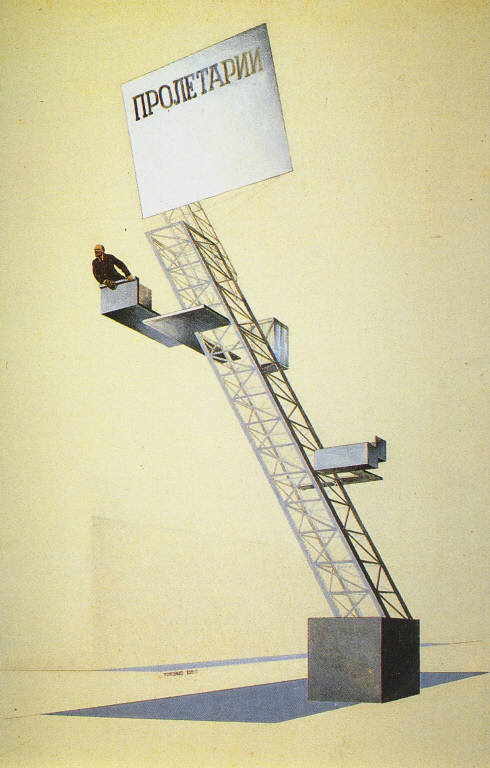
El Lissitzky, Lenin Tribune (1920)
El Lissitzky, Lenin Tribune (1920)

Chris Cutrone

Chris Cutrone is a college educator, writer, and media artist, committed to critical thinking and artistic practice and the politics of social emancipation. ( . . . )

Articles by month

Article dates

November 2026
S M T W T F S
1234567
891011121314
15161718192021
22232425262728
2930  

Hayek, Friedman and the question of freedom

(In part, a response to Naomi Klein)

Chris Cutrone

Prepared for presentation at the University of Chicago teach-in on “Who was Milton Friedman and what is his legacy?,” October 14, 2008.

A GOOD APPROACH to the topic of Milton Friedman and his legacy today can be made indirectly, by reference to Friedman’s intellectual predecessor and mentor, Friedrich Hayek.

It has been our point of departure in Platypus to regard the present as being conditioned by the undigested, and therefore problematic, legacies of at least two generations of failure on the “Left”: the 1960s–70s “New” Left, and the “Old” Left of the 1920s–30s. We have critiqued the assumptions inherited from the 1960s not least because of problematic legacies they contain undigested from the 1930s, which have not been properly thought through even today.

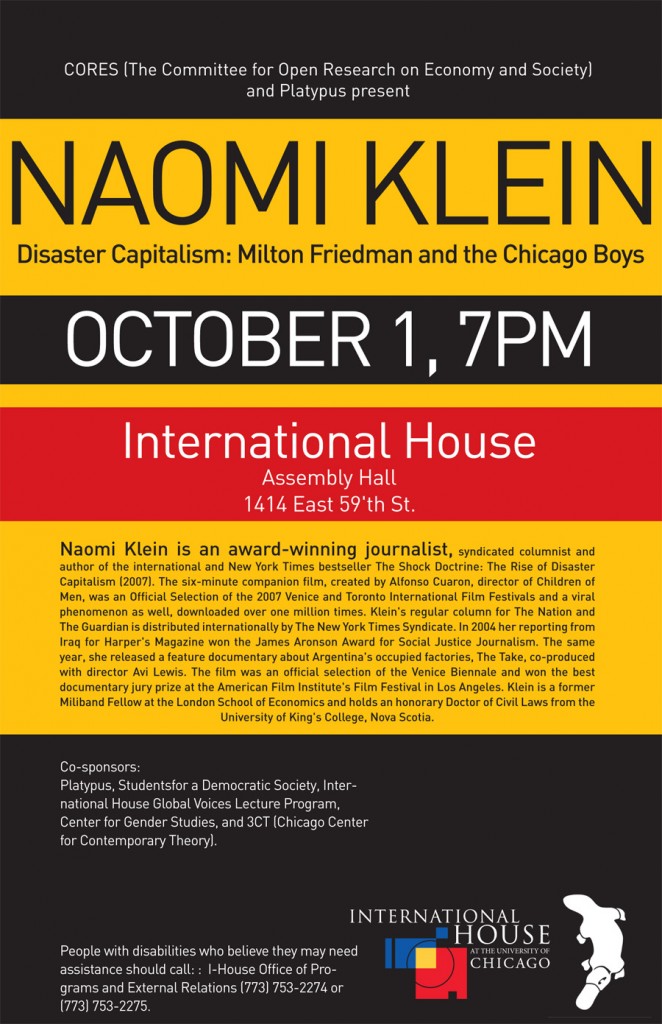
This is a good opportunity, then, to register our exception in Platypus to the politics of the perspective on Friedman and his legacy offered at the October 1 talk given by Naomi Klein, author of the 2007 anti-Friedmanite book The Shock Doctrine, which we co-sponsored at the University of Chicago.

Two statements made by Klein at her talk opposing the establishment of a Milton Friedman Institute at the University of Chicago can be used to frame a discussion of Friedman’s legacy in light of Hayek and the classical liberal tradition more generally.

We in Platypus had the opportunity at her talk to ask Klein two direct questions to which she gave answers that we find to be indicative of fundamental problems on the “Left” today.

One was on the question of freedom: whether and how Klein would respond to the neo-liberalism of Friedman and his followers as attempts to promote greater freedom. Klein responded by saying that she was suspicious and didn’t think there was any “need” for any “grand projects of human freedom,” and she emphasized instead their “danger.”

Klein’s critique of Friedman was that he was a “utopian ideologue,” and that any such ideology of utopian politics can have potentially disastrous effects “in the real world,” on whose behalf she offered to speak “as a journalist.” Klein analogized neo-liberalism to “Trotskyism” as a “purist” ideology that might seem good in theory but is bad in practice. Klein dealt with Friedman’s legacy as being about the “power of ideas,” which she said must be regarded as “dangerous.”

But in addressing Friedman and his legacy this way, Klein neglected what is perhaps the most important aspect of his thought, Friedman’s critique and opposition to what he called the “tyranny of the status quo,” something any purported “Left” should not regard too cynically. One of the principal but mistaken assumptions that the “Left” makes politically is to regard the emphasis on “individual” freedom to be characteristic of the Right, whereas the “Left” is supposed to be more collective and “social” in its focus, emphasizing the principle not of “individualism” but “solidarity” and common welfare.

This is a serious error. It neglects important aspects of the history of the Left, and thus gives a distorted view of history and of the present.

Left and Right cannot be distinguished properly along the axis of individual vs. collective rights and responsibilities, but rather must be understood in terms of how these are related socially. A Marxian approach attempts to be attentive to the desiderata of both individual and collective freedom, how capital is a problem in each of these aspects of modern society.

To help illustrate this point, the example can be raised of a recent bête noire of the media coverage of the current campaign for the U.S. Presidential election, Bill Ayers, the former ’60s radical and member of the Weather Underground, who has since become known for his more significant effort as a grade school reformer, an advocate of the “small schools” program in Chicago.

Milton Friedman was also a critic of the public school system in the United States, and Ayers and his colleagues have complained that their project of school reform has been “hijacked” by the Right, in the form of “school choice,” “charter schools,” and “vouchers.” But Ayers and others advocated, for example, the establishment of publicly funded schools for the separate education of black males to which parents could choose to send their children, in the interest of overcoming the supposedly inherent “racism” of the public school system. Whereas Friedman was coming from a libertarian perspective, Ayers has come from a racial-communitarian one. But their convergence is significant, as is their compatibility with actual processes of change underway in the recent period.

While Friedman and Ayers would not recognize their shared agenda in something like school reform, it in fact exists, although rationalized differently. What needs to be pointed out is how, unwittingly, Friedman’s discontent was thus part of the historical moment of the “New Left” (for instance, it finds consonance with Foucault’s critique of Fordist social rationalization and “discipline”), and, likewise, how Ayers has been just as much a part of the New Right!

This example demonstrates that it would be one-sided and false to imagine that the present situation is the simple result of the politics of either the Left or Right, as each would like to imagine, blaming the other for the problems of the present. Rather, the present needs to be understood as the shared result of what both the “Left” and the Right have had in common since the 1960s, discontent with the Keynesian-Fordist state. The forms such discontent has taken are collectively responsible for the world in which we live today, which needs to be understood not merely as neo-liberal, but also as post-Fordist.

The two dimensions of mid-20th century society need to be distinguished so that their relation can be properly evaluated and critiqued. For the Keynesian and Fordist aspects are different, however they may have come to be related in the practical social-politics of the mid-20th century. Keynesianism was an economics of growth; Fordism was a social politics geared to assure the national basis of that growth: Keynes was not the nationalist Ford was. To say that we live today in a “post-Fordist” society is to emphasize the legacy of Fordism and not to indicate that we have somehow gotten beyond it. The Fordist state is alive and well in key respects, even if Keynesian economics has not fared so well. The Friedmanite turn to neo-liberal economics has taken place in the context of the Fordist national state, even if aspects of this state have been transformed accordingly. We hardly live in the libertarian relation of state to society that Friedman wished from his attack on Keynesianism.

The specific relation of Keynesian economics and Fordist state politics that characterized the mid-20th century has become unraveled, and this change can allow us to perceive and disentangle the relation between the classical political liberalism of Friedrich Hayek and the neo-liberal economics of Milton Friedman. This retrospective appraisal can help us get a better critical grasp of problems of the present financial-economic crisis, as neo-liberal economic policies are passing into disfavor, and the name of John Maynard Keynes and the policies of the 1930s New Deal era are coming up for reconsideration.

Hayek and Keynes should not be opposed, but rather Hayek, as a classical liberal, was opposed to and warned of the dangers of the Fordist-national dimension of the emergent Keynesian-Fordist synthesis of social-politics and economics in the mid-20th century.

To illustrate this distinction, it should be pointed out that not only was Keynes a great admirer of Hayek’s critique of nationalist socialism in his 1944 book The Road to Serfdom, but Keynes had been an early critic and opponent of the nationalism informing the punitive terms of the post-WWI resolution of the 1919 Treaty of Versailles. Keynes, no less than Hayek, saw in the emergence of the national state a great threat to human freedom. Whatever their differences on economics, Hayek and Keynes shared an opposition to the reactionary, regressive character of contemporary “anti-capitalism” (fascism and Stalinism), and so defended capitalism, albeit differently.

Hayek’s critique of the “road to serfdom” and the potential unfreedom in early-20th century “socialism” was specifically in its nationalist character, to which he opposed the freedom of earlier liberal and cosmopolitan capitalism. Hayek’s critique of the inherent affinity of fascism and Nazism with Stalinist national socialism and their shared roots in problems of the character of pre-WWI ostensibly “Marxist” social democracy is profoundly insightful, and cannot be ignored by any purported Left that is concerned with the problem of freedom. A Marxian critique of such “Marxism,” that could satisfy these issues raised by Hayek and other classical liberals, was — and remains — necessary.

The problem of Milton Friedman’s legacy is that its liberalism is one-sided in its too readily identifying the state policies of Keynesian-economics with Fordist social politics and nationalism. The regressive character of the latter cannot be simply chalked up to the effects of the former without adopting an economistic framework that Hayek’s critique of Fordism, for instance, would not have sanctioned. This is why it is important to raise Hayek to help inform the question of Friedman and his legacy. For we should be able to address the intellectual tradition from which Friedman emerged as one concerned first and foremost with the problem of freedom, and not merely as a matter of the technocratic policy concerns of “economics,” as Naomi Klein does, comparing “theory” to “reality” at the level of efficacy. It is not a matter of whether either a Keynesian or Friedmanite economics “works,” but rather the nature and character of the problems of capitalism both seek to address. Apparently “economic” problems need to be properly situated politically in light of the question of freedom. Any critique of Friedman needs to address this dimension and not neglect it by reference to Friedman’s own opportunistic politics.

In the 1970s–80s, as the Keynesian-Fordist synthesis became undone, Friedman found that his ideas received a hearing and practical political opportunities on the Right. But it is wrong, or at the very least not very useful, to try to prosecute Friedman by reference, for instance, to Augusto Pinochet’s dictatorship in Chile. For it was not the case that Pinochet was Friedman’s creature but rather the opposite: Friedman allowed his critique of the Keynesian- Fordist synthesis to be abused politically by the Right, and thus served ends other than freedom. Any “Left” opposition to Friedman would position itself not against his critique of Keynesian Fordism per se (however partial and one-sided it was in its wholesale advocacy of “capitalism,” and tendency, as previously indicated, to collapse the distinction between Keynesian economics and the Fordist state) but rather against the degree to which Friedman in his political thought and action became a figure of the Right. The Fordist state was not “anti-capitalist” but was an expression of inherent problems in the history of capital that drop out of Friedman’s account.

Friedman was of the Right to the degree to which he opportunistically adapted himself to the very “status quo” against which he protested, becoming its apologist despite his avowed intentions. Friedman chose his battle, against Keynesian economics, and made his devil’s bargain compromise, with the power of the Fordist state, and we have paid the price for this politics. This is a real aspect of Friedman’s legacy, and deserves critique and opposition, and not least from the perspective of the tradition of classical liberalism from which Friedman drew his thinking but ultimately ended up betraying. As Naomi Klein correctly points out, the irony of Friedman and his legacy is that his anti-Keynesian economic policy advocacy depended upon the very power of the (Fordist, national) state against whose unfreedom he was ostensibly aiming his critique. But Klein and the “Left” she represents are also not free of such inconsistency from the standpoint of the struggle for greater freedom. They share the inability to regard properly the (post-) Fordist (national) state, for which Klein explicitly apologizes, especially when advocating its developing-world varieties, at least as much as Friedman did by default in his opportunism. But Hayek would have known better.

The second question we in Platypus posed to Klein at her talk was “What is to be done?” Initially, Klein had little to say in this regard. But later in the Q&A, she responded, in an intentionally “provocative” way, that one thing that could be done would be to “nationalize the oil industry.” Klein understands such a demand to be part of her greater advocacy of a “new New Deal,” an idea gaining traction in light of the present economic crisis and the expectations of change with the coming election.

But we need to be careful not to conflate the different dimensions of the historic Keynesian-Fordist state and its social-politics as well as its economic policies, for in doing so we would lose the distinction between its liberal and illiberal aspects, and thus lose the criterion of freedom. Hayek’s critique of the problems of the 1930s Left and its ostensibly “socialist” collusion with the emergent national-state form remains valid. For such “socialism” fell below the threshold of the freedom of capitalism as it had developed under preceding, more “liberal” historical conditions, prior to WWI, an important turning-point Hayek recognized. Hayek was harking back to earlier thinkers in the classical liberal tradition such as Benjamin Constant, who in the early 19th century saw in national-collectivist politics the betrayal of modern forms of both individual and social freedom.

For not only Friedman but his mentor Hayek would have blanched at Klein’s thought of universal oil nationalizations — from Hugo Chavez’s Venezuela and Ahmedinejad’s Iran to Putin’s Russia, and an Obama “new New Deal” America — and for good reason. As Friedman’s mentor Hayek perceived in the emergence of the Fordist national state after WWI, in both its relatively benign as well as grossly pathological forms, such a wave of nationalizations would lay the ground very well, and very quickly, for future wars and other forms of social destruction, at the expense of the freedom-potential a more liberal and cosmopolitan capitalism makes possible. | §

Originally published in The Platypus Review #8 (November 2008).

naomiklein-662x1024

Finance capital

Why financial capitalism is no more “fictitious” than any other kind

Chris Cutrone

The following was distributed as a flyer [PDF] at the occupation protests that began in September 2011.

WITH THE PRESENT FINANCIAL MELT-DOWN in the U.S. throwing the global economy into question, many on the “Left” are wondering again about the nature of capitalism. While many will be tempted to jump on the bandwagon of the “bailout” being floated by the Bush administration and the Congressional Democrats (including Obama), others will protest the “bailing out” of Wall Street.

The rhetoric of “Wall Street vs. Main Street,” between “hardworking America” and the “financial fat cats,” however, belies a more fundamental truth: the two are indissolubly linked and are in fact two sides of the same coin of capitalism.

It would be no less reactionary — that is, conservative of capitalism — to try to oppose “productive” industrial manufacturing or service sector capitalism to “parasitic” financial capitalism.

As Georg Lukács pointed out in his seminal essay “Reification and the Consciousness of the Proletariat” (1923), following Marx’s critique of “alienation” (in Das Kapital, 1867) (and echoing the at-the-time yet-to-be discovered writings by Marx such as the 1844 Economic and Philosophic Manuscripts and the Grundrisse, 1858), modern society structured by the dynamic domination of capital gives rise to “necessary forms of appearance” that are symptomatic of capital.

These reified “forms of appearance” include not only forms of “exchange” such as monetary and financial systems, but also, more fundamentally, forms of wage labor and concrete forms of production, which are just as much a part of capital’s reproduction as a social system as are any conventions of exchange.

This means that one cannot oppose one side of capital to another, one cannot side with “productive labor” against “parasitic capital” without being one-sided and falling into a trap of advocating and participating in the reproduction of capital at a deeper level. Lukács recognized, following Marx, that capital as not merely a form of “economics” but a social system of (re)production.

But most varieties of “Marxism” have missed this very crucial point, and so take Marx to mean rather the opposite, that industrial production embodies what is true and good about capital, while exchange and money represents what is false and bad about it. Such pseudo-”Marxism” has falsely (and conservatively) vilified the supposedly “fictitious” nature of “finance capital.”

Following Marx, Lukács, through his concept of “reification,” sought to deepen the critical recognition of the social-historical problem of capital, to recognize that modern society as structured and dominated by capital exhibits specific symptoms of this domination. Such symptoms are the attempts by human beings individually and collectively to master, control and adjudicate the effects of the social dynamism that capital sets in motion.

However, in Marx’s phrase (from the 1848 Manifesto of the Communist Party), the dynamic of capital ensures that “all that is solid melts into air.” The modern society of capital is one in which all concrete ways of life, social organization and production, are subject to revolutionization through a cycle of “creative destruction.” But Marx did not simply bemoan this dynamism of capital that ends up making transient all human endeavors, mocking their futility.

Rather, Marx recognized this dynamism as an “alienated” form of social freedom. The creative destruction engendered by capital is the way capital reproduces its social logic, but it also gives rise to transformations of concrete ways of social life the world has never before seen, engendering new possibilities for humanity — the past 200 years of capitalism have seen more, and more profound changes, globally, than previous millennia saw. Unfortunately, the reproduction of capital also means undermining such new human potentialities (for instance, new forms of gender and sexual relations) as soon as they are brought onto the ever-shifting horizon of possibility.

With the current financial collapse, the temptation will be to retreat to what many on the pseudo-”Left” have long advocated, a “new New Deal” of Keynesian Fordist and welfare-state social-security reforms. The temptation on the “Left” (as well as the Right) will be to see what some have called “saving capitalism from itself” as “progress.” But such attempts to master the dynamics of capital will not only fail to achieve their aims, but will also entail unexpected further consequences and problems no less potentially destructive for humanity than so-called “free-market” practices of capitalism.

If the neo-Keynesians as well as others, such as the more radical “socialists” on the “Left” are mistaken in their hopes for reformist solutions to the problems of capital, it is not least because they don’t recognize capitalism as a (alienated) form of (increasing the scope of) freedom. Rather, their nemeses among the “neo-liberals” such as Milton Friedman (in the 1962 book Capitalism and Freedom) and Friedrich Hayek (in his 1943 book The Road to Serfdom) have given expression to this liberal dimension of capital, which they opposed to what they took to be the worse authoritarianism of (nationalist) socialism.

Opposed to this have been thinkers such as Karl Polanyi (The Great Transformation, 1944) and John Kenneth Galbraith (The Affluent Society, 1958, which warned of the effects of private-sector capital outstripping the public sector). Polanyi, for instance, complained that capitalism commodified three things that supposedly cannot be commodities, labor, land and money itself. In such a one-sided opposition to capital, Polanyi neglected to realize that what makes modern society what it is, what distinguishes modern capitalism from earlier pre-modern forms of capital, is that it precisely entails subjecting these supposedly not “commodifiable” things to the commodity form. Modern capital is precisely about the radical revolutionizing of how we relate to forms of social intercourse, labor, and nature.

So no one should be fooled into thinking that supposedly better forms of politically managing (e.g., under the Democrats) the social investment in, and thus preserving the “value” and promoting the improvement of material production, infrastructure, or forms of knowledge represents any kind of sure “progress.” — No one should mistake for even a moment that such efforts will not be a windfall and lining the pockets of the capitalists (on “Main Street”) through upward income-redistribution schemes any less than “bailing out” Wall Street will be.

The presently bemoaned deregulation of financial institutions that occurred under Bill Clinton in the 1990s was not meant (merely) to enrich the rich further, but to open the way for new forms of economic and social relations, both locally and globally. Such “neo-liberal” reforms were meant to overcome, in Milton Friedman’s phrase, the “tyranny of the status quo” — a sentiment any emancipatory Left ought not to regard with excessive cynicism. For the neo-liberals found a hearing not only among the wealthy, but also among many left out of the prior Keynesian/Fordist arrangements — see, for instance, the 2006 Nobel Peace Prize winner Muhammad Yunus’s social activist work in “microfinance” in Bangladesh.

A Marxian approach to the problem of capital, as Lukács warned with his concept of “reification,” recognizes that “labor” and its forms of “production” are no less “reified” and “ideological” in their practices under capital, no less “unreal” and subject to de-realization, with destructive social consequences, than are the forms of “exchange,” monetization and finance.

An authentically Marxian Left should take no side in the present debates over the merits and pitfalls of the “bailout” of the financial system. One can and should critique this, of course, but nonetheless remain aware that this is no simple matter of opposing it. This side of revolutionary emancipation beyond capital, a Marxian politics would demand to better finance capital no less than to support labor. Finance capital is no less legitimate if also no less symptomatic of capital than any other phenomenon of modern life. So it deserves not to be vilified or denounced but understood as a way humanity has tried authentically to cope with the creative destruction of capital in modern social life. | §

Originally published in The Platypus Review #7 (October 2008).

Capital in history

The need for a Marxian philosophy of history of the Left

Chris Cutrone

Presented on a panel with Kevin Anderson, Peter Hudis, Andrew Kliman and Sandra Rein at the Marxist-Humanist Committee public forum on “The Crisis in Marxist Thought,” hosted by the Platypus Affiliated Society at the School of the Art Institute of Chicago, July 25, 2008.

I want to speak about the meaning of history for any purportedly Marxian Left.

We in Platypus focus on the history of the Left because we think that the narrative one tells about this history is in fact one’s theory of the present. Implicitly or explicitly, in one’s conception of the history of the Left, is an account of how the present came to be. By focusing on the history of the Left, or, by adopting a Left-centric view of history, we hypothesize that the most important determinations of the present are the result of what the Left has done or failed to do historically.

For the purposes of this talk, I will focus on the broadest possible framing for such questions and problems of capital in history, the broadest possible context within which I think one needs to understand the problems faced by the Left, specifically by a purportedly Marxian Left.

I will not, for example, be focusing so much on issues for Platypus in the history of the various phases and stages of capital itself, for instance our contention that the 1960s represented not any kind of advance, but a profound retrogression on the Left. I will not elucidate our account of how the present suffers from at least 3 generations of degeneration and regression on the Left: the first, in the 1930s, being tragic; the second in the 1960s being farcical; and the most recent, in the 1990s, being sterilizing.

But, suffice it to say, I will point out that, for Platypus, the recognition of regression and the attempt to understand its significance and causes is perhaps our most important point of departure. The topic of this talk is the most fundamental assumption informing our understanding of regression.

For purposes of brevity, I will not be citing explicitly, but I wish to indicate my indebtedness for the following treatment of a potential Marxian philosophy of history, beyond Marx and Engels themselves, and Rosa Luxemburg, Lenin and Trotsky, to Georg Lukács, Karl Korsch, Walter Benjamin, Theodor Adorno, and, last but not least, the Marx scholar Moishe Postone. And, moreover, I will be in dialogue, through these writers, with Hegel, who distinguished philosophical history as the story of the development of freedom. — For Hegel, history is only meaningful the degree to which it is the story of freedom.

Capital is completely unprecedented in the history of humanity, hence, any struggle for emancipation beyond capital is also completely unprecedented. While there is a connection between the unprecedented nature of the emergence of capital in history and the struggle to get beyond it, this connection can also be highly misleading, leading to a false symmetry between the transition into and within different periods of the transformations of modern capital, and a potential transition beyond capital. The revolt of the Third Estate, which initiated a still on-going and never-to-be-exhausted modern history of bourgeois-democratic revolutions, is both the ground for, and, from a Marxian perspective, the now potentially historically obsolescent social form of politics from which proletarian socialist politics seeks to depart, to get beyond.

Hegel, as a philosopher of the time of the last of the great bourgeois-democratic revolutions marking the emergence of modern capital, the Great French Revolution of 1789, was for this reason a theorist of the revolt of the Third Estate. Marx, who came later, after the beginning of the Industrial Revolution of the 19th century, faced problems Hegel did not.

It has often been stated, but not fully comprehended by Marxists that Marx recognized the historical mission of the class-conscious proletariat, to overcome capitalism and to thus do away with class society. Traditionally, this meant, however paradoxically, either the end of the pre-history or the beginning of the true history of humanity. — In a sense, this duality of the possibility of an end and a true beginning, was a response to a Right Hegelian notion of an end to history, what is assumed by apologists for capital as a best of all possible worlds.

Famously, in the Communist Manifesto, Marx and Engels stated that all history hitherto has been the history of class struggles; Engels added a clever footnote later that specified “all written history.” We might extrapolate from this that what Engels meant was the history of civilization; history as class struggle did not pertain, for instance, to human history or social life prior to the formation of classes, the time of the supposed “primitive communism.” Later, in 1942 (in “Reflections on Class Theory”), Adorno, following Benjamin (in the “Theses on the Philosophy of History,” 1940), wrote that such a conception by Marx and Engels of all of history as the history of class struggles was in fact a critique of all of history, a critique of history itself.

So in what way does the critique of history matter in the critique of capital? The problem with the commonplace view of capitalism as primarily a problem of exploitation is that it is in this dimension that capital fails to distinguish itself from other forms of civilization. What is new in capital is social domination, which must be distinguished both logically and historically, structurally and empirically, from exploitation, to which it is not reducible. Social domination means the domination of society by capital. This is what is new about capital in the history of civilization; prior forms of civilization knew overt domination of some social groups over others, but did not know as Marx recognized in capital a social dynamic to which all social groups — all aspects of society as a whole — are subject.

So we must first draw a demarcation approximately 10,000 years ago, with the origins of civilization and class society, when the great agricultural revolution of the Neolithic Age took place, and human beings went from being nomadic hunter-gatherers to becoming settled agriculturalists. The predominant mode of life for humanity went from the hunter-gatherer to the peasant, and was this for most of subsequent history.

Several hundred years ago, however, a similarly profound transformation began, in which the predominant mode of life has gone from agricultural peasant to urban worker: wage-earner, manufacturer, and industrial producer.

More proximally, with the Industrial Revolution in the late-18th to early-19th Centuries, certain aspects of this “bourgeois” epoch of civilization and society manifested themselves and threw this history of the emergence of modernity into a new light. Rather than an “end of history” as bourgeois thinkers up to that time had thought, modern social life entered into a severe crisis that fundamentally problematized the transition from peasant- to worker-based society.

With Marx in the 19th century came the realization that bourgeois society, along with all its categories of subjectivity including its valorization of labor, might itself be transitional, that the end-goal of humanity might not be found in the productive individual of bourgeois theory and practice, but that this society might point beyond itself, towards a potential qualitative transformation at least as profound as that which separated the peasant way of life from the urban “proletarian” one, indeed a transition more on the order of profundity of the Neolithic Revolution in agriculture that ended hunter-gatherer society 10,000 years ago, more profound than that which separated modern from traditional society.

At the same time that this modern, bourgeois society ratcheted into high gear by the late-18th century, it entered into crisis, and a new, unprecedented historical phenomenon was manifested in political life, the “Left.” — While earlier forms of politics certainly disputed values, this was not in terms of historical “progress,” which became the hallmark of the Left.

The Industrial Revolution of the early 19th century, the introduction of machine production, was accompanied by the optimistic and exhilarating socialist utopias suggested by these new developments, pointing to fantastical possibilities expressed in the imaginations of Fourier and Saint-Simon, among others.

Marx regarded the society of “bourgeois right” and “private property” as indeed already resting on the social constitution and mediation of labor, from which private property was derived, and asked the question of whether the trajectory of this society, from the revolt of the Third Estate and the manufacturing era in the 18th century to the Industrial Revolution of the 19th century, indicated the possibility of a further development.

In the midst of the dramatic social transformations of the 19th century in which, as Marx put it in the Manifesto, “all that was solid melted into air,” as early as 1843, Marx prognosed and faced the future virtual proletarianization of society, and asked whether and how humanity in proletarian form might liberate itself from this condition, whether and how, and with what necessity the proletariat would “transcend” and “abolish itself.” As early as the 1844 Manuscripts, Marx recognized that socialism (of Proudhon et al.) was itself symptomatic of capital: proletarian labor was constitutive of capital, and thus its politics was symptomatic of how the society conditioned by capital might reveal itself as transitional, as pointing beyond itself. — This was Marx’s most fundamental point of departure, that proletarianization was a substantial social problem and not merely relative to the bourgeoisie, and that the proletarianization of society was not the overcoming of capital but its fullest realization, and that this — the proletarianized society of capital — pointed beyond itself.

Thus, with Marx, a philosophy of the history of the Left was born. For Marx was not a socialist or communist so much as a thinker who tasked himself with understanding the meaning of the emergence of proletarian socialism in history. Marx was not simply the best or most consistent or radical socialist, but rather the most historically, and hence critically, self-aware. By “scientific” socialism, Marx understood himself to be elaborating a form of knowledge aware of its own conditions of possibility.

For a Hegelian and Marxian clarification of the specificity of the modern problem of social freedom, however, it becomes clear that the Left must define itself not sociologically, whether in terms of socioeconomic class or a principle of collectivism over individualism, etc., but rather as a matter of consciousness, specifically historical consciousness.

For, starting with Marx, it is consciousness of history and historical potential and possibilities, however apparently utopian or obscure, that distinguishes the Left from the Right, not the struggle against oppression — which the modern Right also claims. The Right does not represent the past but rather the foreclosing of possibilities in the present.

For this reason, it is important for us to recognize the potential and fact of regression that the possibilities for the Left in theory and practice have suffered as a result of the abandonment of historical consciousness in favor of the immediacies of struggles against oppression.

Marx’s critique of symptomatic socialism, from Proudhon, Lassalle, Bakunin, et al., to his own followers in the new German Social-Democratic Party and their program at Gotha (as well as in Engels’s subsequent critique of the Erfurt Programme), was aimed at maintaining the Marxian vision corresponding to the horizon of possibility of post-capitalist and post-proletarian society.

Unfortunately, beginning in Marx’s own lifetime, the form of politics he sought to inspire began to fall well below the threshold of this critically important consciousness of history. And the vast majority of this regression has taken place precisely in the name of “Marxism.” Throughout the history of Marxism, from the disputes with the anarchists in the 1st International Workingmen’s Association, and disputes in the 2nd Socialist International, to the subsequent splits in the Marxist workers’ movement with the Bolshevik-led Third, Communist International and Trotskyist Fourth International, a sometimes heroic but, in retrospect, overwhelmingly tragic struggle to preserve or recover something of the initial Marxian point of departure for modern proletarian socialism took place.

In the latter half of the 20th century, developments regressed so far behind the original Marxian self-consciousness that Marxism itself became an affirmative ideology of industrial society, and the threshold of post-capitalist society became obscured, finding expression only obtusely, in various recrudescent utopian ideologies, and, finally, in the most recent period, with the hegemony of “anarchist” ideologies and Romantic rejections of modernity.

But, beyond this crisis and passage into oblivion of a specifically Marxian approach, the “Left” itself, which emerged prior to Hegel and Marx’s attempts to philosophize its historical significance, has virtually disappeared. The present inability to distinguish conservative-reactionary from progressive-emancipatory responses to the problems of society conditioned by capital, is inseparable from the decline and disappearance of the social movement of proletarian socialism for which Marx had sought to provide a more adequate and provocative self-consciousness at the time of its emergence in the 19th century.

Paradoxically, as Lukács, following Luxemburg and Lenin, already pointed out, almost a century ago, while the apparent possibility of overcoming capital approaches in certain respects, in another sense it seems to retreat infinitely beyond the horizon of possibility. Can we follow Luxemburg’s early recognition of the opportunism that always threatens us, not as some kind of selling-out or falling from grace, but rather the manifestation of the very real fear that attends the dawning awareness of what grave risks are entailed in trying to fundamentally move the world beyond capital?

What’s worse — and, in the present, prior to any danger of “opportunism” — with the extreme coarsening if not utter disintegration of the ability to apprehend and transform capital through working-class politics, has come the coarsening of our ability to even recognize and apprehend, let alone adequately understand our social reality. We do not suffer simply from opportunism but from a rather more basic disorientation. Today we are faced with the problem not of changing the world but more fundamentally of understanding it.

On the other hand, approaching Marxian socialism, are we dealing with a “utopia?” — And, if so, what of this? What is the significance of our “utopian” sense of human potential beyond capital and proletarian labor? Is it a mere dream?

Marx began with utopian socialism and ended with the most influential if spectacularly failing modern political ideology, “scientific socialism.” At the same time, Marx gave us an acute and incisive critical framework for grasping the reasons why the last 200 years have been, by far, the most tumultuously transformative but also destructive epoch of human civilization, why this period has promised so much and yet disappointed so bitterly. The last 200 years have seen more, and more profound changes, than prior millennia have. Marx attempted to grasp the reasons for this. Others have failed to see the difference and have tried to re-assimilate modern history back into its antecedents (for instance, in postmodernist illusions of an endless medievalism: see Bruno Latour’s 1993 book We Have Never Been Modern).

What would it mean to treat the entire Marxian project as, first and foremost, a recognition of the history of modernity tout court as one of the pathology of transition, from the class society that emerged with the agricultural revolution 10,000 years ago and the civilizations based on an essentially peasant way of life, through the emergence of the commodity form of social mediation, to the present global civilization dominated by capital, towards a form of humanity that might lie beyond this?

With Marx we are faced with a self-consciousness of an obscure and mysterious historical task, which can only be further clarified theoretically through transformative practice — the practice of proletarian socialism. But this task has been abandoned in favor of what are essentially capital-reconstituting struggles, attempting to cope with the vicissitudes of the dynamics of modern history. But this re-assimilation of Marxism back into ideology characteristic of the revolt of the Third Estate means the loss of the true horizon of possibility that motivated Marx and gave his project meaning and urgency.

Can we follow Marx and the best historically revolutionary Marxists who followed him in recognizing the forms of discontent in the pathological society we inhabit as being themselves symptomatic of and bound up with the very problem against which they rage? Can we avoid the premature post-capitalism and bad, reactionary utopianism that attends the present death of the Left in theory in practice, and preserve and fulfill the tasks given to us by history? Can we recognize the breadth and depth of the problem we seek to overcome without retreating into wishful thinking and ideological gracing of the accomplished fact, and apologizing for impulses that only seem directed against it, at the expense of what might lie beyond the traps of the suffering of the present?

We urgently need an acute awareness of our historical epoch as well as of our fleeting moment now, within it. — We must ask what it is about the present moment that might make the possibility of recovering a Marxian social and political consciousness viable, and how we can advance it by way of recovering it.

For the pathology of our modern society mediated by capital, of the proletarian form of social life and its self-objectifications, the new forms of humanity it makes possible, which are completely unprecedented in history, grows only worse the longer delayed is taking the possible and necessary steps to the next levels of the struggle for freedom.

The pathology grows worse, not merely in terms of the various forms of the destruction of humanity, which are daunting, but also, perhaps more importantly — and disturbingly — in the manifest worsening social conditions and capacities for practical politics on the Left, and our worsening theoretical awareness of them. If there has been a crisis and evacuation of Marxian thought, it has been because its most fundamental context and point of departure, its awareness of its greater historical moment, the possibility of an epochal transition, has been forgotten, while we have not ceased to share this moment, but only lost sight of its necessities and possibilities. Any future emancipatory politics must regain such awareness of the transitional nature of capitalist modernity and of the reasons why we pay such a steep price for failing to recognize this. | §

Originally published in The Platypus Review #7 (October 2008).

Against Debord’s nihilism

Rejoinder to Principia Dialectica (U.K.)

Chris Cutrone

PRINCIPIA DIALECTICA HAS RESPONDED to our critique of their détournement of our “death of the Left” rhetoric with a noisy disclaimer.

But to hold up Guy Debord’s “Situationism” circa 1968 against two centuries of the critical theory and politics of Marx, Engels, Lenin, Luxemburg, Trotsky, Lukács, Korsch, Benjamin, Adorno, et al. — to say nothing of the contributions to enlightenment of Kant, Hegel, Nietzsche, Weber, Durkheim, Freud, et al. — requires either a great deal of gall, or is meant only in jest.

We suspect the latter, and so seek, at the very least, to prevent the misappropriation — really, abuse — of Moishe Postone’s work by such bad faith efforts as Principia Dialectica. — Otherwise:

The title of the Principia Dialectica rejoinder to Platypus cites Amy Winehouse’s 2006 song “Rehab,” which sounds like a 1960s-era pop song, another piquant, if immediately dated and musty British appropriation and slick commodification of American culture. But, although Winehouse sang that she wouldn’t “go to rehab, no, no, no,” as it turned out, later she did!

This story does in fact speak to the principal intention of Platypus, to learn from the past and prevent its pathological repetition: The understandable desire to escape the past in a manic fit of ecstatic optimism is tragic to the extent that it is unrealistic and lands one precisely where one has sworn never to return; it is farcical to the degree that this is repeated — over and over again.

Note to advocates of today’s already obsolete early 1990s-era rehabilitation of Situationism and other post-1960s politics of anarchism, autonomia, “post-work,” etc.: If you find yourself disagreeing with all or several of the most outstanding historical Marxist critical theorists and political actors listed above and/or the enlightened thought about modern humanity from the 17th–19th centuries from which the best Marxists drew and developed their insights, you can be sure that you are in denial and not on any road to recovery.

Whether you like it or not, and one way or another, you will find yourself “back to rehab” — in some form of political social democracy, liberalism, conservatism, or worse, or by being simply depoliticized and folded back into the rhythm of mainstream existence — or, in a dead-end of self-destruction, whether intoxicated or not. Debord’s suicide — motivated very differently from Benjamin’s, Debord being more pathetic than tragic — should stand as a warning to any and all of his wannabe followers.

For, going down this highway, you will sooner or later either render yourself entirely useless politically, or you’ll end up dropping the attempt at emancipatory politics altogether — as indeed Debord’s Situationism had done already from the very beginning.

Platypus, by contrast, seeks to foster recognition by a new generation of thinkers and actors that there might be a point to developing and instrumentalizing ourselves for the possibility of human enlightenment and emancipation, and not complacently wasting ourselves away in a narcissistic narcosis of self-dosing on the gaiety of futility.

Note to young contrarian “rebels:” The “system” is going to consume you one way or another, no matter what you do, so it might as well be in ways that push the envelope of possibility and move oneself and others as far in the directions of human betterment and development of further potential as possible.

What Principia Dialectica says about class struggle, “proletarian” empowerment and capital is of course true: this is all immanent to and perpetuating of the “system.” Where Principia Dialectica, as all anarchism, goes wrong (but perhaps instructively) is in their Romantic nihilism. But the system is our reality — in and through it is the only direction in which our hope might lie.

The world doesn’t need any more Hölderlins; as Hegel said, the “unhappy consciousness” is regressive, falls below the threshold with which it is tasked, and so cannot fulfill itself, but must overcome itself.

Debord’s notes on cocktail napkins can’t help us do that. | §

Coda

Anselm Jappe of the Krisis-Gruppe, in his 1993 book Guy Debord cites Debord’s affinity with Lukács with the following quotation, “The only possible basis for understanding this world is to oppose it; and such opposition will be neither genuine nor realistic unless it contests the totality” [also in Jappe’s pamphlet on Guy Debord’s concept of the spectacle, Chapter 1 of his book]. Principia Dialectica also turns to Jappe for the concept of capital as the “automaton” or “automatic subject” (in Jappe’s book Adventures of the Commodity: for a new critique of value, 2003/05). The question, however, is not one of affirming vs. opposing the social “totality” and the proletariat as being already the “subject-object of history,” but rather transforming the alienated totality of domination in an emancipatory manner, and the possibility of the working class becoming an actual subject of social emancipation in the process of overcoming capital: Lukács was not positing something but politically advocating it, and we need to understand why. According to Hegel, one becomes a subject only in the process of self-overcoming and transformation. This side of such an emancipatory process, the proletariat remains an “object” of the “automatic subject” of capital, which is an expression of the industrial working class’s alienated social agency in value production. What is missing from Principia Dialectica is precisely the sense of history — for instance, why Lukács’s book was titled History and Class Consciousness. The question is not what kind of subject the proletariat is, but what it could be — in the activity of its self-abolition, in, through and beyond capital, on the basis of labor as a socially mediating activity that becomes a form of self-domination under capital, its alienated product. But Lukács recognized such revolutionary socialist politics as the “completion” of “reification,” and so that this is not the end goal of emancipation but rather a necessary stage for the possible overcoming of capital. That, in the USSR, etc. and in Stalinist and social democratic and other nationalist-reformist working class politics in the 20th century, the proletariat participated in the reconstitution of capital and not in its revolutionary overcoming, was the result of the failure of the 1917–19 anticapitalist revolution, not its cause — or the original animus of the Marxism of Lenin, Luxemburg and Trotsky. Debord’s Situationism is just as much an adaptation to this failure as any other form of the “politics” of post-Marxism in the 20th century. Debord and his followers went along with the lie that Lenin led to Stalin, with all the confusion this entailed. The goal is indeed the overcoming of proletarian labor — the society of work — as mediating and thus dominating modern human history. The question is, how? | §

“Let the dead bury the dead!”

A response to Principia Dialectica (U.K.) on May 1968

Chris Cutrone

THE NEW MAYDAY MAGAZINE (U.K.) and Platypus have been in dialogue on the issues of anarchism and Marxism and the state of the “Left” today in light of history. (Please see “Organization, political action, history and consciousness” by Chris Cutrone for Platypus, and “Half-time Team Talk” by Trevor Bark for Mayday, in issues #2, February 2008, and #4, April–May 2008, respectively.)

Principia Dialectica, another new British journal, also has taken note of Platypus (see “Weird gonzo leftoid journal,” April 15, 2008), specifically with our interview of Moishe Postone on “Marx after Marxism” (in issue #3, March 2008).

In their note of us, Principia Dialectica cites our interview with Postone to say that “Postone’s reflections on Lukács are certainly bracing, and enough to challenge any cryogenically frozen leftoid stuck in 1917.” Platypus raises the Bolshevik Revolution of 1917, which Lukács regarded as follows:

Only the Russian Revolution really opened a window to the future; the fall of Czarism brought a glimpse of it, and with the collapse of capitalism it appeared in full view. At the time our knowledge of the facts and the principles underlying them was of the slightest and very unreliable. Despite this we saw — at last! at last! — a way for mankind to escape from war and capitalism.” (1967 Preface to History and Class Consciousness)

But Platypus raises Bolshevism and its historical moment less as a rallying cry than as a question and problem. 1917 should be followed not by an exclamation point but a question mark, but one that has not lost its saliency but only become a more profound enigma in subsequent history. What was to Lukács and others of the time a brief glimpse of emancipatory potential has only become more obscure, but without becoming any less penetrating.

— But today the danger is not being frozen in 1917 but rather 1968.

Principia Dialectica distributed the leaflet “Let the dead bury the dead!” at the May ’68 Jamboree at Conway Hall in London on May 10, 2008. This leaflet uses a great deal of Platypus rhetoric, on the “fossilized” and undead character of today’s “Left,” on anarchism being an enduring “bad conscience” of the failures of Marxism, etc., and involves not only this plagiarism but an unacknowledged response to our statements on the necessary return to the history of the revolutionary Marxist tradition. At the same time, this leaflet rehearses precisely those aspects of a non-/anti-Marxian and/or “anarchist” approach we have addressed previously in our articles in dialogue with Mayday.

The problem with this Principia Dialectica statement is that it has no cognizance of the issue of historical regression. Necessarily, this involves a non-dialectical and non-immanent understanding of capitalism as a “system,” resulting in an insistence on an (historically impossible) “outside” of capitalism. — Regarding the announcement appended below their leaflet, for a meeting on “What is value, and how to destroy it?,” the point, following Marx, is not to “destroy” (the social) “value” (of capital and proletarian labor), but rather to realize and overcome it on its own basis, and so would mean redeeming the very great sacrifices humanity has already made — and continues to make — in the history of capitalism.

Corollary to the one-sided view of and opposition to “value” (and what it means socially) is an unjustified yet assumed progressive view of history. This is unwarranted especially in light of the state of the “Left” today, 40 years after 1968, which has not shown any progress. — Otherwise, why call the “Leftist” commemoration of 1968 that Principia Dialectica picketed with its leaflet, a “wake” conducted by “embalmed” “mummies?” But, like all anarchism, Principia Dialectica has no (need for a) theory of history (of capital).

An incoherent view of capitalism and its recent history both underlies and results from the leaflet’s ambivalent salute and adieu to 1968. As Moishe Postone has pointed out (in his 2006 article on “Theorizing the Contemporary World: Brenner, Arrighi, Harvey”), the combined and equally inappropriate triumphalism and melancholy of post-1968 politics results from the undigested character of the Marxist tradition from which the 1960s “New” Left sought to depart:

[T]he emancipatory potential of general social coordination [i.e., Marxist “planning”] . . . should [not] be dismissed. But that potential can only be realized when it is associated with the historical overcoming of capital, the core of our form of social life. . . . Without such an analysis of capital, however, one that is not restricted to the mode of distribution, but that can, nevertheless, address the emancipatory impulses expressed by traditional Marxism . . . our conceptions of emancipation will continue to oscillate between a homogenizing general (whether effected via the market or the state) and particularism, an oscillation that replicates the dualistic forms of commodity and capital themselves.

As such, the Principia Dialectica leaflet commemorating 1968 is a symptom of what Postone calls the post-1960s postmodernist politics of “premature post-capitalism,” which imagines that the necessity for proletarian labor in mediating the conditions of modern social life and its potential emancipatory transformation has already been overcome in practice, however ripe its overcoming has been historically in theory.

As Lars Lih has pointed out (in his essay “Lenin and the Great Awakening,” in the conference anthology Lenin Reloaded, 2007), the reconsideration of history for an anticapitalist politics adequate to our time would mean indeed redeeming and realizing what Principia Dialectica disdainfully calls “proletarian Messianism.” — Precisely Walter Benjamin’s understanding of the historical significance of such “Messianism,” and its negative philosophy of history in the period of defeat and regression on the Left after 1917–19, provides the necessary guiding insight for such redemption. As Theodor W. Adorno interpreted Benjamin, “The only philosophy which can be responsibly practiced in face of despair is the attempt to contemplate all [historical] things as they would present themselves from the standpoint of [their potential] redemption” (“Finale,” Minima Moralia, 1944–47).

Rather than attempts at redeeming the modern (and still on-going) history of the industrial proletariat, and realizing and fulfilling — and going beyond — this necessity of what Marx called proletarian self-transcendence/self-abolition (Aufhebung), however, the “Left” has (ever since 1917–19, but especially after 1968) regressed behind this task. This is why the revolutionary Marxism of 2nd International radicalism of Lenin, Luxemburg, Trotsky, et al. — as well as the thought and politics of Marx himself — can still “flash up” as a historical image that haunts us and won’t go away, despite all efforts at exorcism by varieties of “post-Marxism.”

The very problematic history of the Marxist revolutionary “tradition” — as well as of the modern workers movement — requires redemption. And this is not simply desirable or possible, but actually unavoidably necessary.

Historical “anarchism” and its various offspring (e.g., Situationism) remain the deserved forms of the “bad conscience” of the failures of historical (“traditional”) Marxism, but anarchism is nevertheless a symptomatic regression to pre-Marxian socialism (of Proudhon et al.).

Marxism was not a mistaken detour because it failed historically. Rather, the continued recrudescence of anarchism proves in a certain sense that a reconstitution of the Marxian point of departure remains necessary. A revisiting — and “repetition” — of the Marxian critique of (pre-Marxian as well as post-Marx-ist) socialism is in order. — As Adorno put it (in “Resignation,” 1969), the return of anarchism “is that of a ghost,” which however “does not invalidate the [Marxian] critique” of it.

For Adorno, anarchism manifested “the impatience with theory.” Ironically, such impatience with theory is corollary to the dismissal of the industrial proletariat as “Subject” of human emancipation (through its self-transformation and overcoming). This dismissal is seen in the Principia Dialectica celebration of the “happy unemployed” and the calls to “never work ever” and thus (try to) remain “outside” the “system.” But as the historical Marxian critique of “actually existing socialism” — and the history of capitalism to date — has shown, there is no secure let alone emancipated state outside of capitalism that has been possible. Capitalism will be overcome from within (its own historical logic), or not at all.

As Adorno put it (in “Imaginative Excesses,” orphaned from Minima Moralia), “Only if the extremes [of the theoretically armed revolutionary intellectuals, and the industrial working class] come together will humanity survive.” — Platypus is noted — and attacked — for being on the one hand too intellectual and on the other hand too committed to a proletarian path to social emancipation beyond capital. Thus our indication of this dual necessity of theory and practice finds its critical affirmation — even when our project remains unacknowledged rather than singled out by our interlocutors.

The history of the failed Marxian attempted departures from symptomatic socialism (from Marx’s departure from Proudhon, to Lenin, Luxemburg, Trotsky and Lukács’s departure from the politics of 2nd International Social Democracy and its “vulgar Marxism,” to Trotsky and the Frankfurt School’s departures from Stalinized 3rd International Communism) still tasks us, but not as ritual invocation devoid of the actual content of historical self-understanding, but only as this history allows for its critical apprehension — in the critique of the present and how we got here. | §

Originally published in The Platypus Review #5 (May–July 2008).

Exchange on “race”

Aay Preston-Myint and Chris Cutrone

Dear Editors,

I would like to respond to Chris Cutrone’s article, “Review: Angela Davis, ‘How does change happen?’” from the March 2008 issue #3. I agree with Cutrone’s general sentiment that we as a country have failed to productively engage the problem of race, and that an honest critique of capitalism is pretty much absent from American politics. However, one does not necessarily follow the other. I disagree that a discussion of capitalism must necessarily displace a discussion of race, a term which Cutrone disrespectfully frames in quotation marks and describes as a “distraction” and “inadequate category.” I appreciate that perhaps therein lies a desire to transcend racism, but the tone of the article make it seem as if Cutrone wants the rest of us to somehow just wake up and get over race so we can talk about the “real” meat of the issue, capitalism. I do agree that the language of race is often counterproductive, complicated by centuries of taboos, underlying resentments, outward hostility, and fear. However, to further marginalize an already difficult subject strikes me as counterproductive, and quite frankly, a bit lazy.

Cutrone mentions in his article that (non-white) race is often just code for poverty, but is it not the other way around as well? When politicians talk about pursuing criminals in the “inner city” and cutting off “welfare mothers,” are they not pandering to fear and resentment towards people of color, and the assumption that non-whites are in poverty? It is certainly true that not all low-income people are brown, but in a nation (and even a world) where so many of our citizens face poverty because they are brown, any useful critique of capitalism must also incorporate discourse on race. I believe that a lack of such discourse is why people of color often balk at the thought of organizing around race-ambivalent or race-neutral philosophies such as Marxism or Anarchism versus organizing around racial identity, even when they have anti-capitalist beliefs.

We must remember that many of the canonical Marxist philosophers were white and were products of much more racially homogeneous societies than ours, and as such, held significant privilege not to think about race if they didn’t want to. Is it possible that they could not have foreseen how concepts of race and class would affect one another other in a country founded by waves of immigrants from around the world, many of whom were (and continue to be) used as disposable labor?

One can argue to an extent that race is a construct. Furthermore, it is a construct that, within a capitalist context, is often employed to justify class-based oppression, exploitation of labor, and imperialism. But however constructed we may believe race to be, it would be disingenuous, and even irresponsible, to pretend that it is not worth discussing. If I walk down the street and get beaten up by a gang of, say, working-class white kids because I am brown, it is just that — I have not been “beaten up” because I am “brown,” and I certainly haven’t been beaten up for being poor.

The anger, resentment and violence brought about by the victims and perpetrators of racism is real, and to that effect we all must do real work to eradicate it, not just hope that it will be spirited away by sprinkling some scare quotes around the issue. The problem of race affects us deeply on a subconscious level, and it is going to be hard to unlearn. Activists in positions of power and privilege must allow people of color the space to define race and racism on their terms, while educating themselves on why and how organizing tactics and philosophies that neglect race (and other facets of identity) so often fail to build successful coalitions. Those affected by racism must also realize that while organizing around racial identity can be a useful tool, we must also act across lines of gender, sexuality, nationality, and class. We need to be open to radical and critical philosophy, especially with regards to analyzing capitalism’s role in our struggle. We must remember not to confuse our aspirations for equality and justice with an amassing of individual power, prestige or wealth — or we will once again be forced look back in a few generations and realize that our achievements are “not the victory for which we have struggled.”

— Aay Preston-Myint, Chicago, IL, April 17, 2008


Chris Cutrone responds:

Analysis

Black people are not poor because they are black — any more than white people are poor because they are white. Poverty and resulting social disempowerment of black people have been rationalized on the basis of anti-black racist assumptions, and poverty among black people has been successfully isolated — “ghettoized” — and so defused as a social-political issue. Welfare programs were eliminated, while most recipients were white, by reference to the idea that society had tried to help poor people for a generation but to no avail, they just cannot be helped, but must be left to sink or swim on their own. Racism played a role in sanctioning such atrocity, but this does not mean that black poverty is caused by racism. Poverty is a structural problem of American society that will not be overcome short of overcoming capitalism. As long as this structural poverty exists without an adequate anticapitalist politics to combat it, racism will take the place of the proper recognition of the social nature of the problem, and thus prevent the politics necessary to overcome it.

History and politics

Those thinkers and actors in a certain anticapitalist critical-theoretical and revolutionary political tradition, Marx, Engels, Lenin, Luxemburg, Trotsky, Lukacs, Benjamin, Adorno et al., did not emerge out of a hyper-racialized social context like the U.S. The depth and meaning of anti-black racism in the U.S. is peculiar to its history; it is not a matter of ethnocentrism, national oppression, or any other form of cultural chauvinism, etc. Despite (or perhaps because) Marx did not share the concrete social context of such a racist society as the U.S., he recognized very clearly the stakes of the American Civil War against slavery that “Labor cannot emancipate itself in the white skin where in the black it is branded” (Capital, 1867), a formulation that remains unsurpassed. Black Americans are American, as American as any “white” American could possibly claim to be. At the same time, the history of anti-black racist oppression is inseparable from the development of capitalism. And, historically, socialism has been the most consistently anti-racist form of politics.

It was not any supposed lack of awareness or insensitivity to the issue of racism that caused black radicals of the “Old” Left in the 1920s–30s such as Claude McKay and Paul Robeson, inspired to Communist politics by the 1917 Bolshevik Revolution, to have failed to articulate a “black” power ethos or practical political principle, but because this would have cut against the grain of their actual progressive-emancipatory politics. These figures were not lacking in black “pride” or political militancy, but they were part of the truly heroic (and truly tragic) history of radicalism of the early 20th Century that now lies obscured behind the more recent history of the 1960s and the aftermath of its failures (which were more farcical than tragic). As Davis pointed out in her Jan. 24 lecture I reviewed, the real historical background and basis for the Civil Rights movement of the 1950s–60s was the earlier “cross-racial” organizing of workers, in the South — where it meant risking one’s life, white or black — as well as in the North, in the 1920s–30s, when it was actually much more difficult to do this than it would have been in the 1960s, but which the “Left” of the ’60s failed to even try to do, rationalizing their failure with separatist Black Power ideology.

The late-’60s Black Power turn was the result of the failures and frustrations of the limitations of the liberal integrationist politics of Martin Luther King, Jr., A. Philip Randolph, Bayard Rustin, et al. But this was not because King et al. were somehow lacking in “black” consciousness — as was scurrilously implied by Malcolm X with his famous “house nigger”-”field nigger” rhetoric — but because the practical politics of liberal-reformist integrationism could not address adequately the issue of capitalism, though King et al. were concerned with labor issues (the 1963 March on Washington was “for jobs and freedom”). Coming as we do today after the manifest inadequacies and failures of the policy reforms of the Civil Rights era, we can fall victim to naturalizing the logic of the Black Power turn of the late ’60s and think of it and the attitudes we inherit from it as some kind of necessary stage. But this would be a mistake, and not only because the Black Power turn was not a turn to the Left, but rather to the Right — the Black Power turn was a conservative recoil, an adaptation to defeat and dashed expectations, a lowering of horizons that involved the unwarranted assumption of the intractability of white racism — a sin much worse on the part of the “white” radicals who embraced this perspective than perhaps for the black radicals who articulated it.

More importantly, we can and must say today, more than 40 years later, that post-Black Power politics has obviously failed — and much more miserably than the Civil Rights Movement — to improve the social conditions for black people in the U.S. — as Adolph Reed, who I cited in my review of Davis, for one, has written about extensively, for instance in “Black Particularity Reconsidered” (AKA “The ‘Black Revolution’ and the Reconstitution of Domination,” 1979/86), pointing out the highly detrimental effects of “posing as politics.” — But whereas earlier black radicals of the 1920s–30s moved on from the charlatanry of Marcus Garvey et al. to the liberal, radical and socialist politics of W. E. B. Du Bois et al., the “politics” informed by the ’60s–’70s “New Left” regressed backwards along the same path, to Ron Karenga inventing holidays like Kwanzaa, etc., by the 1980s even rehabilitating Booker T. Washington’s avowedly conservative notions of “self-help” and waxing nostalgic for the “black community” of the segregated conditions of the Jim Crow era (see Henry Louis Gates, Jr., et al.), and affirming “black culture” as already constituting a valid political realm of “everyday acts of resistance” (see Robin D. G. Kelley et al.) — all the results of political failures on the “Left.” As Bayard Rustin pointed out at the advent of the Black Power turn, “Passionate self-assertion can be a mask for accommodation” (quoted in John D’Emilio, Lost Prophet: the life and times of Bayard Rustin, Free Press, 2003, p. 475).

So this is not a matter of whether one chooses to prioritize “race” over “class,” etc., but rather how one understands the problem of racism and how capitalism is understood as a context within which changes in social problems like racism (becoming better or worse) take place. Capitalism is a global social system that determines the value and employment of human activity (or “labor”) and its reproduction in ways over which people have remained relatively powerless as individual and social agents. Capitalism is the reason why there is such a thing as “disposable” labor, why human beings as potential laborers are subject to being “disposed of,” and all the social consequences of this. So both social categories of “race” and socioeconomic “class” find their conditions of greater social context in the dynamics and historical changes of capital. (This is also true of issues of gender and sexuality. See the potentially seminal but largely neglected essays by Juliet Mitchell, “Women: the Longest Revolution,” 1966; and John D’Emilio, “Capitalism and Gay Identity,” 1973.)

Not simply “race” and “class,” but racism and capitalism and how they are related need to be addressed by any purportedly social emancipatory politics. The ways the “Left” has tried — or failed to try, and found excuse from trying — to address the problems of racism (as one would need to do in organizing the working class) since the 1960s have been worse than inadequate, and have turned into ideological distractions and political dead ends, bogged down in a host of pseudo-problems (that, for instance, Barack Obama was able to identify in his speech — against the desperate last gasp of racist politics by the Clintons et al.), whereas, according to Rustin’s critique of the Black Power turn, “the real cause of racial injustice . . . is not bad attitudes but bad social conditions” (“The Failure of Black Separatism,” Harper’s Magazine, January, 1970). Without a practical political focus on capitalism, the social conditions for racism will remain unaddressed, and racism and the problems affecting black people and others can continue.

Ideology

“Race” is a pseudo-biological category that deserves to be placed in quotation marks because it is not “real;” it is not to be naturalized and taken for granted as a point of departure, but rather needs to be attacked as the very thing to be overcome. An anti-racist politics, a politics opposed to any form of racism, cannot just assume “race” from the start without becoming confused and confounded.

Black “racial” identity is a negative not a positive value and cannot be rehabilitated or inverted for it has only ever meant degradation. We ought not to forget that anti-black racist sentiment — the disqualification of individuals rationalized by reference to their blackness — is just as prevalent among blacks as among whites and other groups in the U.S.

As Frantz Fanon put it very succinctly over 50 years ago, in Black Skin, White Masks (1952), “What is often called the black soul is a white man’s artifact,” “For the black man there is only one destiny. And it is white,” and “The Negro is not. Any more than the white man.” We ought not to forget this.

Because we all share a social destiny in capitalism, one which we must work through and overcome in order to undermine the social conditions of possibility for racism (which are modern in nature), as Fanon also said, perhaps most outrageously, “Long ago the black man admitted the unarguable superiority of the white man, and all his efforts are aimed at achieving a white existence.” — I strongly encourage all those interested in the possibility of overcoming racist oppression to read closely and ponder and internalize deeply the theses in the Introduction and Conclusion of Fanon’s brilliant and profound book.

“Sickness and madness”

The world might not have been very ready to overcome capitalism up to now, but it has been more than ready to overcome racism, and so there’s no reason to resign ourselves to it or treat it as more of an obstacle than it need be. The persistence of racism — including the accommodation of it on the “Left” — is the surest sign of the barbarism of our times. And so “racial” consciousness can be nothing other than debilitating and fundamentally depoliticizing. As the late Malcolm X characterized his regrets about his participation in the black nationalist Nation of Islam,

[I] remember the time [when a] white college girl came into the restaurant who wanted to help the [Black] Muslims and the whites get together and I told her there wasn’t a ghost of a chance and she went away crying. . . . Well, I’ve lived to regret that incident. In many parts of the African continent I saw white students helping Black people. Something like this kills a lot of argument. I did many things as a [Black] Muslim that I’m sorry for now. I was a zombie then — like all [Black] Muslims — I was hypnotized, pointed in a certain direction and told to march. Well, I guess a man’s entitled to make a fool of himself if he’s ready to pay the cost. It cost me twelve years. That was a bad scene, brother. The sickness and madness of those days — I’m glad to be free of them. (Interview with Gordon Parks, 1965)

It’s incumbent upon us on the “Left” to try to root out and eliminate such “sickness and madness” as completely as possible, for it is nothing other than an obstacle to social emancipation or even the possibility of reform.

As the psychoanalyst Fanon pointed out, such “race” consciousness is an expression of wounded narcissism, a traumatic fixation on the past, and resulting paranoia, problematic for a healthy reality principle, and maintaining the past in the present at the expense of the future.

Identifying one’s political consciousness and practice as racially “black” — or “white” — is, as Fanon put it, citing the German Idealist philosophical tradition, an evasion and abdication of working through the “pathology of freedom,” work that must be based on the “refusal to accept the present as definitive.” | §

Originally published in The Platypus Review #5 (May–July 2008).

Review: Angela Davis

How does change happen?

Chris Cutrone

ON THE FRIGID WINTER EVENING of Thursday, January 24, Angela Davis, a former Communist Party activist associated in the 1960s–70s with the Student Nonviolent Coordinating Committee (SNCC) and the Black Panther Party, and current Professor in the History of Consciousness program at the University of California at Santa Cruz, gave the annual George E. Kent lecture (in honor of the first black American tenured professor) at the University of Chicago Rockefeller Chapel, to an overflow audience from the campus and surrounding community. The title of Davis’s talk was “How Does Change Happen?,” and, with the looming February 5 Super Tuesday primary elections to determine Democratic Party candidacy for President of the United States, Davis took as her point of departure the current contest between the first effective candidacies by a woman and a black American, Hillary Clinton and Barack Obama. Davis also noted, with wry irony, that the current Republican presidency of George W. Bush is by far the most “diverse” administration in U.S. history.

But Davis stated that such apparent present overcoming of historical social limitations of race and gender was “not the victory for which we have struggled.” This observation of the disparity between social-political struggles and their outcomes formed a central, strong theme of Davis’s talk. Davis elaborated this further through discussion of how “collective demands are transformed into individual benefits.” In Davis’s estimation, individual women and black and Latino Americans such as Clinton, Obama, Attorney General Alberto Gonzales, Secretary of State Condoleezza Rice, and Supreme Court Justices Sandra Day O’Connor and Clarence Thomas and others have benefited from historically more collective struggles against racial and ethnic discrimination and restrictive gender roles, without greater social justice or equality or collective empowerment being achieved.

Thus Davis came to discuss the question that she said has been presented to her on many occasions by her students of whether the struggles of the 1960s had been “in vain.” While Davis acknowledged that it could certainly appear to be so, she said that she did not wish to “believe” that this was indeed the case. So Davis raised the question of in what ways the 1960s New Left had succeeded, and how it had failed to achieve its goals.

In addressing such issues, Davis placed the Civil Rights movement of the 1950s–60s in greater historical context, pointing to the “cross-racial” struggles of the preceding 1920s–30s Left, for example the organizing of sharecroppers in Alabama by the Communist Party, which Davis said had laid the groundwork for the subsequent Civil Rights movement. This was the strongest point in Davis’s talk. However, perhaps the weakest point came when Davis tried to show such continuity of background in her further historical narrative, after the 1960s, in which she contended that the Black Panther Party’s free breakfast community programs for black schoolchildren had led to the implementation of U.S. federal government Head Start programs. Similarly, Davis’s defense of affirmative action programs since the 1960s did not serve her intention of showing how demands for structural change and collective empowerment had been diverted into more depoliticized individual benefits, for affirmative action had never been an anti-poverty measure and had always been geared specifically to meet “middle class” demands against institutional discrimination.

This contrast in Davis’s characterization of different historical moments of movements against anti-black racism in America, in the 1920s–30s and the 1960s–70s, up to the present, posed the issue of how adequately socialpolitical struggles for improving the social conditions of black Americans and reforming American society can be understood as having been against “racism”—though of course such struggles involved confronting legal segregation and other historical forms of institutionalized racism. In her talk, Davis used the category of “race” unproblematically to reference an irreducible reality of “difference” that she took everyone to already recognize. Davis oscillated between conflicting prognoses of the present, whether anti-black racism has been ameliorated or worsened since the 1960s. The category of “race” works ambivalently in discussing two obvious changes since the 1960s: that legal and institutional racism as well as common racist attitudes have been overcome or diminished while social conditions for most black Americans have worsened. But this only begs the question, which should be at the core of trying to think about how political and social change can and does happen, of the very adequacy or lack of such categories as “race” and “racism” to address the problems facing black Americans and their greater social context today.

In the context of the global economic downturn since 1973, in which the average per capita purchasing power of American workers to meet their needs has decreased by as much as 30 percent while incomes have been massively distributed upwards to a small elite, the possibilities for the simultaneous if paradoxical outcome of overcoming legal and institutional racism while conditions for most black Americans have worsened, could be understood better in terms of changes in capitalism that have involved satisfying, even if in limited ways, historical demands for change in American society such as an end to “racial” (and gender) discrimination. In America, black “race” has coded for poverty and hence realities of socioeconomic “class,” and anti-black racism has functioned to rationalize or at least naturalize poverty in the U.S., masking fundamental structural problems of American society, but this might function differently today than in the past, especially in light of the much-deplored separation of the concerns of the black “middle class” from the greater lot of black Americans since the 1960s. In her talk, Davis missed an opportunity to challenge and educate her audience in favor of calibrating her comments to what she seemed to perceive to be her audience’s conceptions of social-political problems. But such conceptions are in fact the effects of ideas like Davis’s that bear the undigested legacy of failed politics on the Left since the 1960s. As Adolph Reed pointed out in an article on the Hurricane Katrina disaster, “The Real Divide” (The Progressive, November, 2005), “As a political strategy, exposing racism is wrongheaded and at best an utter waste of time,” a distraction from addressing the necessary socioeconomic and political problems facing black Americans.

Davis’s talk lacked a sense of how capitalism as a specific problem and context for social politics subordinates and molds issues like racism historically. But the questions Davis raised in her talk nevertheless pointed in directions of how such an understanding of capitalism might help overcome the apparent paradoxes of changes in the problem of racism since the 1960s.

In the 1960s, Davis had studied with members of the Frankfurt Institute for Social Research, in Frankfurt, Germany with Theodor Adorno and subsequently in San Diego with Herbert Marcuse. Adorno had discouraged Davis from leaving her studies to participate in student activism while Marcuse had encouraged this.[1] But we might say retrospectively today that had Davis heeded Adorno’s advice instead and given herself the opportunity for a more thorough critical investigation of the role of changes in capitalism in how historical changes such as the transformation and amelioration of anti-black racism could be understood more adequately and hence politically effectively, then Angela Davis, along with other radical intellectuals like her, could have contributed to better thinking and politics that might have helped us avoid the present situation in which one is left with the unsatisfying choice between proclaiming the historical end of racism and trying to address present social-political problems with antiquated and inadequate categories like “race.” | §

Originally published in The Platypus Review #3 (March 2008).


1. Angela Y. Davis, “Marcuse’s Legacies” (1998), in John Abromeit and W. Mark Cobb, eds., Herbert Marcuse: a critical reader (Routledge, 2004), 46–47.

On anarchism and Marxism

Organization, political action, history, and consciousness

Chris Cutrone

Socialism is the first popular movement in world history that has set itself the goal of bringing human consciousness, and thereby free will, into play in the social actions of mankind . . . to try to take its history into its own hands; instead of remaining a will-less football, it will take the tiller of social life and become the pilot to the goal of its own history.
— Rosa Luxemburg, The Crisis of German Social Democracy (1915)

PLATYPUS HAS EARNED RECOGNITION from the new British publication Mayday: magazine for anarchist/libertarian ideas and action, in its inaugural issue #1 (Winter 2007–08) “Introduction: Open letter” (pp. 2–7). Mayday cites the initial Platypus statement, “What is a platypus? On surviving the extinction of the Left:”

Attempts at progressive political renewal are occurring all round the world . . . Platypus in their 2006 document ‘On Surviving the Extinction of the Left’ say: ‘We maintain that past and present history need not indicate the future. Past and present failures and losses on the Left should educate and warn, but not spellbind and enthrall us. Hence, to free ourselves, we declare that the Left is dead. — Or, more precisely, that we are all that is left of it. This is less a statement of fact than of intent. — The intent that the Left should live, but the recognition that it can, only by overcoming itself. And we are that overcoming!’ (2–3)

Mayday goes on to say:

This is a spirit which Mayday has much in common with, although we include the anarchist movement in this assessment, and it is through engagement with such groups who are beginning again that serious progress may occur. (3)

The Platypus assessment of the “death” of the “Left” also applies to anarchism.

But we should distinguish a Marxian approach from anarchism to clarify our engagement. A key distinction is the relation of political organization and historical consciousness. Critical historical consciousness is primary for Platypus, and we are currently addressing classical issues in the history of revolutionary Marxism 1900–40 through a series of discussions in Chicago, reading Lenin, Luxemburg and Trotsky to approach the relation between history and organization on the Marxist Left, how and why theory and political programme are essential forms of historical memory and consciousness on the Left. Platypus asks: What is the purpose of “revolutionary” organization? Revolutionary “leadership?” — Or, as present “anarchist” aversion to organizational leadership would have it, are such formulations contradictions in terms?

The Mayday “Introduction: Open letter” states that “Mayday was produced because experience within political movements led to dissatisfaction with what already passes for politics and political organisation” (3). Mayday critiques the organizational “conservatism” and “hierarchies” of political groups “more concerned with the continuation of themselves rather than the growth of an independent and free workers movement” (3). Mayday ascribed this phenomenon to “Leninist tactics which are designed to perpetuate the organization not the class struggle” (3). But Mayday thinks “anarchist” groups are not exempt from this problem: “Rather than enabling progressive politics, existing practice was rather sectarian in approach; they practice self-isolating politics, rather than an inclusive and growing approach, and this even from anarchists” (3). Mayday notes the legacy of 1960s New Left activism that the “movement is full of lions led by donkeys,” due to an “anti-intellectualism” that is “also suggestive of hidden hierarchies inside outwardly democratic appearances” (3). Mayday thereby disarticulates a usual but unwarranted and problematic identification of intellectualism with pitfalls of leadership.

Platypus considers that there might be reason for the self-perpetuation of avowedly “revolutionary” organizations, but that this should not be taken for granted and needs to be justified. Perhaps there is a specific relation of organization to consciousness and emancipatory action that is lost in the classic antinomy of spontaneity vs. organization. As Rosa Luxemburg’s biographer J. P. Nettl pointed out, Lenin and Luxemburg each addressed different, complementary questions, but towards the same purpose: How does political action enable transformative organization; and how does political organization enable transformative, emancipatory, and not foreclosing action? How can the Left “live” and take form not deadly to itself?

Nicholas Spencer, in his 1997 essay “Historicizing the Spontaneous Revolution: Anarchism and the Spatial Politics of Postmodernism,” stated the issue as follows:

[T]he Marxist model of a rational or scientific understanding of historical processes . . . culminate[s] in a class-based revolution at the end of dialectical time. . . . Conversely, those of an anarchist persuasion have often criticized the Marxist emphasis on rational history as a counter-revolutionary justification for the authority of the state and political party leaders. Both anarchists and Marxists consider themselves the spokespersons for the authentic political revolution. . . . Luxemburg supported the need for party leaders and organization to guide revolutions according to the historical science of dialectical materialism. . . . According to anarchist philosophy, belief in history is the guarantor of political authority, since change over time implies the need for a centralized body to guide the processes of change. The anarchist appeal to spontaneous revolution is one symptom of the rejection of history. [Available on-line at: http://www.ags.uci.edu/~clcwegsa/revolutions/Spencer.htm]

Platypus pursues the revolutionary Marxist tradition to ask questions of the relation between organization and historical consciousness. What role, if any, does historical consciousness play in emancipatory politics? What is meant by “historical” consciousness?

The relevance of history is not given but made. But “made” in a dialectical sense. As Marx put it in The 18th Brumaire of Louis Bonaparte, humanity makes history but not under conditions of its own choosing. History is made but in ways that also produce us. We make history with what is given under certain conditions, and so need to be conscious of how history is made and reflect upon its significance, rather than taking it for granted. This is why Walter Benjamin spoke, in his 1940 “Theses on the Philosophy of History,” of the “writing” of history, historiography on the Left being urgent for emancipatory politics.

From a Marxian approach to capital, there are two registers for apprehending history: the specificity of modern, capitalist society as an epochal problem distinguished from other historical forms of society; and the historical transformations that occur within the epoch of capital in which social-emancipatory movements take part, since Marx’s time of the Industrial Revolution and related social and political changes starting in the mid-19th century and the emergence of the modern workers’ movement, to the present. The issue of capital thus becomes the question of: What changes while remaining “the same?”

Benjamin’s concept of “constellation” refers to the sense that historical moments might not have pertinence to the present in a linear-progressive way. Rather, these historical constellations appear as structuring figures in the constitution of the present, as sets of enduring problems yet to be worked through. As Benjamin put it, this is a matter of making the past present. Hence something that happened more recently might not have a more immediate relevance to problems of the present than something that happened long ago. Something later might expire faster because it is less essential to the present than something earlier might allow us to grasp.

Such constellations in the appearance of history are importantly involuntary: as Benjamin put it, they “flash up;” as Marx put it, they “weigh like a nightmare on the brains of the living.” So history cannot be a simple matter of an inventory of “lessons already learned.” For, as Benjamin put it, “even the dead are not safe.” The significance of the past changes as a function of the present. History haunts us as a problem in the present. This is why Benjamin spoke of regarding history from the standpoint of its redemption. What value, if any, do past thoughts and actions have for us now? The history of the Left furnishes us with a set of questions and problems that we are tasked to answer in the present. But, as Adorno put it in Negative Dialectics (1966), “What has been cast aside but not absorbed theoretically will often yield its truth content only later. It festers as a sore on the prevailing health; this will lead back to it in changed situations.”

The question of organization can be seen in a limited, one-sided respect if it is treated merely in terms of effective action in the present, if it is not also seen as a problem of historical continuity, through moments of change in which conscious actors have taken part. The organization of emancipatory politics should be understood properly as a matter of self-transformative action. What organization allows for itself to be transformed in and through actions it makes possible? Thus we can see that the present fossilization of the Left, in both theory and practice, presents problems of organization in a certain light. We need to understand the reasons for and significance of this inertia, and how it is a problem that we don’t have the choice to bypass but must try to overcome.

Programmatic organization might be necessary precisely because it can objectify and thus make available for critical reflection problems of changes in consciousness. Problems of organization are not only deplorable in terms of resulting incapacity for effective and sustainable transformative action under changing conditions, but might be important symptoms whose task it is for us to work in and through, and not merely oppose. Perhaps we need to be “conservative” in our “revolutionary” politics in order to be actually radical in the present.

“History” can be accumulated in forms of organizational programme as a problem of consciousness in and of the present, in the results of attempts (but failures) to consciously act effectively. But organization transcends the immediate act; it is its own cause and effect. Hence this is a problem of how we recognize history in the guise of problems of organizational forms, not simply as a matter of their inevitable obsolescence. Not simply that groups and programmes on the Left have become “dead,” but how and why this has become so, for what they were trying to accomplish has hardly become irrelevant but remains to be fulfilled. Such is the only way this history can be made relevant, if at all, to the present. So Platypus asks: What did historical Marxism seek but fail to accomplish that might yet succeed through our efforts?

Hence, the Platypus declaration that “the Left is dead!” is not only a characterization of the present as a place or condition in which we happen to be, but is more importantly a historical characterization of the present, a hypothesis and provocation for recognition of what has led to the present and what it might take to lead ourselves out of it. So it is not merely a question of “where” we “are” vs. where we “were,” as Mayday, among others, asks, but also and perhaps more importantly “when” we are — and “when” was the historical Left? How can the historical Left, specifically the history of revolutionary Marxism, help us situate ourselves in and despite the historical moment of today?

For we do not live in some timeless and perpetual present of oppression and struggle against it, but in what Benjamin called the “time of the now” (Jetztzeit), a time of particular and fleeting possibilities and the ambiguously obscure history that brought them — us — into existence.

The present might not be an opportunity for a break so much as for recovery and reinvention. As Lenin wrote, in the title of his 1901 article that became the basis for What is to be done?, “Where to begin?” — Or, how? Platypus proceeds now that emancipatory social politics is necessarily at a preliminary phase of potential development. Beginning this way gives the history of the Left and questions and problems of our consciousness of it relevance for being able to grasp the very possibility of emancipatory politics today, and what is most essential towards this. | §

Originally published in The Platypus Review #2 (February 2008).

“Resistance” and the “Left”

The 3 Rs: Reform, Revolution, and “Resistance”

The problematic forms of “anticapitalism” today

Chris Cutrone

Presented at the public forum of the Platypus Affiliated Society on “The 3 Rs: Reform, Revolution, and ‘Resistance’: The problematic forms of ‘anticapitalism’ today,” with panelists Michael Albert (Z magazine), Stephen Duncombe (New York University), Brian Holmes (Continental Drift), and Marisa Holmes (new Students for a Democratic Society), School of the Art Institute of Chicago, November 6, 2007. An edited transcript of the forum was published in The Platypus Review #4 (April–May 2008). (Video recording.)

After the failure of the 1960s New Left, the underlying despair with regard to the real efficacy of political will, of political agency, in a historical situation of heightened helplessness, became a self-constitution as outsider, as other, rather than an instrument of transformation. Focused on the bureaucratic stasis of the Fordist, late 20th Century world, the Left echoed the destruction of that world by the dynamics of capital: neoliberalism and globalization.

The idea of a fundamental transformation became bracketed and, instead, was replaced by the more ambiguous notion of “resistance.” The notion of resistance, however, says little about the nature of that which is being resisted, or of the politics of the resistance involved.

“Resistance” is rarely based on a reflexive analysis of possibilities for fundamental change that are both generated and suppressed by the dynamic heteronomous order of capital. “Resistance” is an undialectical category that does not grasp its own conditions of possibility; it fails to grasp the dynamic historical context of capital and its reconstitution of possibilities for both domination and emancipation, of which the “resisters” do not recognize that that they are a part.

— Moishe Postone, “History and Helplessness: Mass Mobilization and Contemporary Forms of Anticapitalism” (Public Culture 18.1: 2006)

My name is Chris Cutrone and I am representing the Platypus Affiliated Society at this forum we have organized.  Here at the School of the Art Institute, I teach Marxian critical social and aesthetic theory, through the works of Benjamin and Adorno.  I am one of the original lead organizers of Platypus.

When we in Platypus conceived the topic of this forum on “Resistance” and the Left, we had in mind the title of a pamphlet written over a hundred years ago by the brilliant Marxist radical Rosa Luxemburg, titled Reform or Revolution?, which sought to argue for the necessity of revolutionary politics on the Left, not against reforms, but against a reform-ist perspective that was developing on the Marxist Left at the time, in which it was regarded that only reforms were possible — and hence that political and social revolution was not only unlikely and unnecessary, but undesirable as well.

We in Platypus seek to respond, in the present, to the development of the perspective on the Left that assumes that only “resistance” is possible.  We find this to be a symptom of the degradation and degeneration of the Left over at least the past generation — over the last 40 years, since the 1960s “New” Left — and, indeed, for much longer than that.  We find the current self-understanding of the Left as “resistance” to express despair not only at prospects for revolutionary transformation, but also for substantial institutional reforms.

We in Platypus seek to develop critical consciousness of the history of the Left, which we think is necessary for the possibility of emancipatory politics today and in the future.  We understand the last, 20th Century, as one of the history of the defeat and decline — and ultimate disappearance — of the Left, as the 19th Century was of the Left’s emergence and rise.  We consider how we might suffer from a more obtuse grasp, a less acute consciousness, of socially emancipatory politics than those on the Left that came before us were able to achieve, how the Left has degenerated in both practice and theory.

In Rosa Luxemburg’s phrase, the world in the crisis of the early 20th Century faced the choice of “socialism or barbarism.”  But socialism was not achieved, and so perhaps the present is the descendant and inheritor of barbarism — including on the “Left.”

So we seek to re-open the question and problem of anticapitalist politics at the most fundamental levels, asking what it means to struggle against and seek to move beyond capitalism, and what makes this possible — and desirable. — This is what the name and the works of Marx signify to us.

Marx did not invent anticapitalist politics or socialism, but rather sought to understand the significance of Left politics in light of history.  Marx saw himself, and we regard him principally in his capacity of offering a critique of the Left, understanding its assumptions and aspirations in light of the historical development of possibilities, and thus seeking to push these further, through seeking to understand how the Left pointed beyond itself.

For instance, we follow Marx as a critic of the Left to the extent that we find that the conception of emancipation remains inadequate if understood as deriving primarily from struggles against exploitation and oppression.  Rather, following Marx and his liberal predecessors, we seek to specify the freedom-problem expressed in the history of capitalist society, to clarify how capitalism is bound up with changes in the character of free humanity.

We find the true significance and meaning of anticapitalist politics in its expression of how capital itself is the product of and continually creates possibilities for its own self-transformation and self-overcoming.  Modern categories for emancipatory social struggles should be understood as part and parcel of capital and how it might point to its own transformation and self-abolition.

We find evidence of failure to grasp capital in this double-sided sense to the extent that the very conception of emancipation — as the freedom-in-becoming of the new, rather than the freeing of the prior-existent — to be virtually tabooed on the Left today.  The Left today almost never speaks of freedom or emancipation, but only of “resistance” to the dynamics of change associated with capital and its transformations.  The spirit of Marx’s observation that in bourgeois society, under capital, “all that is solid melts into air,” has been displaced by his other famous observation from the Communist Manifesto that “history is the history of class struggle” — but even this has been debased to the sense of the perennial suffering of the oppressed, taking the subaltern in its alterity, and not, as Marx meant in his notion of the proletariat, in the figuration of the new — and the new not as an end, but as an opening onto yet further possibilities.

A crucial distinction Marx found it important to make over a hundred and fifty years ago was between a progressive-emancipatory and reactionary-conservative critique and opposition to capital.  Marx spoke of “reactionary” socialism, and categorized socialists of his day such as Proudhon, the coiner of the term “anarchism,” among conservative and not progressive responses and oppositions to capital.  Marx resisted the one-sided, Romantic critique of capital prevalent in his time, and understood socialism as being made possible by capital itself, as becoming possible only through capitalism.

But, with the reconsideration of Marx and Marxian critical theory must come reconsideration of the meaning of the history of subsequent Marxism.  But this means treating the tradition of the revolutionary Marxist Left of the turn of the 19th and 20th and of the early 20th Century, especially of its best and most effective exponents, Lenin, Luxemburg, and Trotsky, not in terms of what this Left actually accomplished, which from the standpoint of emancipation was minimal and quickly stifled and undone, but rather what the historical revolutionary Marxist Left strived for but failed to achieve.

Platypus seeks to reconsider the legacy of Marxist politics in order to understand our present as being conditioned — and haunted — by its failure, so that we can marshal its suppressed and buried history, its unfulfilled emancipatory potential, to the service of the critique of and the attempt to overcome the most fundamental assumptions of the present, including and especially those on the “Left.” | §

3 Rs poster