Lenin’s liberalism

Chris Cutrone
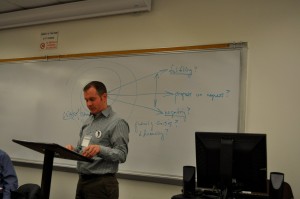
Presented on a panel with Paul LeBlanc and Lars T. Lih at the Left Forum 2011, Pace University, New York, March 19, 2011 (audio recording); at the third annual Platypus Affiliated Society international convention, the School of the Art Institute of Chicago, April 30, 2011; and at the Marxist Literary Group summer Institute on Culture and Society, University of Illinois at Chicago, June 22, 2011.

Introduction

Lenin’s Marxist politics has been profoundly misconstrued and distorted, both positively and negatively, as supposedly having wanted to strip capitalist society of its deceptive veneer and assert the unadorned proletariat as the be-all and end-all of “socialist” society. Certainly not merely the later Stalinist history of the Soviet Union, but also practices of the Soviet state under Lenin’s leadership in the Civil War, so-called “War Communism,” and the Red Terror, lent themselves to a belief in Lenin as a ruthless destroyer of “bourgeois” conditions of life. But, then, what are we to make, for instance, of Lenin’s pamphlets on The State and Revolution and “Left-Wing” Communism: An Infantile Disorder? For they emphasized both the necessary persistence of “bourgeois right” among the workers in the long transition from socialism to communism, requiring the continuation of state mediation, and the fact that Marxists had understood their effort as trying to overcome capital “on the basis of capitalism” itself. A prime example of Lenin’s insistence on the mediation of politics in society was his opposition to Trotsky’s recommendation that labor unions be militarized and subsumed under the state. Lenin wanted to preserve, rather, the important non-identity of class, party, and state in the Soviet “workers’ state,” which he recognized as necessarily carrying on, for the foreseeable future, “state capitalism” (characterized by “bureaucratic deformations” due to Russian conditions). Lenin thus wanted to preserve the possibility of politics within the working class, a theme that reached back to his first major pamphlet, What is to be Done? Lenin’s “last struggle” (Moshe Lewin) was to prevent the strangling of politics in the Soviet state, a danger he regarded not merely in terms of Stalin’s leadership, but the condition of the Bolsheviks more generally. For instance, Lenin critically noted Trotsky’s predilection for “administrative” solutions.

Georg Lukács, Karl Korsch and Theodor Adorno, teasing out a “Hegelian” dimension to Lenin’s Marxism, derived from Lenin’s theoretical writings and political practice an elaboration of the Marxist theory of social mediation in capital, through the politics of proletarian socialism, that sought to recover Lenin from a bad utopian perspective of the desire to do away with politics altogether. Rather, such Marxist critical theory following Lenin understood overcoming the “alienation” and “reification” of capital as providing the possibility for the true practice of politics, a neglected but vital contribution Lenin made to the development of Marxism. Lenin did not attempt to destroy modern forms of political mediation, but rather to achieve the true mediation of theory and practice, in politics freed from society dominated by capital. This was the content of Lenin’s liberalism, his “dialectical” Marxist attempt, not to negate, but rather to fulfill the desiderata of bourgeois society, which capital had come to block, and which could only be worked through “immanently.”

The controversy about Lenin

Lenin is the most controversial figure in the history of Marxism, and perhaps one of the most controversial figures in all of history. As such, he is an impossible figure for sober consideration, without polemic. Nevertheless, it has become impossible, also, after Lenin, to consider Marxism without reference to him. Broadly, Marxism is divided into avowedly “Leninist” and “anti-Leninist” tendencies. In what ways was Lenin either an advance or a calamity for Marxism? But there is another way of approaching Lenin, which is as an expression of the historical crisis of Marxism. In other words, Lenin as a historical figure is unavoidably significant as manifesting a crisis of Marxism. The question is how Lenin provided the basis for advancing that crisis, how the polarization around Lenin could provide the basis for advancing the potential transformation of Marxism, in terms of resolving certain problems. What is clear from the various ways that Lenin is usually approached is that the necessity for such transformation and advance of Marxism has been expressed only in distorted ways. For instance, the question of Marxist “orthodoxy” hinders the proper evaluation of Lenin. There was a fundamental ambiguity in the way Marxism addressed its own historical crisis, in the question of fidelity to and revision of Marx, for instance in the so-called “Revisionist Dispute” of the late 19th century. Lenin was a leading anti-revisionist or “orthodox” Marxist. This was also true of other Second International radical Marxists, such as Rosa Luxemburg and Leon Trotsky. In what ways did these figures, and above all Lenin, think that being true to Marx was required for the advancement and transformation of Marxism?

The Frankfurt School Critical Theorist Theodor Adorno, in his 1966 book Negative Dialectics, wrote of the degeneration of Marxism due to “dogmatization and thought-taboos.” There is no other figure in the history of Marxism who has been subject to such “dogmatization and thought-taboos” as much as Lenin. For Adorno, figures in the history of Marxism such as Lenin or Luxemburg or Kautsky should not be approached in terms merely of their theoretical perspectives or practical actions they took or advocated, but rather in their relation of theory and practice, or, why they thought they did what they did when they did so. As Adorno put it, theory and practice have a changing relation that “fluctuates” historically.

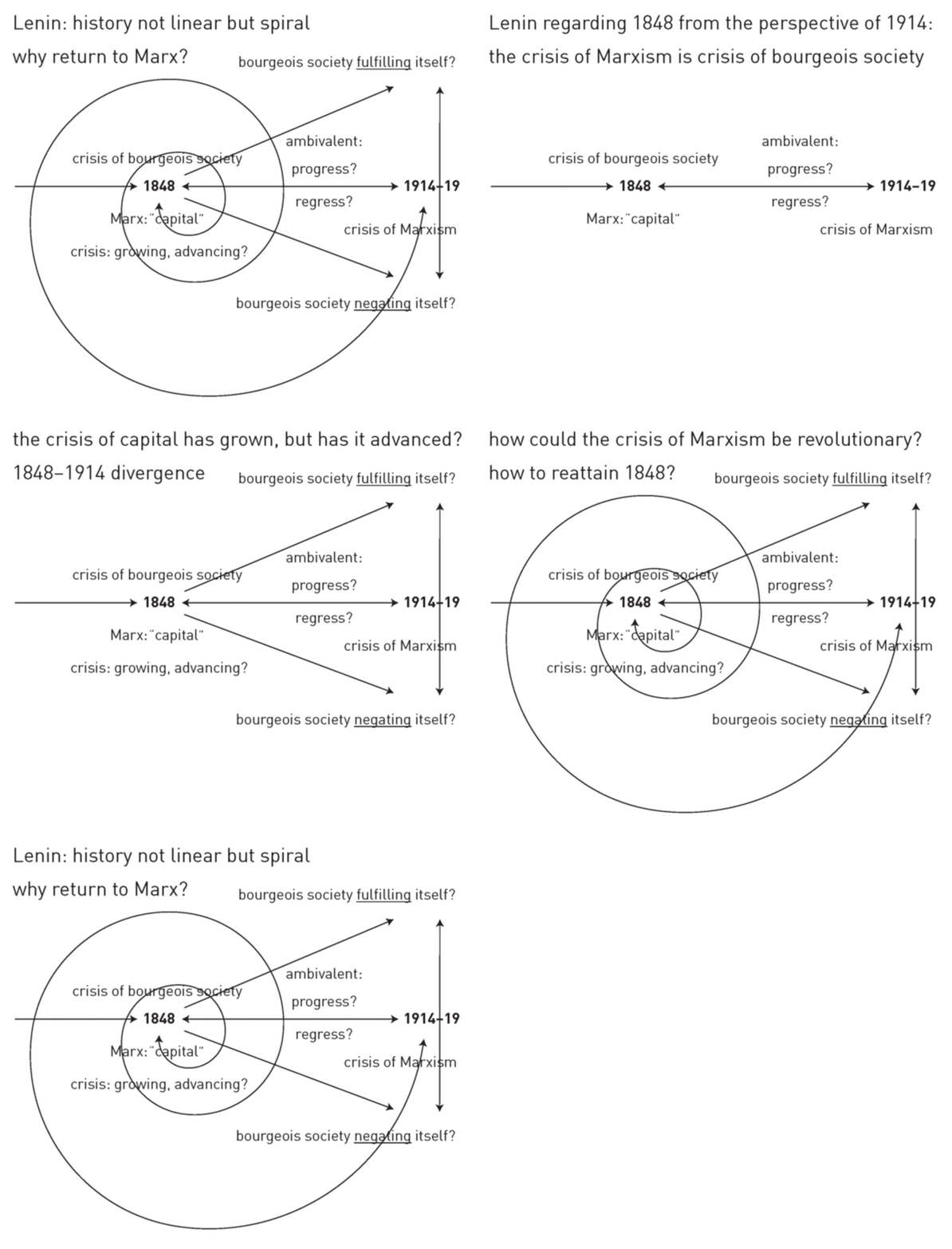
Lenin, among other Marxists, thought that the political party served an important function with regard to consciousness, and wrote in What is to be Done? of the key “importance of the theoretical struggle” in forming such a party. Lenin thought that theory was not simply a matter of generalization from experience in terms of trial and error, as in traditional (pre-Kantian) epistemology, but, importantly, in the Hegelian “dialectical” sense of history: this is how Lenin understood “theory.” As Lenin put it, history did not advance in a line but rather in “spirals,” through repetitions and regressions, and not simple linear “progress.” In this respect, the past could be an advance on the present, or, the present could seek to attain moments of the past, but under changed conditions. And such changed conditions were themselves not to be regarded simply as “progressive.” Rather, there was an important ambivalence to history, in that it exhibited both progress and regress. In his 1915 Granat Encyclopedia entry on Karl Marx, describing “dialectics” from a Marxian perspective, Lenin wrote,

In our times, the idea of development, of evolution, has almost completely penetrated social consciousness, only in other ways, and not through Hegelian philosophy. Still, this idea, as formulated by Marx and Engels on the basis of Hegel’s philosophy, is far more comprehensive and far richer in content than the current idea of evolution is. A development that repeats, as it were, stages that have already been passed, but repeats them in a different way, on a higher basis (“the negation of the negation”), a development, so to speak, that proceeds in spirals, not in a straight line; a development by leaps, catastrophes, and revolutions; “breaks in continuity”; the transformation of quantity into quality; inner impulses towards development, imparted by the contradiction and conflict of the various forces and tendencies acting on a given body, or within a given phenomenon, or within a given society; the interdependence and the closest and indissoluble connection between all aspects of any phenomenon (history constantly revealing ever new aspects), a connection that provides a uniform, and universal process of motion, one that follows definite laws — these are some of the features of dialectics as a doctrine of development that is richer than the conventional one.

With Marxism, the “crisis” of bourgeois society was recognized. The crisis of bourgeois society circa 1848 was what Marx called “capital,” a provocative characterization. The spiral development through which Lenin, among other Second International radicals such as Luxemburg and Trotsky, thought that history in the modern era had regressed through the “progress” since Marx and Engels’s time in 1848, the moment of the Communist Manifesto, showed how and why the subsequent development of Marxism sought to re-attain 1848. Was history since 1848 progress or regress? In a certain sense, it was both. In this history, bourgeois society appeared to both fulfill and negate itself. In other words, bourgeois society had become more itself than ever; in other respects, however, it grew distant from its earlier achievements and even undermined them. (For instance, the recrudescence of slave labor in the decades leading up to the U.S. Civil War.) The Second International radicals thus sought to return to the original potential of bourgeois society in its first moment of crisis, circa 1848. As Karl Kraus put it, in a way that registered deeply with Walter Benjamin and Adorno, “Origin is the goal.” Even though the crisis of capital or bourgeois society grew, the question was whether the crisis advanced. The Second International radicals recognized that while the crisis of capital, in Marx’s sense, grows, the crisis must be made to advance, as history does not progress automatically. It was in this sense that there was, potentially, a return of the 1848 moment in the development of Marxism itself, which was the attempt to make the growing crisis — what Luxemburg and Lenin called “imperialism,” and what Lenin termed capitalism’s “highest stage” — a historical advance.
The paradox of such development and transformation of Marxism itself through the return to the past moment of potential and resultant “crisis” was expressed well by Karl Korsch, who wrote, in his 1923 essay on “Marxism and Philosophy,”

[The] transformation and development of Marxist theory has been effected under the peculiar ideological guise of a return to the pure teaching of original or true Marxism. Yet it is easy to understand both the reasons for this guise and the real character of the process which is concealed by it. What theoreticians like Rosa Luxemburg in Germany and Lenin in Russia have done, and are doing, in the field of Marxist theory is to liberate it from the inhibiting traditions of [Social Democracy]. They thereby answer the practical needs of the new revolutionary stage of proletarian class struggle, for these traditions weighed “like a nightmare” on the brain of the working masses whose objectively revolutionary socioeconomic position no longer corresponded to these [earlier] evolutionary doctrines. The apparent revival of original Marxist theory in the Third International is simply a result of the fact that in a new revolutionary period not only the workers’ movement itself, but the theoretical conceptions of communists which express it, must assume an explicitly revolutionary form. This is why large sections of the Marxist system, which seemed virtually forgotten in the final decades of the nineteenth century, have now come to life again.

So, what were these “revolutionary” aspects of Marxism that were recovered in the course of the “crisis of Marxism” (Korsch’s phrase), and how did Lenin help recover them?
Lenin: history not linear but spiral

Lenin and the political party

Lenin made a portentous but indicative remark in the first footnote to his book What is to be Done?, in which he stated that,

Incidentally, in the history of modern socialism [there] is a phenomenon . . . in its way very consoling, namely . . . the strife of the various trends within the socialist movement. . . . [In] the[se] disputes between Lassalleans and Eisenachers, between Guesdists and Possibilists, between Fabians and Social-Democrats, and between Narodnaya Volya adherents and Social-Democrats, . . . really [an] international battle with socialist opportunism, [will] international revolutionary Social-Democracy . . . perhaps become sufficiently strengthened to put an end to the political reaction that has long reigned in Europe?

In other words, could working through the issue of opportunist-reformist “revisionism” within Marxism be the means for overcoming capital? This would appear to be the self-centrality of Marxism taken to its fullest flower. But there was a rationale to this. Not only did Lenin (subsequent to What is to be Done?) want the Mensheviks thrown out of Russian Social Democracy (Lenin agreed with the Mensheviks on excluding the so-called “economistic” tendencies of Marxism and the Jewish Bund workers’ organizations), but a seldom remarked fact was that Luxemburg, too, wanted the reformist Revisionists thrown out of the German Social Democratic Party (Kautsky waffled on the issue). Lenin and Luxemburg wanted to split the Second International from its reformists (or, “opportunists”).

Lenin not only thought that splits, that is, political divisions, in the Left or the workers’ movement were possible and desirable, but also necessary. The only differences Lenin had with figures such as Luxemburg or Kautsky were over particular concrete instances in which such splits did or could or should have occurred. For instance, Luxemburg thought that the split in Russian Social Democracy in 1903 was premature and so did not concur with Lenin and the Bolsheviks on its benefits. And, importantly, the question was not merely over whether a political split could or should take place, but how, and, also, when. Politics was a historical phenomenon.

There is the specific question of the “party” as a form of politics. Marx and Engels had written in the Communist Manifesto that, “The Communists do not form a separate party opposed to the other working-class parties.” So, this would appear to present a problem in the case of Lenin, who is notorious for the “party question.” But it poses a problem for the question of Marxism in general, for Marxism confronted other, opposed, political tendencies in the working class, for instance anarchism in the First International. What had changed between Marx and Engels’s time and Lenin’s?

As Marxists, Lenin and Luxemburg considered themselves to be vying for leadership of the social democratic workers’ movement and its political party; they didn’t simply identify with either the party or the movement, both of which originated independently of them. Both the workers’ movement and the social-democratic party would have existed without Marxism. For them, the party was an instrument, as was the workers’ movement itself. In responding to Eduard Bernstein’s remark that the “movement is everything, the goal nothing,” Luxemburg went so far as to say that without the goal of socialism the workers’ movement was nothing, or perhaps even worse than nothing, in that it exacerbated the problem of capitalism, for instance giving rise to the “imperialist” form of capitalism in the late 19th century. How were the social-democratic movement and its political parties understood by Marxists? For considering this, it is necessary to note well Marx’s critique of the Gotha Programme that had founded the German SPD and Engels’s subsequent critique of the Erfurt Programme that had made Marxism the official perspective of the Social Democratic Party. They critiqued these programmes because that’s what Marxists do: critique. No matter what had been written in these programmes, it was certain to elicit critiques from Marx and Engels.

The Marxists, that is, Marx and Engels, seem to have reluctantly gone along with the formation of a permanent party of social democracy, but not without serious reservations and caveats. The endorsement of party politics was provisional and conditional. For instance, in 1917, Lenin himself threatened to quit the Bolshevik party. Lenin thought that he could quit the party and continue to lead the revolution, that he would quit the party in order to lead the revolution.

Luxemburg’s biographer, British political scientist J.P. Nettl, traced the question of the social-democratic party to a set of problematic conceptions, all of which were challenged in practice and theory by the radical Left in the Second International, in figures such as Luxemburg and Lenin. The party could be conceived as an interest-aggregator and pressure-group on the state, advancing the interests of the working class. Or it could be conceived, as it was most overtly by its leadership, under its organizational leader August Bebel and its leading theorist Karl Kautsky, as a “state within the state,” or what Nettl termed an “inheritor party,” aiming to take power. Involved in the latter was a theory not only of revolution but also of socialism, both of which were problematical. Specifically troublesome was the idea of building up the working class’s own organization within capitalism so that when its final crisis came, political power would fall into the hands of the social democrats, who had organized the working class in anticipation of such an eventuality. But these were conceptions that were challenged and critiqued, not only by later radicals such as Luxemburg and Lenin, but also by Marx and Engels themselves. Marxists such as Marx and Engels and Lenin and Luxemburg were, rightly, deeply suspicious of the social-democratic party as a permanent political institution of the working class.

The problem of party politics

To situate this discussion properly, it is important to return to the classical liberal scorn for political parties. There was no term of political contempt greater than “party man,” or “partisan” politics, which violated not only the value of individuals thinking for themselves but also, perhaps more importantly, the very notion of politics in the liberal-democratic conception, especially with regard to the distinction between the state and civil society. Whereas the state was compulsory, civil society institutions were voluntary. While political parties, as forms of association, could be considered civil society organizations, the articulation of such formations with political power in the state struck classical liberal thinkers as particularly dangerous. Hegel, for one, explicitly preferred hereditary monarchy over democracy as a form of executive authority, precisely because it was free of such a problem. For Hegel, civil society would remain more free under a monarchy than under democracy, in which he thought political authority could be distorted by private interests. The danger lay in the potential for a civil society group to capture state power in its narrow, private interests. Moreover, in the classical liberal tradition, the idea of the professional “politician” was severely objectionable; rather, state-political figures rose through other civil society institutions, as entrepreneurs, professors, priests, etc., and only reluctantly took on the duty of public office: “It’s a dirty job, but somebody has to do it.”

This problem of modern politics and its forms recurred in the late 19th and early 20th centuries to thinkers such as Robert Michels, a student and associate of Max Weber, similarly concerned with the problem of modern “bureaucracy,” who, in a landmark study, compared the German SPD to the Democratic Party in the U.S., specifically with regard to the issue of the “party machine,” with its “ward bosses,” or machine-party politics, and the resulting tendency towards what Michels called “oligarchy.” Michels had been a member of the SPD, in its radical wing, until 1907. (Michels, who also studied the Socialist Party in Italy, went on to join Italian fascism under the former Socialist Benito Mussolini, because he thought fascism was a solution to the problem of “bureaucracy,” but that’s another story.) So the problem of party-politics was a well-known issue in Lenin’s time. For Second International radical Marxists such as Luxemburg and Lenin, the workers’ social-democratic party was not to be an interest-aggregator and permanent political institution of social power like the Democratic Party in the U.S. (which ultimately became the party of the labor unions). What, then, was the function of the social-democratic party, for figures such as Lenin and Luxemburg?

Obviously,  Lenin’s concerns with politics were not the same as those of liberals, who sought to prevent the ossification of political authority from stymieing the dynamism of civil society in capitalism. For Lenin’s concern was above all with revolution, that is, fundamental social transformation. But was the issue of politics thus so different in Lenin’s case? This raises the important issue of in what way social revolution and transformation was related to “politics,” in the modern sense. That is, whether Lenin was interested in the “end” of politics as conceived in liberalism and practiced under capitalism, or instead concerned with overcoming the obstacle to the practice of politics that capitalism had become. How was overcoming the social problem capitalism had become a new beginning, for the true practice of politics? In this sense, it is important to address how political mediation was brought into being but ultimately shaped and distorted by the modern society of capital, especially after the Industrial Revolution.

“Politics” is a modern phenomenon. Modern politics is conditioned by the crisis of capital in modern history. Traditional civilization, prior to the bourgeois, capitalist epoch, was subject to crises that could only be considered natural or divine in origin. Modern society is subject, for Marxists (as well as for liberals), rather, to human-made crisis thus potentially subject to politics. Bourgeois politics indeed responds to the permanent crisis of capitalism — in a sense, that’s all it does — but in inadequate terms, naturalizing aspects of capitalism that should be regarded as changeable, but can only be so regarded, for Marxists, as radically and consistently changeable, from a proletarian or working-class socialist perspective. Thus, modern politics has been haunted by the “specter of communism,” or socialism. As Marx put it, in The Eighteenth Brumaire of Louis Bonaparte,

Every demand of the simplest bourgeois financial reform, of the most ordinary liberalism, of the most formal republicanism, of the most insipid democracy, is . . . stigmatized as “socialism.”

Furthermore, the concrete meaning of socialism or communism is subject to change. For Marxists, the demand for socialism in the 19th century was itself an engine of capitalist development, historically. The story of socialism, then, is bound up with the development of capital, and the question of whether and how its crisis was growing and advancing.

Moreover, the question of party-politics per se is a post-1848 phenomenon, in which modern socialism was bound up. In other words, the crisis of bourgeois society in capital after the Industrial Revolution and the failure of the “social republic” in 1848, was the crisis of bourgeois society as liberal. The rise of party-politics was thus a feature of the growing authoritarianism of bourgeois society, or, the failure of liberalism. As such, socialism needed to take up the problems of bourgeois society in capital that liberalism had failed to anticipate or adequately meet, or, to take up the cause of liberalism that bourgeois politics had dropped in the post-1848 world. For Marx, the problem was found most saliently in Louis Bonaparte’s popular authoritarianism against the liberals in Second Republic France, culminating in the coup d’état and establishment of the Second Empire. As Marx put it, the capitalists were no longer and the workers not yet able, politically, to master the bourgeois society of capital. Party-politics was thus bound up with the historical phenomenon of Bonapartism.

Lenin and the crisis of Marxism

The period of close collaboration between Luxemburg and Lenin around the 1905 Russian Revolution saw Luxemburg leveling a critique of the relation that had developed between the social-democratic party and the labor unions in her pamphlet on The Mass Strike, the Political Party, and the Trade Unions. (Also, during this time Luxemburg wrote a defense of Lenin against the Menshevik charge of “Blanquism,” which she called “pedantic,” and thought said more of the reformist opportunism of those leveling the charge against Lenin than about its target.) In her Mass Strike pamphlet, Luxemburg delineated specific and non-identical roles for the various elements she mentioned in her title, that is to say, general strike committees, political parties, and labor unions (not mentioned specifically were the “soviets,” or workers’ councils). In this sense, the “mass strike” was for Luxemburg a symptom of the historical development and crisis of social democracy itself. This made it a political and not merely tactical issue. That is, for Luxemburg, the mass strike was a phenomenon of how social democracy had developed its political parties and labor unions, and what new historical necessities had thus been brought into being. Luxemburg’s pamphlet was, above all, a critique of the social-democratic party, which she regarded as a historical symptom. This was prefigured in Luxemburg’s earlier pamphlet on Reform or Revolution?, where she addressed the question of the raison d’être of the social-democratic movement (the combination of political party and labor unions).

From this perspective of regarding the history of the workers’ movement and Marxism itself as intrinsic to the history of capitalism, then, it becomes possible to make sense of Lenin’s further articulations of politics in his later works, The State and Revolution and “Left-Wing” Communism: An Infantile Disorder, as well as in the political disputes that attended the young Soviet state that had issued from the Russian Revolution and had endured the Civil War and stabilization of international capitalism in the aftermath of WWI. Lenin maintained a strictly minimal conception of the state, restricting it to the monopoly of authority for the exercise of force, precisely in order to avoid an all-encompassing conception of the state as the be-all and end-all of politics. Similarly, Lenin deemed “infantile” the impatience of supposed radicals with existing forms of political mediation, such as parliaments, stating unequivocally that while Marxism may have “theoretically” surpassed a liberal conception of the state, this had not yet been achieved “politically,” that is, in practice. In response to Trotsky’s recommendation that labor unions be militarized in the Soviet state, Lenin maintained that unions needed to remain independent not only of the state, but also of the Communist Party itself. The workers needed the ability, according to Lenin, of asserting their rights against the party and the state. Lenin recognized the necessity of an articulated non-identity of state, political parties, and other voluntary civil society institutions such as labor unions. This was grounded in Lenin’s perspective that capitalist social relations could not be abolished in one stroke through political revolution, that, even though the state had been “smashed,” it was reconstituted, not on the basis of a new social principle, but on the continuation of what Lenin called “bourgeois right,” long after the political overthrow and even social elimination of a separate capitalist class. “Bourgeois right” persisted precisely among the workers (and other previously subordinate members of society) and so necessarily governed their social relations, necessitating a state that could thus only “wither away.” Politics could be only slowly transformed.

Finally, there is the question of Adorno’s continued adherence to Lenin, despite what at first glance may appear to be some jarring contradictions with respect to Lenin’s own perspective and political practice. For instance, in a late essay from 1969, “Critique,” Adorno praised the U.S. Constitutional system of “divisions of powers” and “checks and balances” as essential to preserving the critical function of reason in the exercise of political authority. But this was an example for Adorno, and not necessarily to be hypostatized as such. The making common of executive and legislative authority in the “soviet” system of “workers’ councils” was understood by Lenin, as Adorno well knew, to coexist with separate civil society organizations such as political parties, labor unions and other voluntary groups, and so did not necessarily and certainly did not intentionally violate the critical role of political mediation, at various levels of society.

It has been a fundamental mistake to conflate and confuse Lenin’s model of party politics for a form of state in pursuing socialism. Lenin presupposed their important non-identity. The party was meant to be one element among many mediating factors in society and politics. Moreover, Lenin’s party was meant to be one among many parties, including multiple parties of the working class, vying for its adherence, and even multiple “Marxist” parties, differing in their relation of theory and practice, or means and ends.

By contrast, there was nothing so repressive and authoritarian as the Kautskyan (or Bebelian) social-democratic “party of the whole class” (or, the “one class, one party” model of social democracy, that is, that since the capitalists are of one interest in confronting the workers, the workers need to be unified against the capitalists). The social-democratic party, after all, waged the counterrevolution against Lenin and Luxemburg.

Lenin preserved politics by splitting Marxism. For this, Lenin has never been forgiven. But, precisely for this, Lenin needs to be remembered. | §

Originally published in The Platypus Review 36 (June 2011).
Share

Badiou’s “communism” — a gerontic disorder

Chris Cutrone

Presented on a panel with Nayi Duniya (Demarcations journal), co-author of Alain Badiou’s “Politics of Emancipation:” A Communism Locked Within the Confines of the Bourgeois World, and Bruno Bosteels (Cornell University) at the Left Forum 2011, Pace University, New York, March 19, 2011; and on the panel “Badiou and post-Maoism: Marxism and communism today,” with Mike Ely, Joseph Ramsey and John Steele at the third annual Platypus Affiliated Society international convention, the School of the Art Institute of Chicago, April 30, 2011 (audio recording). (An audio recording of the related April 12, 2011 lecture at the School of the Art Institute of Chicago, on “The Idea of Communism: Badiou, Althusser and Lacan,” is available.)

Perhaps the most condemnatory thing that could be said of Badiou’s “communism” was something Badiou himself wrote, when he defined “communism” as a “Kantian regulatory idea,” a norm to be aspired to, rather than a concrete reality to be achieved. This not only besmirched the historical Marxist idea of “communism,” but also Kant! For Kant addressed freedom as something that could and should be, not as a utopia. And Marx remained deeply engaged in practical politics. Leon Trotsky wrote, more than a hundred years ago, after the 1905 Russian Revolution (in the 1906 pamphlet Results and Prospects), that “Marxism converted socialism into a science, but this does not prevent some ‘Marxists’ from converting Marxism into a Utopia.” Trotsky also wrote that, “[I]n academies . . . it might be possible artificially to detain the proletariat for fifty, a hundred or five hundred years, but in the course of all-round life in capitalist society, on the basis of unceasing class struggle[,] . . . [t]he growth of the consciousness of the proletariat transforms this class struggle, gives it a deeper and more purposeful character.” Trotsky was not a utopian any more than Kant or Marx were.

However, as we know, such “unceasing class struggle” that Trotsky had in mind, which could “transform” the “consciousness of the proletariat” and potentially “give it a deeper and more purposeful character,” is precisely what the world has been missing, for at least a generation. The Marxist vision for proletarian socialism has passed, almost completely into oblivion. Badiou’s late redefinition of “communism” is a response — an adaptation — to this historical reality. Indeed, Trotsky was writing at the crest of 2nd International Marxism, which developed in the period from 1871 to 1917, whose history Badiou deliberately seeks to bury. Badiou characterizes this period, like our own, as an “interval,” in which “the communist hypothesis was declared to be untenable,” “with the adversary in the ascendant.” What is the basis of Badiou’s judgment of this period, 1871 to 1917, in which, not only did bourgeois society go through its last great flowering, in the Belle Époque, but Marxism flourished as an international workers’ movement, commanding a dedication to socialist revolution by millions in the core capitalist countries? The period between the Paris Commune and the October Revolution was not in any way like ours; it was not cynical, but optimistic in the sense of historical mission and the real potential of human progress. Badiou shares the skepticism that has developed regarding such historical potential. Indeed, we can say that Badiou is typical of the 1960s-era New Left in this regard. Badiou cannot recognize 2nd Intl. Marxism as an advance. Moreover, Badiou is, in Trotsky’s sense, “academic,” despite his avowed intentions. The last thing Badiou imagines is that he has conceded. Badiou’s entire philosophy was developed out of concern for “fidelity,” resisting the apostasies of the 1968 generation in the decades that followed. — The question is, to what does Badiou claim fidelity? Certainly not Marxism.

What has sanctioned Badiou to bury the admittedly obscure history of the first wave of Marxism in the 2nd Intl., today? And why does Badiou find an affinity in our moment with that of the pre-WWI world, which otherwise seems so unlikely? In certain respects, Badiou is rather optimistic in finding such an affinity, hoping that today we are in a period of preparation for the realization of more radical social transformation — “revolution” — down the road. Badiou thus tries to keep fidelity to “the revolution” in his estimation of the present. But which “revolution?” Badiou is clear that his model for revolution is May 1968 in France and the contemporaneous Great Proletarian Cultural Revolution in China. Presumably, in the latter case, this means a commitment to Mao and “Marxism-Leninism.” But, beneath this, there is a certain unmistakable pessimism to the characterization of the formative era of Lenin’s Marxism in the 2nd Intl., as being, like ours, one of conservative reaction. — Was the growth of Marxism in the late 19th and early 20th centuries really a retreat, after the defeat of the Paris Commune? Or, has Badiou mistaken one revolution for another? Badiou has maintained fidelity, not to “communism,” in Marx’s sense, but rather to “democracy,” that is, the eternal bourgeois revolution. It is thus significant that Badiou dates modern communism, not to Marx in 1848, but to the Jacobins in 1792. This obscures the history that came between.

The truth is that Badiou’s “communism” is deeply anti-Marxist. Not merely non-Marxist, in the sense of what it tends to leave out, but actually hostile to historical Marxism. Perhaps this is unremarkable. Perhaps it is not a problem in itself. But it may bear some inquiry into the potential consequences that might flow from this. Perhaps Badiou is quietly acknowledging that Marxism may have become an obstacle to the kind of social change that, in his estimation, is possible and desirable — and necessary. That is a real question. Does Marxism speak to the needs of the present? But to consider this — to consider what Badiou may have to offer as an alternative to Marxism — we must address what Badiou means by “communism.”

Badiou defines communism as “radical democratic equality.” The “hypothesis” that motivates communism, according to Badiou, is that,

the logic of class — the fundamental subordination of labour to a dominant class, the arrangement that has persisted since Antiquity — is not inevitable; it can be overcome. . . . [A] different collective organization is practicable, one that will eliminate the inequality of wealth and even the division of labour. . . . The existence of a coercive state, separate from civil society, will no longer appear a necessity: a long process of reorganization based on a free association of producers will see it withering away.

Furthermore,

As a pure Idea of equality, the communist hypothesis has no doubt existed since the beginnings of the state. As soon as mass action opposes state coercion in the name of egalitarian justice, rudiments or fragments of the hypothesis start to appear. Popular revolts — the slaves led by Spartacus, the peasants led by Müntzer — might be identified as practical examples of this “communist invariant.” With the French Revolution, the communist hypothesis then inaugurates the epoch of political modernity.

However, the potential for emancipated humanity expressed in communism that Marx recognized in the modern history of capital is not assimilable without remainder to pre- or non-Marxian socialism. Marx’s thought and politics are not continuous with the Spartacus slave revolt against Rome or the teachings of the Apostles — or with the radical egalitarianism of the Protestants or the Jacobins. So what was Marx’s distinct contribution? As Marx put it, “Communism is the necessary form and the dynamic principle of the immediate future, but communism as such is not the goal of human development, the form of human society.” This was because, according to Marx, “Communism is a dogmatic abstraction and . . . only a particular manifestation of the humanistic principle and is infected by its opposite, private property.” Marx was not the preeminent communist of his time but rather its critic, seeking to push it further. The best Marxists who followed, such as Lenin, Luxemburg and Trotsky, similarly sought to push their respective political movement of “revolutionary social democracy” in the 2nd Intl. further. In so doing, they revealed and grappled with the form of capital of their moment in history, what they called “imperialism,” seeking to make it into capital’s “highest” and last stage, the eve of revolution. Badiou, by contrast, addresses inequality as a timeless, perennial problem. He thus departs fundamentally from Marx and Marxism, and liquidates the revolution of capital.

Badiou conceives of the relation between freedom and equality as an ontological one, in the mathematical terms of set theory, transhistoricizing it. Badiou’s background is in Lacanian and Althusserian “post-structuralist” French thought, in common with other prominent New Left-era thinkers — and former students of Louis Althusser — such as Étienne Balibar and Jacques Rancière. Althusser found, in the Russian and Chinese Revolutions, a salutary challenge to the notion of the Hegelian “logic of history,” that revolutionary change could and indeed did happen as a matter of contingency. Althusser took great inspiration from Mao in China and Lenin in Russia for advancing the possibility of emancipation against a passive expectancy of automatic evolution in the historical process of capital. For Badiou, this means that emancipation must be conceived of as an “event,” which involves a fundamental reconsideration of ontology. Badiou does not conceive of the transformation of the capitalist mode of production that would allow for overcoming the socially pernicious aspects of specifically capitalist forms of inequality. By contrast, Marx looked forward to the potential for overcoming the conditions of possibility for the reproduction of capitalist class dynamics in the mode of production itself: capital’s overcoming of the need to accumulate the value of surplus labor-time. Marx saw the historical potential to overcome this socially mediating aspect of labor, expressed, for instance, in automated machine production. However, Marx also foresaw that, short of socialism, the drive to accumulate surplus-value results in producing a surplus population, an “industrial reserve army” of potential “workers” who thus remain vulnerable to exploitation. A politics based only in their “democratic” discontents can result, not in the overcoming of the social need for labor, but in the (capitalist) demand for more labor, the demand to be put to work. Or, as Max Horkheimer, director of the Marxist Frankfurt Institute for Social Research, put it, machines “have made not work but the workers superfluous.” Marx anticipated this when he warned that realization of the socialist demand to abolish of “private property” would (merely) make society as a whole into one giant capitalist dominating its members. Marx even went so far as to analogize this with socialist calls to abolish marriage as a “bourgeois” institution, which he said would result only in universal prostitution — indeed, that capitalism was already bringing this about.

For Marx, elimination of a separate capitalist class would not in itself be emancipatory unless a transformation in the “mode of production” and its social relations came about. Marx did not think that the capitalists were the cause, but the effect of capital, calling them its “character masks.” Nonetheless, Marx endorsed, however critically, the traditional socialist demand to abolish private property and “expropriate the expropriators,” regarding this as a necessary first step: necessary, but not sufficient, to realize a society beyond the mode of production and social relations of capital. As Lenin underscored this, in The State and Revolution, on the eve of the October 1917 Revolution in Russia, such social relations of bourgeois society, namely, the mutual exchange of labor as the form of social solidarity in capital, could only be transformed gradually and thus “wither away,” and not be abolished and replaced at a stroke. The proletarian socialist revolution was supposed to open the door to this transformation. But, since then, the history of the Russian and Chinese Revolutions showed another potential, that is, the reconstitution of capital, under the guise of “socialism.” Marx had already foreseen such a possibility in the limited consciousness of his socialist and communist contemporaries of the 19th century, and he criticized them “ruthlessly” for this. Marx and Lenin recognized a problem in “socialism” itself that their supposed followers have neglected or avoided.

All this remains hidden to Badiou. But it was precisely this Marxist approach to capital as a “mode of production,” or form of society, that distinguishes Marx from other socialists or communists, and motivated revolutionaries who followed Marx, such as Lenin, maintaining that Marxism pursued the possibility of overcoming capital “on the basis of capitalism” itself. Badiou situates emancipatory possibilities rather atavistically, in a pre-historical ontology, to which the philosophy of mathematics — for instance, the question of “number and numbers” (the title of one of his books) — can be an adequate guide. For Badiou, in a procedure that recalls a self-criticism session or assembly at a “reeducation” camp, matter itself, in its open-ended recombinations, poses the solution to what Marx called “communism,” the “riddle of history.” Each element must be broken down to its radical potentiality for permutation — for instance, in the Maoist “revolutionary people,” for emancipatory change to take place. It is not for nothing that Badiou conceives of revolution not as a process but an event, or, that his conception of “process” is founded on a conception of the “event.” On the other hand, Badiou finds Marxists such as Lenin (and Marx himself) conceding to the existing social hierarchies and thus betraying the “idea of communism,” for instance in the party-state, which Badiou regards in retrospect as a “failed experiment.” Thus, Badiou.

What of Marx and Marxism? Marx distinguished capitalist inequality from that of the traditional caste system that had characterized civilization for millennia before the emergence of bourgeois society in the post-Renaissance world. As Adorno pointed out, to call all of history the “history of class struggles” was to indict all of (“recorded”) history, and to thus consign it to the mere “pre-history” of authentic humanity. But this humanity was itself historically specific, and emergent — to the era of capital. Just as traditional inequality was not the cause of the form of community that the ancients regarded as being divine in origin, capitalist inequality was not the cause but the effect, the product of the cosmos of capital. Marx’s magnum opus, Capital, explored how the post-Industrial Revolution society of capital produced a new form of inequality, between capitalist and worker, but one liable to be cast and responded to in the form of the original Revolt of the Third Estate that had ushered in modern bourgeois society in the 17th and 18th centuries. Marx found an important disparity — a self-contradiction — to have developed between the political aspirations of the subjects of capital, for “social democracy,” and the potential of capital to go beyond bourgeois society and its forms of politics — liberalism and democracy. This did not make Marx and those who followed him illiberal or anti-democratic, but they did regard liberalism and democracy — the combined libertarian and social-egalitarian impulses in modern politics — as means and not ends in and of themselves. This is because they regarded capitalism itself as a process and not merely a state of being. Marx and his best followers, such as Lenin, looked forward not merely to more liberalism and more democracy, but to the potential transcendence of the need for both liberalism and democracy, an “end” to politics as presently practiced. But not all at once, and not by denying them in the present. Capital is not an eternal event of inequality that needs to be met with the event of revolution. Badiou does not deny liberalism and democracy, but rather unconsciously reaffirms their present, bourgeois forms, at a deeper and more obscure level. Badiou’s ontology of “radical egalitarian democracy,” provides not a critical recognition, but a philosophical affirmation of the way bourgeois society already proceeds, however contradictorily. Badiou mystifies.

The challenge is to recognize the symptomatic character of liberalism and democracy in the crisis of capital, as it had developed in the 19th century, setting the stage for the history that came later. But such symptomology was not to be “cured” in the sense of elimination, but rather undergone and worked through — as Nietzsche put it, modernity is an “illness, but the way pregnancy is an illness,” bringing forth new life. The problem, as Marx recognized it, was that, by the mid-19th century, when bourgeois society entered into crisis, after the Industrial Revolution, and became “proletarianized,” humanity faced a situation in which, as Engels later described it, the capitalists were no longer and the workers not yet able to master the society of capital. Marx regarded this as the source of the authoritarianism of the modern, capitalist (nation-)state, despite the promises of classical bourgeois liberalism for a minimal state and a free, cosmopolitan civil society that would, for instance, reduce legislatures to, at most, sites of public debate and political recognition of social facts already accomplished on the ground — what Kant, for one, expected. But the bourgeoisie could no longer and the proletariat not yet rule modern society. The genie of capital had been let loose. The historical task of emancipating humanity had thus fallen from the bourgeois to the proletarian members of society. Marxists have recognized that this is the situation in which the world has remained stuck ever since then — ever since the failed “social democratic” Revolutions of 1848, on the eve of which Marx and Engels had published their inaugural Manifesto. For Marx, the demand for “social democracy” was part of the history of capital, to be worked through “immanently” and transcended. But none of this registers for Badiou. Marx marked a potential turning point for humanity; he was not merely one in a chain of prophets reaching back for thousands of years. He was thinker and political actor for our, modern time.

The cost of liquidating the specific history of capital — its peculiar constraint on society and its potential beyond itself — is Badiou’s reduction of “communism” to the perennial complaint of the subaltern, the millennial dream of social equality, as a specter haunting the world that has more in common with eschatological “justice,” posed by religion at the end of time, than with the pathology of the modern, bourgeois world of capital, in which humanity actually suffers today. We must awaken from this nightmare — the vain wish that things be otherwise — of the oppressed. For we are not only oppressed, but tasked by capital.

Nevertheless, the failure of historical Marxism has made Badiou an evidently adequate symptomatic expression of our time — its confusion and diminished expectations, well shy of the epochal transformation that had motivated Marx and the best Marxists, historically. We must remember Marxism, so we can forget Badiou: forget the time that made such ideology — such naturalization, indeed ontologization — of defeat so appealing, and finally consign it, where it belongs, to pre-history. | §

Share

The Left and prospects for democracy in the Middle East: Iraq

Chris Cutrone

Presented on a panel with Issam Shukri (Worker-communist Party of Iraq) and Ashley Smith (International Socialist Organization) at the Left Forum in New York City, Pace University, March 21, 2010.

American political activist Danny Postel interviewed the British Left historian of the Middle East Fred Halliday in Chicago in 2005. They published the interview under the title “Who is responsible?” This is the question faced by purported “Leftists” internationally. What would it mean to practice a responsible politics on the Left in the face of phenomena like the Iraq war?

But we can turn this problem around slightly, in the issue of the U.S. invasion and occupation of Iraq, now winding up. The question is, “Who was responsible?” for the war. While the Spartacist socialist radical Karl Liebknecht may have said of Germany in the first World War, “The main enemy is at home!,” he certainly did not think that the German ruling class was the only enemy or the main enemy of everyone, but rather the main enemy for the German Left, especially in the context of the war in which the German working class was held hostage. So the kind of inverted nationalism one sees in today’s so-called “anti-imperialism” is completely foreign to the perspectives of historic revolutionary Marxist politics. While U.S. policy is certainly responsible, it is not exclusively so. And while the U.S. ruling class and its government may be the “main” or principal enemy for American Leftists, it is not the only one – and, perhaps more importantly, it is certainly not the main or only enemy for Iraqi Leftists. Most have avoided this fundamental truth. But this is a measure of the unseriousness of their “politics.”

Baathism was responsible at least as much as U.S. Republicans and neoconservatives for the Iraq war. This can be demonstrated conclusively to the degree that Saddam Hussein and his Baathist regime made two disastrous miscalculations: 1.) in feigning possession of WMDs; and 2.) thinking that it was possible to split Europe from U.S. hegemony and balance one against the other, preserving some breathing room for Baathist Iraq. That Iraqis had absolutely no ability to resist these catastrophic political miscalculations by the Baathist regime is the most fundamental fact conditioning the war. The truth is that the Baathist regime is what made the war possible — perhaps even inevitable — to begin with. The regime was willing to drag the rest of Iraq down with it.

On the Baathists’ political calculus, would it have been better if Iraq had indeed had WMDs, or if Europe had actively opposed the U.S. invasion and occupation of Iraq? Were the Russian and Chinese vetoes in the U.N. Security Council in any way progressive or emancipatory in character? Who had the best interest of the Iraqis, let alone their potential emancipation, in consideration in this decisive context? Weren’t the Europeans, Russians (and before them, the Soviets) and Chinese, and not only the U.S., responsible for not only the toleration but the very existence and continued subsistence of the Baathist regime in Iraq?

So the geopolitics of the Iraq war needs to be evaluated in light of Iraq and the greater Middle East, not exclusively and perhaps not even primarily in terms of U.S. hegemony — to which there is no actual alternative anyway. The U.S. was going to remain the cop of the world whether or not it invaded Iraq. That the U.S. risked and did not necessarily enhance its role as global cop/hegemon in invading and occupying Iraq should point this basic fact out clearly enough.

The truth is that all of the neighboring countries were hostile to Baathist Iraq. (This is also true, relatedly, for Iran today, so this is a historical lesson that needs to be learned!) Not only Europe but also Russia and China were no reliable friends of the Iraqis, to say the least. They have long been and remain perhaps worse enemies of the Iraqis than the U.S. has been, as seen in their erstwhile support for Saddam’s Baathist Iraq.

In this situation that the Worker-communist Party has described evocatively as the “dark scenario” for Iraq, we must face the deeper history that has made this possible today. Only in this way can we face squarely the tasks of the present — the potential possibilities internationally for a truly social-emancipatory politics. All else remains vain posturing or merely hand-wringing. In the U.S. itself, it is merely high-strung rhetoric covering, in the case of Iraq, a desire to have the Republicans voted out in favor of the Democrats. Now that this has happened, there is embarrassed silence about Iraq on the “Left.” But Obama did exactly what he promised. And the Democrats more generally never offered anything of a progressive-emancipatory alternative to the Republican policy. — This can be seen in Biden’s proposal to divide Iraq into three separate countries, punishing the Sunnis for their resistance by robbing them of access to Iraq’s oil wealth (which is concentrated in the Shiite South and Kurdish North). Leaving Baathist Iraq alone would have hardly been better for the Iraqis in the long term, if history is any kind of indication.

Why did the Iraq war happen? Because Saddam’s Baathist regime had turned Iraq into a pariah state internationally, and a grotesque house of horrors for its own inhabitants. The Baathist regime was becoming worse not better for the Iraqis as time went on. Saddam was willing to wager the Iraqi people, seemingly without limit, for the continuation of his regime. Did he really think he could outlast the hostility he had generated, not only with the U.S., but also with Iran, Saudi Arabia, and others? What was the actual future for Baathist Iraq, if not implosion and civil war, barring (also) foreign intervention of one form or other (if not invasion and occupation)? — Has Lebanon really been any better?

On the other hand, what about Iraq today, after the invasion and occupation? It is arguably true that, apart from Israel, Iraq is today the most politically “democratic” state (if only in political dynamism) in the Middle East. The U.S. achieved its aims of removing Baathism and making Iraq a state more responsible not only to the international community but also to its own inhabitants. The only question is whether the cost for achieving this has been too great. If so, then one needs to ask, who actually made it so costly? Was the so-called “resistance” worth it? Was it even directed at the U.S. occupiers, or really at its sectarian opponents (on both sides)? Was it only or even primarily the U.S. that was responsible for the destruction, or were there other actors involved, and, if so, how do we hold them accountable — and how may any purported “Left” challenge and oppose them, moving forward? Isn’t this the question we especially face today, when the U.S. is vacating the scene? Or will the “Left” simply forget about Iraq, end of story? — Weren’t Iraq and the Iraqis always in fact forgotten in the estimations of the so-called “Left?”

Who was responsible? | §

Share

The Green Movement and the Left: prospects for democracy in Iran

Chris Cutrone

Presented on a panel with Siyaves Azeri (Worker-communist Party of Iran) and Hamid Dabashi (Columbia University) at the Left Forum in New York City, Pace University, March 21, 2010. A previous version of this presentation was given at the Platypus Affiliated Society public forum on “30 years of the Islamic Revolution in Iran: the tragedy of the Left,” with panelists Maziar Behrooz (San Francisco State University), Kaveh Ehsani (DePaul University, Chicago) and Danny Postel, University of Chicago, November 5, 2009, whose transcript was published as a special supplement to Platypus Review #20 (February 2010), and presented as an individual lecture at Loyola University, Chicago, December 3, 2009, and at the University of Chicago, October 29, 2009.

I would like to pose the question: What can the history of the Islamic Revolution in Iran teach the Left?

The 30th anniversary of the toppling of the Shah of Iran witnessed the controversy over the election results in the Islamic Republic, in which the incumbent (Mahmoud) Ahmadinejad claimed victory over his opponent (Mir-Hossein) Mousavi, and mass protests against this result were subject to brutal, violent repression.

These two historic moments, those of the birth and crisis of the Islamic Republic of Iran, communicate over time, and can tell us a great deal about the nature and trajectory of the contemporary world, and the role of the demise of the Left in it.

We in Platypus approach the history of the Islamic Revolution in Iran as a specific story in the overall history of the death of the Left — its historical decline and disappearance.  The self-destruction of the Left in Iran is a good entry into investigation of the death of the Left internationally, over the course of at least the past generation.

It is instructive that, where once the Left in Iran was the most vital and potentially significant in the Middle East or Muslim world, today the Left has been completely eradicated in Iran.

Whereas the Shah simultaneously sought to repress and co-opt the Left, the Islamic Republic has brought about its entire elimination in Iran (and has sought to do so elsewhere, for instance in the Lebanese civil war, through its proxies Hezbollah).  It is in this sense that one can meaningfully talk about the reactionary, Right-wing character of the Islamic Republic, relative to what came before it under the Pahlavi dynasty.  There are fewer possibilities for Iranian society today than there were 30 years ago.  This bitter fact is something most try to avoid confronting, but is where I want to focus attention in my presentation.

The Left is defined by potential and possibility, the Right by its foreclosure.  The Left expresses and reveals potential possibilities, while the Right represses and obscures these.

For this reason, the role of the Iranian and international Left in repressing and obscuring the true character of social possibilities in Iran, during the period leading up to Islamic Revolution, is crucial for grasping, not only how the Left destroyed itself, but also, and more importantly, how it destroyed itself as a Left, and thus contributed to the construction of a new Right.  Only justice for past crimes committed by the Left can recover old, and open new possibilities in the present.  Only by confronting its problematic historical legacy can the Left today be a Left at all.  But this is something virtually no-one wants to do.

Slavoj Zizek, in his recent book In Defense of Lost Causes, cites Heidegger’s embrace of Nazism and Foucault’s embrace of the Islamic Revolution in Iran to demonstrate the importance and necessity of what Zizek calls “taking the right step in the wrong direction.”  Zizek is eager, as he expressed in his writing on the recent election crisis in Iran, to find the “emancipatory potential” of “good Islam.”  He thinks that a more radical emancipatory potential was grasped, however uncertainly, by Foucault in 1979 (and by Heidegger in 1933!).  I wish to argue the contrary, that Foucault’s — and the rest of the “Left’s” — embrace of Islamism was and continues to be a conservative move, thinly veiled by claims to more radical bona fides.

This phenomenon of seeking the “emancipatory potential” of “good Islam” can be traced all the way through the recent election crisis in Iran.  We need to examine the trajectory of the supposedly “Left” Islamist discontents and opposition to the Shah’s regime leading up to the Islamic Revolution, and how this plays out for continuers of such politics such as Mousavi in the Islamic Republic in the present.

The New Left Islamist figure Ali Shariati is key to understanding the relation of the Left to Islamism, both around the 1979 toppling of the Shah and the political divisions in the Islamic Republic of Iran today.  For instance, opposition presidential candidate Mousavi, and especially his wife Zahra Rahnavard, were students of Shariati who worked closely with him politically in the 1960s and ’70s.  The largest political organization on the Left in the 1979 revolution were the MEK (Mojahedin-e-Khalq, or People’s Mojahedin of Iran), who helped organize the street protests that toppled the Shah and participated in the taking of the U.S. embassy, and found inspiration in Shariati’s approach to Islam.

The fact that Mousavi and Rahnavard eventually joined the Khomeini faction, and that there is a significant likelihood that Khomeini’s agents were responsible for Shariati’s untimely death in exile in 1977 at age 44, should not obscure the New Left Islamist roots of the Khomeiniite Islamic Republic, of which Mousavi was Prime Minister from 1981–89, under Khomeini’s “supreme” leadership, approving the slaughter of the Left.  The present controversy in the Islamic Republic establishment is not to be understood in terms of new wine in old bottles but rather the old in the new.  The Islamist politics on both sides is a Right-wing phenomenon, now as before.  Mousavi as standard bearer for discontents in the Islamic Republic is a phenomenon of political confusion, to which any Left must attend.  There are significant problems to be addressed in the relation of ideology to social and political reality.  The point is that Khomeini’s supremacy in the Islamic Revolution was not to be explained by his superior insight and grasp of realities, but rather his successful navigation of them, which is a different matter.  The present dispute between Ahmadinejad and Mousavi amounts to this.

Khomeini did not lead a revolutionary transformation of Iranian society but rather the reconsolidation of Iran after the crisis and fall of the Shah.  The phenomenon of the so-called “Left” (for the most part) calling black white, does not change the fact that Khomeini represented a Right-wing response to the discontents and crisis of Iranian society in the 1970s.  The Left’s support of Khomeini expresses its disorientation and confusion theoretically, and its Right-wing role practically.  There is no mystery here: telling women to cover themselves was not an emancipatory act!

The collapse of the Shah’s regime did not increase but ultimately decreased the possibilities for Iranian society.  The Khomeiniite Islamic Republic was not the expression but the repression of potential, in the context of diminished possibilities.  To understand how this was so, it is useful to consider the historical trajectory of Iran in global context.  The developmental states of the post-colonial world underwent a severe crisis starting with the global downturn of the 1970s.  The 1970s were the period in which, for example, so-called “Third World debt” manifested itself as a serious problem for these states.

Oil revenues could not provide remedy in the case of Iran, because what was encountered, throughout the world in the 1970s, was the crisis of the mid-20th century transformations that went on under the rubric of “modernization.”  In Iran, this was carried out through the Shah’s White Revolution, in which he had been goaded, beginning in the early 1960s, by the U.S. Kennedy Administration, and continued to be by those subsequent.  Khomeini’s rise as a politician originated in protest against the policies of modernization — and social liberalization — implemented by the Shah, under pressure from the U.S.  Khomeini was always clear about this in ways the “Left” has not been.  The Left abdicated from providing an emancipatory response to the changes in Iranian society.  The Shah stood between Right- and Left-wing discontents, but the Left steadily liquidated its own concerns.

Indeed, despite that discontents with the Shah were channeled into New Left “anti-imperialist” politics, the Shah indeed was bucking the “Great Satan” on his own accord.  Not only was the Shah’s regime prompted to transform Iranian society, through the White Revolution reforms of the 1960s–70s, exacerbating social and political discontents, but indeed responsibility for the ultimate demise of the Shah can be laid at the door of U.S. policy, for President Carter refused to support the Shah against the tumult of protests that broke out in 1978.  The U.S. not only supported the Shah’s regime but significantly undermined it as well.  This was not a mistake on the part of the U.S., but expressed the differing interests of U.S. policy as against the Shah.

So much for supposed “anti-imperialism.” — So, what happened in Iran?  Certainly the close if not always happy relationship between the Shah’s regime and the U.S. became symbolic for discontents in Iran.  But symbolic in what sense?  The New Left conception of “imperialism” got in the way of a sober perception of the problems facing Iranian society in the 1970s.  Iran was not suffering from U.S. imperial oppression.  Rather, Iran faced a crossroads in its development in which an insurgent Islamist politics found purchase.  The nature of this Islamist politics was obscured by the Left’s conceptions of the potential social-political divisions in Iranian society and in its greater global context.

Iran was the site for the most significant political Left in the Middle East and Muslim world.  Many thousands of Iranian students with Leftist inclinations studied abroad in Europe and North America.  In their encounter with the metropolitan New Left, they were encouraged to embrace the supposed Muslim roots of Iranian society and find potential there for emancipatory politics.  But emancipation from what, and for whom?

The issue of Islamist politics looms.  The New Left Islamist Shariati considered himself a follower of Frantz Fanon.  Others, including Khomeini, also found resonance with Fanon’s writings (on Algeria and Africa), on what they considered to be the problem of “cultural imperialism.”  So, according to this view, Iran suffered, not from structural and political problems in modern historical context, so much as from cultural problems, of so-called “Westernization,” which was pathologized.  The problems of modernization became the problem of Westernization, which thus needed to be eradicated.  Islamist politics was the means by which the cure for this “disease” has been attempted.

To this day, the Islamic Republic of Iran is premised on a culturalist conception of politics.  Ahmadinejad and others speak of Iran’s “political frontiers” as if they were just lines on a map.  Their “Islamic Revolution” is civilizational and global in reach.  It is not about Iran.  Ahmadinejad wrote an “open letter” to President Bush chastising the failure of “liberal democracy” and urging the principles of Islamist politics instead.

Khomeini’s Islamic Republic, whose legitimate mantle was in dispute between Mousavi and Ahmadinejad in the recent election, is premised on the idea that the entire Iranian population, suffering from the illness of “cultural imperialism” by the West, needed to be held as minority wards of the mullahs.  This is why there is a Guardian Council and a Supreme Leader above all elected officials.  When Ahmadinejad referred to the election protesters as “shit,” this was the social imagination behind it: he considered them to be religiously fallen, culturally corrupted, and hence evil, in a disqualifying, dehumanizing sense.  The powers-that-be of the Islamic Republic, still pursuing the Islamic Revolution, including Mousavi, have moral contempt for the people of Iran — as any Right-wingers do for their subalterns.

This is why it is worse than tragic, indeed, I would argue, criminal, for the Left to continue to embrace today, in whatever form, the presuppositions of such Right-wing politics of Islamism — as the Left did in the Islamic Revolution 30 years ago.  It was worse than a mistake then, and it continues to be so today.  The degree to which the Green Movement espouses or merely accepts the framework of the Islamic Republic, it remains in the thrall of Islamist politics. It is part of the deliberate obscuring of social realities behind bad ideology and worse politics.  The history of the past 30 years proves that Islamism was no way to address the discontents and ameliorate the problems of Iranian or indeed Muslim society. This is not only a lie, but a crime.

Any purported “Left” must treat Islamist politics, not as some kind of framework, but as a deadly obstacle, necessary to overcome. | §

Share

The American Left and the “black question” — from politics to protest to the post-political

Chris Cutrone

Presented on a panel with Tim Barker (Columbia University), Benjamin Blumberg (Platypus) and Pamela C. Nogales C. (Platypus) at the Left Forum in New York City, Pace University, March 20, 2010.

The black American political scientist Adolph Reed, Jr. recently wrote an essay on “The Limits of Anti-Racism” for the Left Business Observer, in which Reed stated that anti-racism as politics has clearly failed.  Earlier, Reed had written about the Hurricane Katrina disaster that pointing to racism may prove to be an unacceptable “distraction” from more substantial politics.  Reed also pointed out, however, that “race is a class issue,” thereby bypassing, productively, the usual “race vs. class” antinomy that has long plagued the American “Left.”  Considering that, at present, anti-black racist attitudes have appreciably diminished, while the social conditions for the vast majority of black Americans have worsened and not improved since the 1960s, seen clearly in declining statistics of social welfare and employment, as well as more spectacularly in mass criminalization and incarceration, this raises serious issues for problems considering the question of American “race and class” for the “Left.”  But perhaps this question has passed into history, now.

The present moment may be a good occasion for a thorough and critical reconsideration of anti-racism as politics, both with regards to today, and retrospectively, as regards the history of the American Left, in what Ben Blumberg has termed its “Unmet Challenge.”  The point is that if the problem of anti-black racism in the U.S. has been an “unmet challenge” perhaps it will remain so, as it has now passed into history.  Today, it may be less a matter of an existing challenge for the Left, but more the legacy of a historically missed opportunity for the American Left, a missed opportunity for which we continue to pay a steep price in the attenuated possibilities for a social-emancipatory and anticapitalist politics today in the U.S.

Clearly, the historical problem of anti-black racism in the U.S. has been resolved to a certain extent, but in the most politically conservative way possible.  What the historical phenomenon of the Obama Presidency symbolizes with regards to the problem of anti-black racism is the historical result of a combination of: 1.) middle class anti-discrimination initiatives; with 2.) the post-1960s economic downturn (in which real incomes have declined for the American working class by as much as 40%) and labor union decimation; and 3.) culturalist politics.  It has meant a naturalization and not an overcoming of the supposed black-working class divide.  The “Left” since the 1960s, especially since the Black Power turn, has played into this supposed divide, with terrible results both for the vast majority of black Americans and for the American working class and Left politics as a whole.

I am going to offer a very provocative formulation of this problem: that what was most specific and peculiar about American anti-black racism historically was also an expression of its greatest emancipatory potential regarding capitalism.  There is a great historical paradox in that the worst, most thorough-going historic racism in modern history, that of the condition of blacks in the Jim Crow-era Southern United States, coincided with the historic height of working class political movement and empowerment.  I wish to raise this paradox as a question: What was the relation between the development of working class organization and politics and the exacerbation of racist divisions in American society?  How was the “racial” division of the American working class an expression of the self-contradictory character of working class politics under capital? — Relatedly, how was it that CIO unionism in the 1930s, which meant challenging segregation through inter-racial organizing, became, by the 1960s, the spectre of labor unions as conservative institutions: as white working class job trusts, excluding black workers?

Rather than taking on this very important question directly, I want to point out that, to my mind, there has been a false resolution of this historic problem in the transformation of American racism since that time, away from its sui generis “race color-caste” character (as in the “one drop rule” etc.) to harmonizing with the more globally typical racism associated with ethno-cultural divisions in society.  In the post-1960s era, specifically, there was a romance of alternative models of racial identity, for instance in Brazil.  But Brazil is a very brutal place for black people, if for different reasons of political history than the U.S. is.  The degree to which the U.S. becomes more like Brazil in its racial dynamics, with a stark distinction between conditions for black middle class and (sub-)working class people, I think that this represents a regressive and not progressive trend.  Let me explain.

The transformation of black Americans from a “race color-caste” into an “ethnic” or “culturally” distinct group, for instance seen in the substitution of “African-American” for “black,” has meant the passing of an opportunity to overcome the specifically racist (and not “cultural”) division of the American working class, in a potential transformation of working class organization and politics in a progressive-emancipatory and anticapitalist direction.  Combating racist divisions was once an issue around which it was possible to organize workers for radical politics.  No longer.  The task of working class political integration was displaced into middle-class integration through the model of ethno-cultural “diversity.”  Whereas race was once a class issue, an issue for the American working class as such, it is now much less so, and hence it has ceased to be the same kind of issue — and challenge — for the Left and American society it once was.  It has become the more direct matter of poverty.

Racism could have been a revolutionary issue, but was depoliticized, at least as an issue for the working class and for an anticapitalist Left.  Now more than ever “race is a class issue” (in Reed’s sense), but it is now so in a way that (as Reed has noticed) can only be addressed effectively in purely class terms, as an issue of the black working class and so-called “underclass.”

There is an irony of the earlier turn-of-the-20th century American socialist Eugene Debs’s declaration that socialism had nothing to offer blacks apart from their interests as workers. This was (mis)taken, especially by the 1960s “New Left,” to be, not merely inadequate, but some evidence of American “Old” Left or working class racism.  But this formulation by Debs turns out to have been the actual historical task — long since failed — of the Left, up to the present.  The problem is: how do we fulfill Debs’s task today?  How do we make “racism” into a “class issue,” as Reed put it, after racism per se seems to have been defused as a political issue in American life? — Perhaps we don’t!

It may seem that the W.E.B. DuBois/NAACP and Rev. Martin Luther King, Jr. program (of supposed “middle class” integrationism) has been fulfilled, but really it was the Booker T. Washington program of accommodation to an invidious class and “racial” situation which has ultimately succeeded.  The black working class has been effectively “handled” by increasingly effective middle-class black political leadership (primarily in the Democratic but also the Republican Party), while its grievances have been successfully neutralized as a political matter in American social life.  We have not only Obama but, more significantly, a host of black cops and prison wardens (not to mention U.S. military commanders) supervising the degradation of social life.  These are not Uncle Toms or “house Negroes,” according to the old imagination, but rather a new, post-1960s black middle class of managers of American poverty.  This is the deeply conservative-reactionary character of social politics in our time.

For black Americans did not want recognition of their supposed “cultural” differences (think of Obama listening to Jay-Z on his I-Pod while shooting hoops at the White House), but have demanded, more basically, increased life-chances in American society.  They have received one but not the other.  We have gone all the way back to the beginning, in this sense.  This is the way in which Debs’s formulation haunts us today.

It is not the 1960s-era politics of “Black Power” and cultural politics of the ’70s–’80s that comprise our open wound in the present, but rather the deeper post-Reconstruction era failures of American working class politics, which has shadowed historical developments ever since.  It is not the historical figures of Malcolm X, the Black Panthers or Marcus Garvey who stand accusingly over the present, but rather Fredrick Douglass and Paul Robeson — and hence MLK and DuBois, but in the less familiar guise of a labor-Left and not a “racial” politics.  MLK’s “dream” has only apparently been realized; his core demand for “jobs and freedom” (the slogan of the 1963 March on Washington) for all Americans has clearly not.  What was supposedly a “reformist” demand turns out to be the most revolutionary of all. | §

Share

The Decline of the Left in the 20th Century

Toward a Theory of Historical Regression

Presented at the Left Forum in New York City, Pace University, April 18, 2009, and revised and expanded for presentation at the 1st annual Platypus international convention, Chicago, June 12, 2009. The panel, “The Decline of the Left in the 20th Century: Toward a Theory of Historical Regression,” was organized around four significant moments in the progressive diremption of theory and practice over the course of the 20th century: 2001 (Spencer A. Leonard), 1968 (Atiya Khan), 1933 (Richard Rubin), and 1917 (Chris Cutrone), introduced by Benjamin Blumberg. (Video recording.)

1917

Chris Cutrone

In place of the old bourgeois society, with its classes and class antagonisms, we shall have an association, in which the free development of each is the condition for the free development of all.
— Friedrich Engels and Karl Marx, Manifesto of the Communist Party (1848)

Hegel links the freedom of each to the freedom of all as something of equal value. But in doing so he regards the freedom of the individual only in terms of the freedom of the whole, through which it is realized. Marx, by contrast, makes the free development of each the precondition for the correlative freedom of all.
— Karl Korsch, Introduction to Marx’s Critique of the Gotha Programme (1922)

THE YEAR 1917 is the most enigmatic and hence controversial date in the history of the Left. It is therefore necessarily the focal point for the Platypus philosophy of history of the Left, which seeks to grasp problems in the present as those that had already manifested in the past, but have not yet been overcome. Until we make historical sense of the problems associated with the events and self-conscious actors of 1917, we will be haunted by their legacy. Therefore, whether we are aware of this or not, we are tasked with grappling with 1917, a year marked by the most profound attempt to change the world that has ever taken place.

The two most important names associated with the revolution that broke out in 1917 in Russia and in 1918 in Germany are the Second International Marxist radicals Vladimir Lenin and Rosa Luxemburg, each of whom played fateful roles in this revolutionary moment. Two Marxian critical theorists who sought to follow Luxemburg and Lenin to advance the historical consciousness and philosophical awareness of the problems of revolutionary politics, in the wake of 1917, are Georg Lukács and Karl Korsch.

While neither Lenin nor Luxemburg survived the revolutionary period that began in 1917, both Lukács and Korsch ended up disavowing and distancing themselves from their works, both published in 1923, that sought to elaborate a Marxian critical theory of the revolutionary proletarian socialist politics of Lenin and Luxemburg. Lukács adapted his perspective to the prevailing conditions of Stalinism in the international Communist movement and Korsch became a critic of “Marxist-Leninist” Bolshevism, and an important theorist of “Left” or “council communist” politics. Meanwhile, Luxemburg was pitted against Lenin in a similar degeneration and disintegration of the revolutionary consciousness that had informed the revolution of 1917.

The forms that this disintegration took involved the arraying of the principles of liberalism against those of socialism, or libertarianism against authoritarianism. Lenin and Lukács became emblems of authoritarian socialism, while Luxemburg and Korsch became associated with more libertarian, if not liberal, concerns.

But what remains buried under such a misapprehension of the disputed legacy of 1917 is the substance of agreement and collaboration, in the revolutionary Marxist politics of that moment, among all these figures. Behind the fact of Luxemburg’s close collaboration and practical political unity with Lenin lies the intrinsic relationship of liberalism with socialism, and emancipation with necessity. Rather than associating Lenin with revolutionary necessity and Luxemburg with desirable emancipation in such a one-sided manner, we need to grasp how necessity, possibility, and desirability were related, for both Luxemburg and Lenin, in ways that not only allowed for, but actually motivated their shared thought and action in the revolution that opened in 1917.

Both Lenin and Luxemburg sought to articulate and fulfill the concerns of liberalism with socialism—for instance in Lenin’s (qualified) endorsement of self-determination against national oppression.

Lukács and Korsch were among the first, and remain the best, to have rigorously explored the theoretical implications of the shared politics of Luxemburg and Lenin, in their works History and Class Consciousness and “Marxism and Philosophy,” respectively. Both Lukács and Korsch approached what they considered the practical and theoretical breakthrough of the Third International Marxist communism of Luxemburg and Lenin by returning to the “Hegelian” roots of Marxism, a reconsideration of its “idealist” dimension, as opposed to a “materialist” objectivistic metaphysics that lied behind “economism,” for example.

This involved, for Lukács and Korsch, an exploration of Lenin and Luxemburg’s break from the objectivistic “vulgar Marxism” of the politics and theory of the Second International, exemplified by Karl Kautsky. Lukács’s term for such objectivism was “reification”; Korsch addressed it by way of Marx’s approach to the philosophical problem of “theory and practice,” which, he argued, had become “separated out” in the Second International period, their “umbilical cord broken,” while Lenin and Luxemburg had tried to bring them back into productive tension and advance their relation through their revolutionary Marxism.

Ironically, while the title of Lukács’s work is History and Class Consciousness, it was concerned with a more “philosophical” exposition and categorial investigation of the problem of “reification” and the commodity form as socially mediating, following Marx in Capital. Meanwhile, Korsch’s “Marxism and Philosophy” actually addressed the historical vicissitudes of the theory-practice problem in Marx and Engels’s lifetime and in the subsequent history of the Marxism of the Second International. In both cases, there was an attempt to grasp the issue of subjectivity, or the “subjective” dimension of Marxism.

But it was this focus on subjectivity from which both Lukács and Korsch broke in their subsequent development: Lukács disavowed what he pejoratively called the attempt to “out-Hegel Hegel,” making his peace with Stalinist “dialectical materialism,” while (later) attempting to found a “Marxist ontology.” Korsch, on the other hand, distanced himself from what he came to call, pejoratively, the “metaphysical” presuppositions of Marxism — even and, perhaps, especially as practiced by Lenin, though also, if to a lesser extent, by Luxemburg and even by Marx himself — pushing him ultimately to call for “going beyond Marxism.”

In this complementary if divergent trajectory, Lukács and Korsch reflected, in their own ways, the return of the “vulgar Marxism” that they had sought to supersede in their theoretical digestion of 1917 — a return marked by the Stalinization of the international Communist movement beginning in the 1920s. For example, Theodor W. Adorno was excited to meet Lukács in Vienna in 1925, only to be repulsed at Lukács’s disavowal of the work that had so strongly inspired Adorno and his colleagues in the Frankfurt School, such as Walter Benjamin and Max Horkheimer. Korsch, who had also, like Lukács, been associated with the Frankfurt School from its inception, had come by the end of the 1930s to scorn the Frankfurt critical theorists as “Marxist metaphysicians,” while in the 1960s Lukács wrote contemptuously of them as having taken up residence at the “Grand Hotel Abyss,” explicitly deriding them for following his early work. In such disavowals can be found evidence for the repression of the problems Lukács and Korsch had sought to address in elaborating Marxian theory from Lenin and Luxemburg’s revolutionary thought and action in 1917–19.

Likewise, in subsequent history, the relation between “means” and “ends” for the Marxist radicals Lenin and Luxemburg in the moment of 1917 became obscured, Lenin being caricatured as believing, in some Machiavellian fashion, that the “ends justified the means,” or exemplifying “revolutionary will.” Luxemburg was equally caricatured as an upholder of principled emancipatory means in extolling the virtues of practical defeat, seemingly happy to remain a Cassandra of the revolution. Biographically, this is crudely reconciled in the image of Luxemburg’s quixotic martyrdom during the Spartacist uprising of 1919, and Lenin’s illness and subsequent removal from political power at the end of his life, condemned to watch, helpless, the dawn of the Stalinist authoritarianism to which his political ruthlessness and pursuit of revolutionary ends had supposedly led.

In either case, rather than serving as an impetus for a determined investigation of these revolutionary Marxists’ thought and action at the level of the basis for their self-understanding and political judgment — models from which we might be able to learn, elaborate, and build upon further — they have been regarded only as emblems of competing principles, in the abstract (e.g., on the question of the Constituent Assembly, over which they had differed only tactically, not principally). So Lenin’s writings and actions are scoured for any hint of authoritarian inhumanity, and Luxemburg’s for anything that can be framed for its supposedly more humane compassion. At the same time, the futility of both their politics has been naturalized: It is tacitly understood that neither what Lenin nor Luxemburg aspired to achieve was actually possible to accomplish — either in their time or in ours.

In the words of Adorno’s writing on the legacy of Lenin, Luxemburg, Korsch, and Lukács, in his last completed book, Negative Dialectics, this way of approaching 1917 and its significance evinced “dogmatization and thought-taboos.”[1] The thought and action of Lenin and Luxemburg are now approached dogmatically, and they and their critical-theoretical inheritors, Lukács, Korsch, Benjamin, and Adorno, are approached only with a powerful thought-taboo firmly in place: that the revolutionary moment of 1917 was doomed to failure, and that its fate was tragically played out in the character of the revolutionary Marxism of its time. Their Marxism is thus buried in an attempt to ward off the haunting accusation that it did not fail us, but rather that we have failed it — failed to learn what we might from it. But, like Lukács and Korsch in their subsequent development, after they convinced themselves of the “errors of their ways,” we have not recognized and understood, but only rationalized, the problematic legacy of 1917.

1917 remains a question — and it is the very same question that Lenin and Luxemburg went about trying address in theory and practice — whether we ask it explicitly of ourselves now or not. It is the great tabooed subject, even if that taboo has been enforced, either by a mountain of calumny heaped upon it, or the “praise” it earns in Stalinist — or “Trotskyist” — “adherence.”

For example, it remains unclear whether the “soviets” or “workers’ councils” that sprung up in the revolutions of 1917–19 could have ever been proven in practice to be an adequate social-political means (for beginning) to overcome capitalism. The Lukács of the revolutionary period recognized, in “The Standpoint of the Proletariat,” the third part of his essay on “Reification and the Consciousness of the Proletariat,” the danger that

[As Hegel said,] directly before the emergence of something qualitatively new, the old state of affairs gathers itself up into its original, purely general, essence, into its simple totality, transcending and absorbing back into itself all those marked differences and peculiarities which it evinced when it was still viable. . . . [I]n the age of the dissolution of capitalism, the fetishistic categories collapse and it becomes necessary to have recourse to the “natural form” underlying them.[2]

Lukács recognized that the “producers’ democracy” of the “workers’ councils” in the revolutionary “dictatorship of the proletariat” was intrinsically related to, and indeed the political expression of, an intensification of the “reification” of the commodity form. Nevertheless, it seems that the attempt, by Lenin and Trotsky’s Bolsheviks, to bring “all power to the soviets” in the October Revolution of 1917, and by Luxemburg’s Spartacists in the German Revolution that followed, is something we can learn from, despite its failure. For this revolutionary moment raises all the questions, and at the most profound levels, of the problematic relationship between capitalism and democracy that still haunt us today.

Similarly, Korsch recognized that the revolutions of 1917–19 were the outcome of a “crisis of Marxism” that had previously manifested in the Second International, in the reformist “revisionist” dispute, in which the younger generation of radicals, Luxemburg, Lenin, and Trotsky, first cut their teeth at the turn of the century. But, according to Korsch in 1923, this “crisis of Marxism” remained unresolved. The unfolding of 1917 can thus be said to be the highest expression of the “crisis of Marxism” that Luxemburg, Lenin, and Trotsky — and Korsch and Lukács after them — recognized as manifesting the highest expression of the crisis of capitalism, in the period of war, revolution, counterrevolution, civil war, and reaction that set the stage for subsequent 20th century history. Arguably, the world never really overcame or even recovered from this crisis of the early 20th century, but has only continued to struggle with its still unresolved aftermath.

In this sense 1917 was not, in the self-understanding of its thinkers and actors, an attempt to leap from the realm of necessity, but rather the attempt to advance a necessity — the necessity of social revolution and transformation — to a higher stage, and thus open a new realm of possibility. The enigmatic silence surrounding the question of 1917 is masked by a deafening din of opprobrium meant to prevent our hearing it. It remains, as Benjamin put it, an “alarm clock that in each minute rings for sixty seconds,” whether we (choose to) hear it or not.[3] But the degree to which those who have come later have done so, the repression of 1917 has been achieved only at the cost of a regression that, as Benjamin put it, ceaselessly consumes the past and our ability to learn from it, ceding the meaning of history and its sacrifices to our enemies, and rendering those sacrifices in past struggles vain.

Recognizing the nature of the difficulty of 1917, that the problems we find in this moment comprise the essence of its potential pertinence for us, may be the first step in our recognizing the character of the regression the Left has undergone since then. Like a troubling memory in an individual’s life that impinges upon consciousness, the memory of 1917 that troubles our conceptions of social-political possibilities in the present might help us reveal the problems we seek to overcome, the same problems against which Lenin and Luxemburg struggled. Even if a failure, theirs was a brilliant failure from which we cannot afford to be disinherited. | §

Originally published in The Platypus Review #17 (November 2009).


[1] Theodor W. Adorno, Negative Dialectics, translated by E. B. Ashton (New York: Continuum, 2007), 143.

[2] Georg Lukács, “Reification and the Consciousness of the Proletariat,” in History and Class Consciousness: Studies in Marxist Dialectics, translated by Rodney Livingstone (Cambridge, MA: MIT Press, 1971), 208.

[3] Walter Benjamin, “Surrealism,” in Walter Benjamin: Selected Writings, vol. 2, 1927–1930, edited by Michael W. Jennings (Cambridge, MA: Harvard University Press), 218.

Share